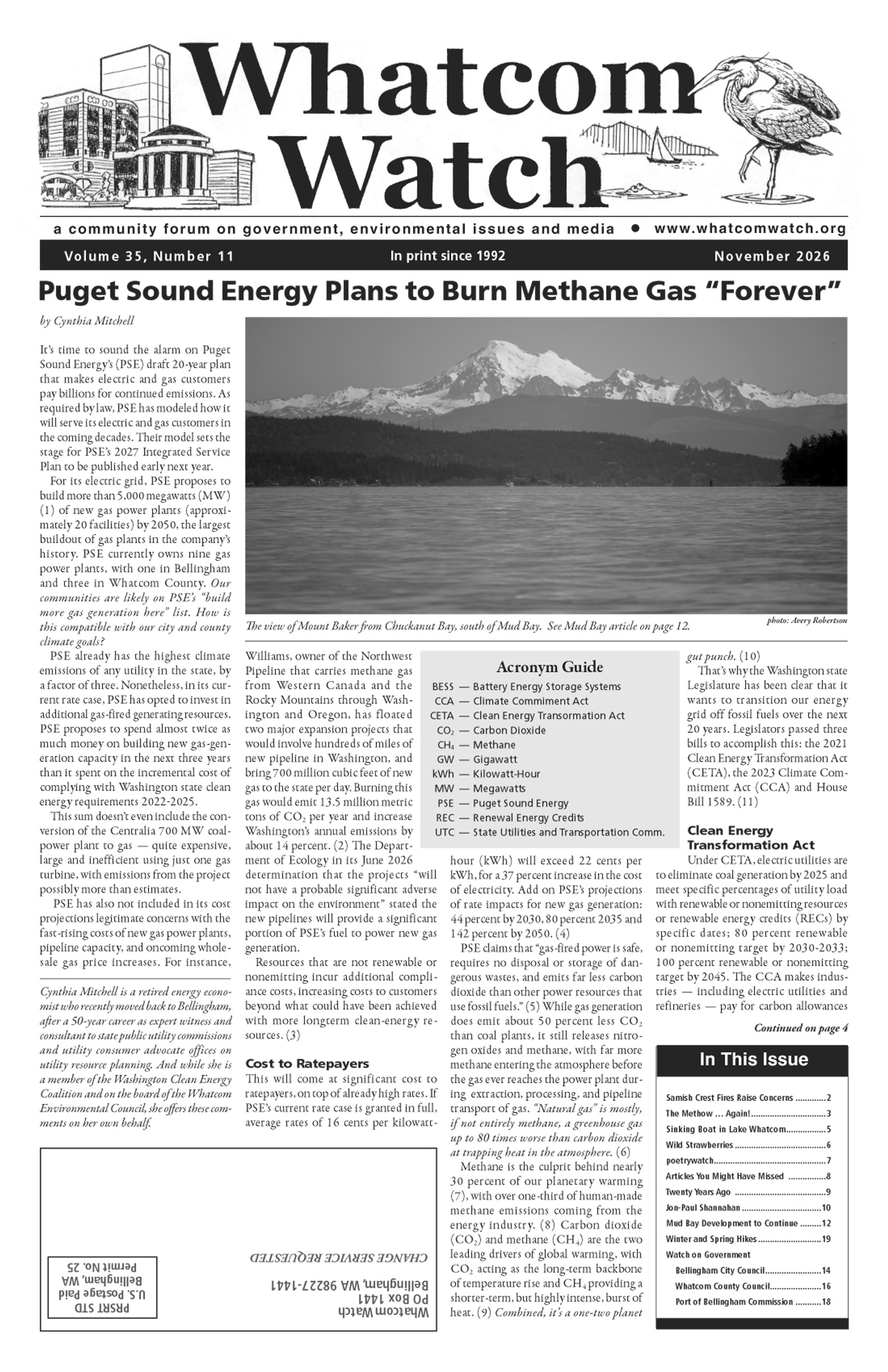
Since January 2014, Whatcom Watch has been reprinting articles from issues printed 20 years ago. The below article appeared in the October/November 2006 issue of Whatcom Watch.
Cleanup in the Whatcom Waterway and ASB
Editor’s Note: Phase 1 of the Whatcom Waterway cleanup was completed in 2016. Phase 2 cleanup will take place from 2028 – 2031. The total estimated cleanup cost is $200 million.
by Wendy Steffensen
The hot topic in Bellingham is the cleanup of mercury-contaminated sediments from the Whatcom Waterway and from Georgia-Pacific’s former treatment lagoon, known as the ASB. As the North Sound Baykeeper, I’ve been closely tracking and commenting on the many aspects of this issue, including the various cleanup options presented by the Department of Ecology (Ecology).
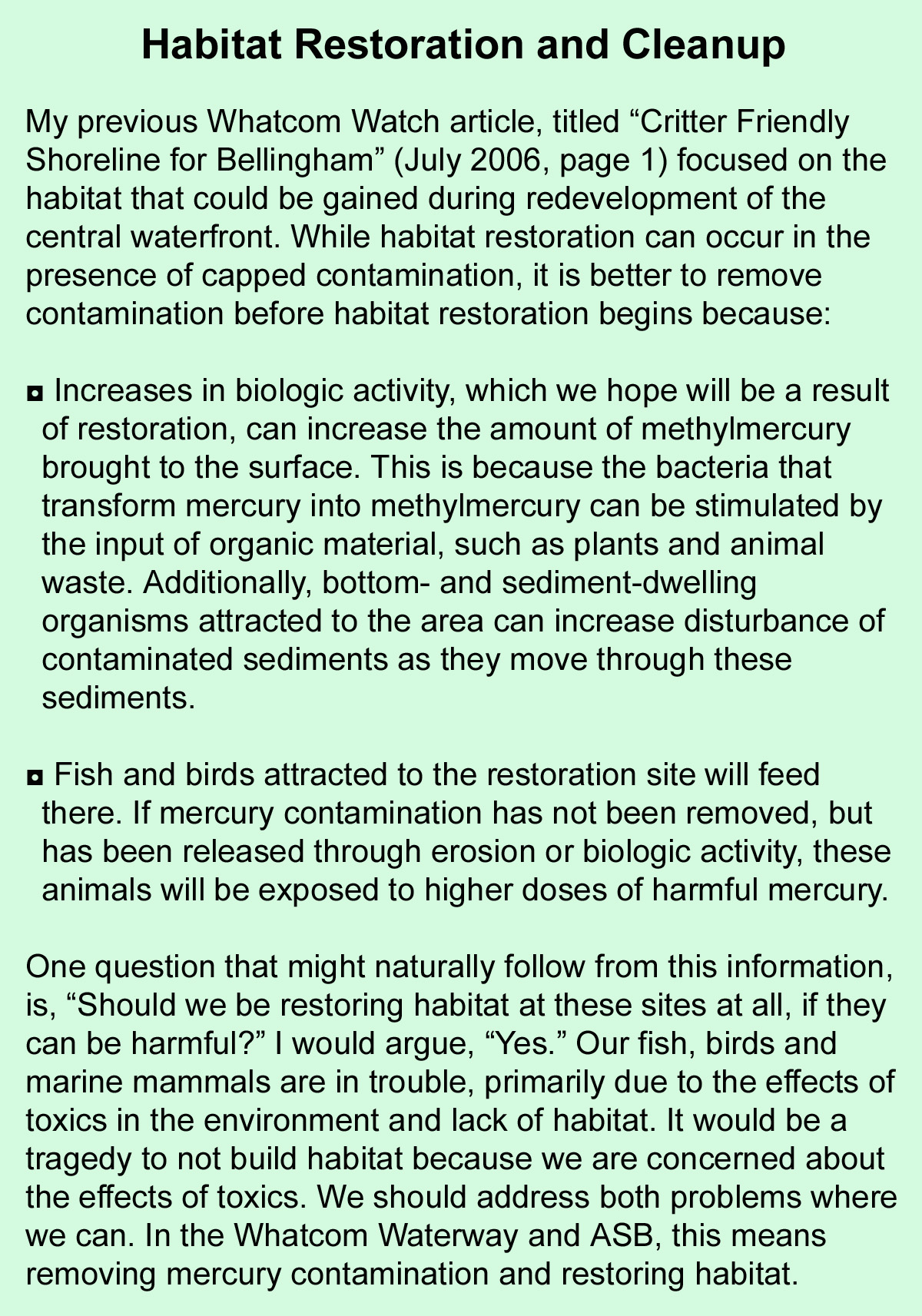 Because this is so important to the community, I hope you, too, will take the time to understand the issue and submit your comments. Ecology is accepting public input on the draft Remedial Investigation/Feasibility Study, due to be released on Oct. 10. This document outlines various options for cleanup, including the preferred remedy. The comment period will run for 60 days after the release date. The more comments that are received, and the more thoughtful they are, the more likely they will affect which cleanup option is chosen. To help you in further understanding the issue and making meaningful comments, here is some background information.
To view my comment letter and analysis of the cleanup plans and to get a template for writing your own comment letter, visit http://www.re-sources.org/baykeeper.htm.
Mercury
Mercury is a metal that occurs naturally in the environment. Since the rise of the industrial revolution, the amount of mercury cycling in the environment has increased dramatically, mainly though the burning of coal and through its use as a catalyst in chlor-alkali (chlorine manufacturing) plants. The operation of Georgia-Pacific’s chlor-alkali plant, from 1965 through 1999, discharged 10 to 13 tons of mercury into Bellingham Bay.
Once introduced into the environment, mercury persistently cycles between different forms, which vary in toxicity. The most toxic form of mercury, methylmercury, is formed by bacteria in low-oxygen environments such as in the sediments of Bellingham Bay. Methylmercury poses the greatest threat to animals at the top of the food chain because it “bioaccumulates,” which means it is taken up and passed along by each animal in the food chain. Many of the fish we eat carry a high dose of methylmercury. The dose will be higher if the fish is older and larger, is a predator or is harvested from an urban or contaminated area.
Methylmercury presents a health risk to animals that eat fish, especially those that eat long-lived fish such as tuna and shark, or who consume fish as a primary food staple. In humans, methylmercury has been linked with heart and kidney problems. Developing babies exposed through the placenta and mother’s milk are at particular risk, along with young children, because methylmercury also affects brain development. In young humans, methylmercury exposure decreases IQ, memory, language and fine motor abilities. In fish and birds, exposure affects foraging and nesting behaviors.
Some of the mercury in Bellingham Bay now occurs as methylmercury, although we don’t know how much. After the cleanup, the amount of methylmercury and the extent of the exposure of fish and people to methylmercury will still be unknown. The amount of methylmercury formed can be affected by several factors:
- The amount of mercury available for formation of methylmercury. The more mercury left in the sediment, the more will be available for methylmercury conversion, and the greater the risk.
- The rate of methylmercury production. Methylmercury production is affected by the amount of sulfates and sulfides in sediments. In some studies, methylmercury production has also been shown to be stimulated by plant growth and animal activity. As the environment changes in the Whatcom Waterway, the rate of methylmercury production might also change.
- The disturbance of mercury contamination. Sediments can be disturbed and disrupted through the action of marine organisms, propeller washing, anchor dragging and big storms. Contamination has been measured within the surface sediments of Bellingham Bay and at depths up to 11 feet. The shallower the contamination, the more likely it will be disturbed, and the greater the risk of exposure. Thus, it is crucial to remove contamination at shallower depths.
Removing contamination at deeper depths is not as crucial, but it is still important, as sediment disturbances cannot be accurately predicted. Disturbances that bring mercury-laden sediment closer to the surface also bring methylmercury to the surface. Disruption can also stimulate methylmercury production, because the environmental conditions that affect methylmercury production will have changed (concentrations of oxygen, sulfate and nutrients).
With so much uncertainty regarding methylmercury exposure and production, it is difficult to evaluate whether or not it’s safe to leave some portion of mercury in the sediments. A prudent approach, especially under these circumstances, is to remove the mercury.
Department of Ecology Preferred Remedy
Ecology, in collaboration with the Port of Bellingham, which owns the Whatcom Waterway and ASB, has put forth a draft-preferred remedy for cleanup. Basically, this remedy calls for capping (burying) much of the contamination in the Whatcom Waterway with limited dredging, mostly to serve navigational purposes. The remedy also calls for the full dredging and upland disposal of contamination in the ASB.
According to Washington state law, the cleanup remedy selected should:
- be “implementable,”
- be as permanent as feasible,
- protect human health and the environment over the long term,
- take the public’s concerns into account, and
- be no more costly than is needed to meet the cleanup objectives.
As of this point, Ecology has not yet taken the public’s concerns into account. Thus, the preferred remedy could change depending upon the public comment received.
We at RE Sources do not believe the preferred remedy is as protective and permanent as needed. We are calling for full removal of mercury that is above the state’s cleanup level in the Whatcom Waterway and ASB.
_______________________________
When this article was written in 2006, Wendy Steffensen was the North Sound Baykeeper with RE Sources. She was a trained toxicologist and specialist in water quality issues. She had been working on Bellingham Bay issues since 2000.