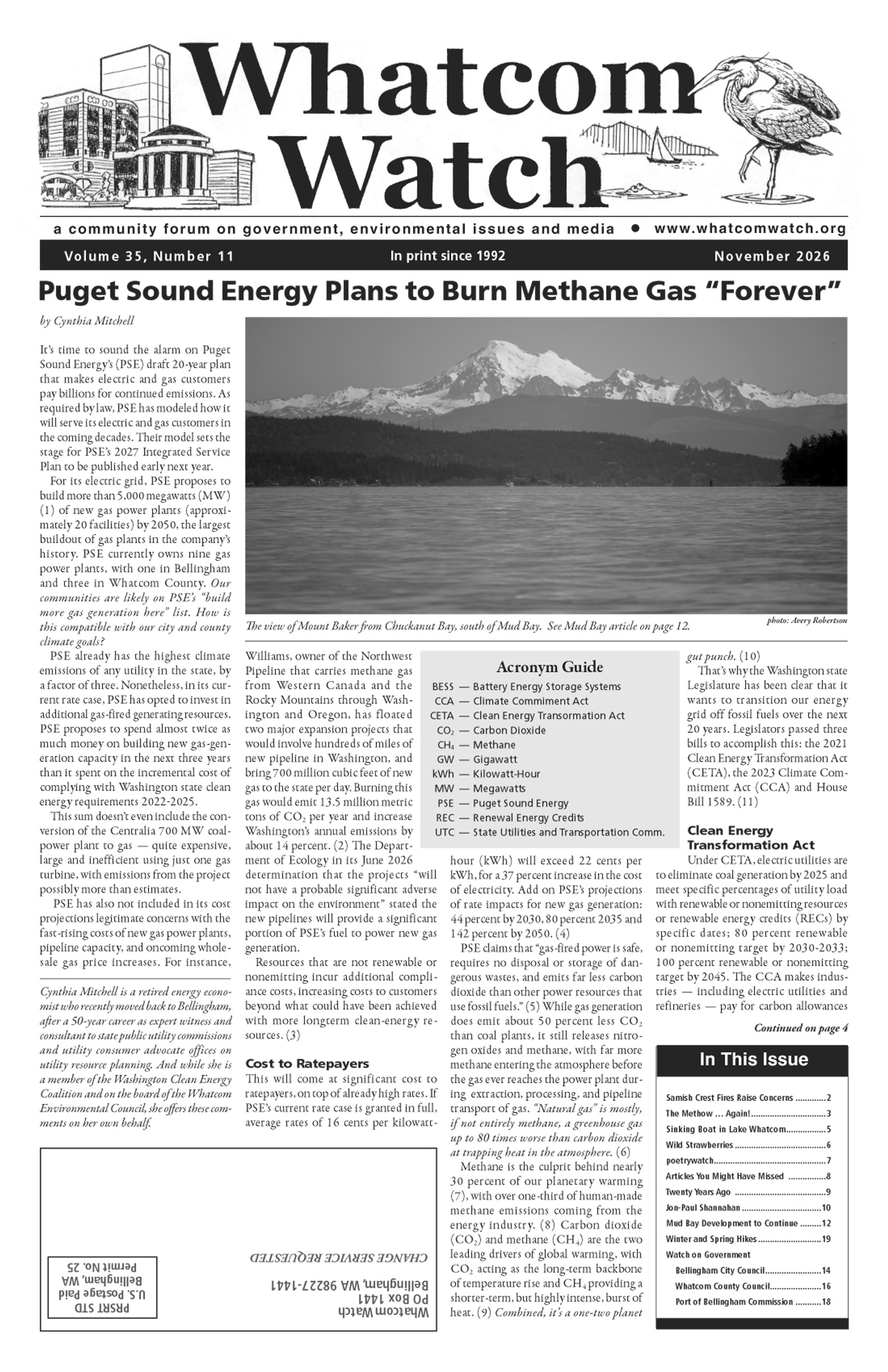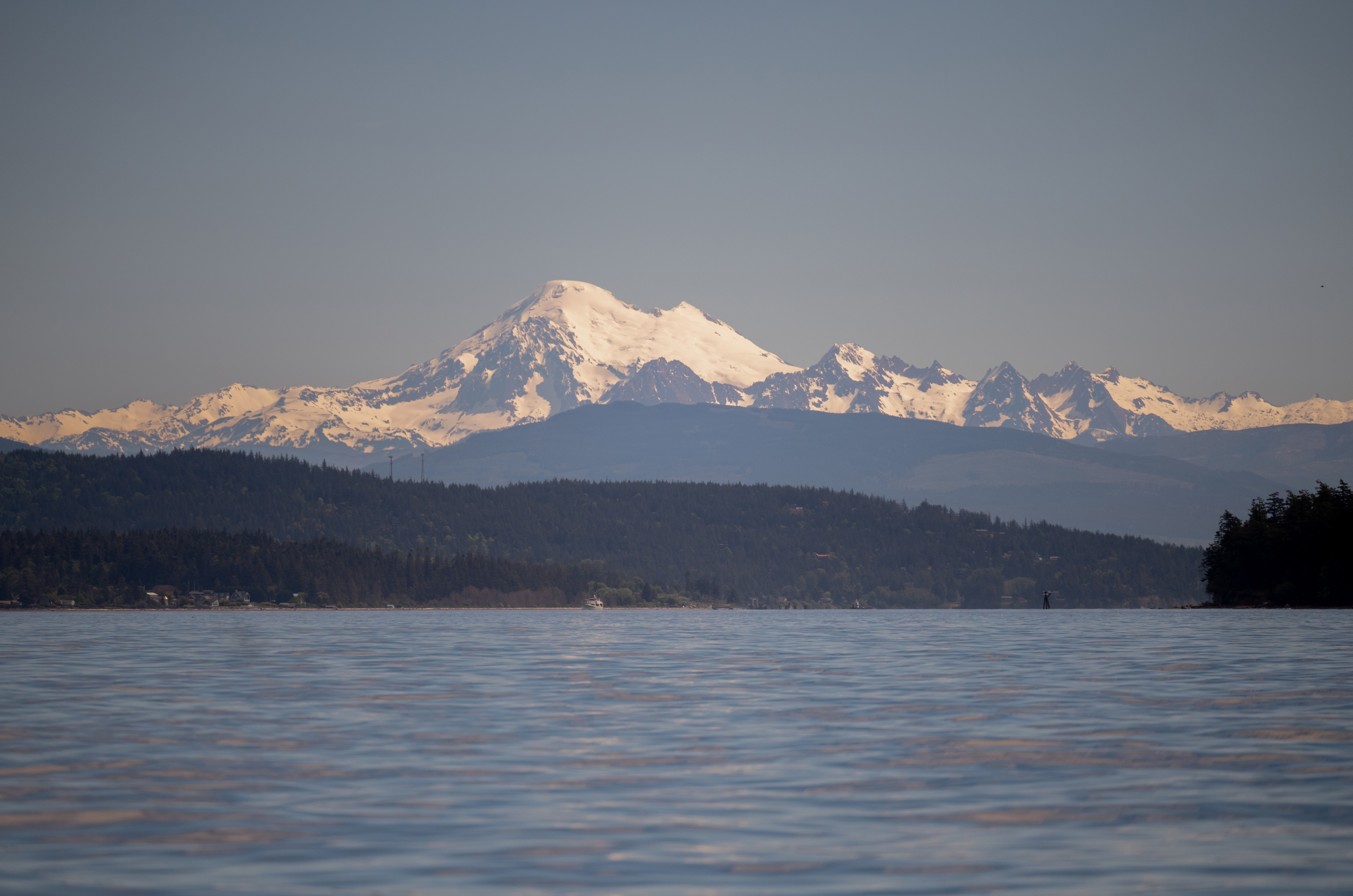
photo: Avery Robertson
The view of Mount Baker from Chuckanut Bay, south of Mud Bay.
See Mud Bay article in this issue
by Cynthia Mitchell
It’s time to sound the alarm on Puget Sound Energy’s (PSE) draft 20-year plan that makes electric and gas customers pay billions for continued emissions. As required by law, PSE has modeled how it will serve its electric and gas customers in the coming decades. Their model sets the stage for PSE’s 2027 Integrated Service Plan to be published early next year.
For its electric grid, PSE proposes to build more than 5,000 megawatts (MW) (1) of new gas power plants (approximately 20 facilities) by 2050, the largest buildout of gas plants in the company’s history. PSE currently owns nine gas power plants, with one in Bellingham and three in Whatcom County. Our communities are likely on PSE’s “build more gas generation here” list. How is this compatible with our city and county climate goals?
PSE already has the highest climate emissions of any utility in the state, by a factor of three. Nonetheless, in its current rate case, PSE has opted to invest in additional gas-fired generating resources. PSE proposes to spend almost twice as much money on building new gas-generation capacity in the next three years than it spent on the incremental cost of complying with Washington state clean energy requirements 2022‒2025.
This sum doesn’t even include the conversion of the Centralia 700 MW coal power plant to gas — quite expensive, large and inefficient using just one gas turbine, with emissions from the project possibly more than estimates.
PSE has also not included in its cost projections legitimate concerns with the fast-rising costs of new gas power plants, pipeline capacity, and oncoming wholesale gas price increases. For instance, Williams, owner of the Northwest Pipeline that carries methane gas from Western Canada and the Rocky Mountains through Washington and Oregon, has floated two major expansion projects that would involve hundreds of miles of new pipeline in Washington, and bring 700 million cubic feet of new gas to the state per day. Burning this gas would emit 13.5 million metric tons of CO2 per year and increase Washington’s annual emissions by about 14 percent. (2) The Department of Ecology in its June 2026 determination that the projects “will not have a probable significant adverse impact on the environment” stated the new pipelines will provide a significant portion of PSE’s fuel to power new gas generation.
Resources that are not renewable or nonemitting incur additional compliance costs, increasing costs to customers beyond what could have been achieved with more long-term clean-energy resources. (3)
Cost to Ratepayers
This will come at significant cost to ratepayers, on top of already high rates. If PSE’s current rate case is granted in full, average rates of 16 cents per kilowatt hour (kWh) will exceed 22 cents per kWh, for a 37 percent increase in the cost of electricity. Add on PSE’s projections of rate impacts for new gas generation: 44 percent by 2030, 80 percent 2035 and 142 percent by 2050. (4)
PSE claims that “gas-fired power is safe, requires no disposal or storage of dangerous wastes, and emits far less carbon dioxide than other power resources that use fossil fuels.” (5) While gas generation does emit about 50 percent less CO2 than coal plants, it still releases nitrogen oxides and methane, with far more methane entering the atmosphere before the gas ever reaches the power plant during extraction, processing, and pipeline transport of gas. “Natural gas” is mostly, if not entirely methane, a greenhouse gas up to 80 times worse than carbon dioxide at trapping heat in the atmosphere. (6)
Methane is the culprit behind nearly 30 percent of our planetary warming (7), with over one-third of human-made methane emissions coming from the energy industry. (8) Carbon dioxide (CO2) and methane (CH4) are the two leading drivers of global warming, with CO2 acting as the long-term backbone of temperature rise and CH4 providing a shorter-term, but highly intense, burst of heat. (9) Combined, it’s a one-two planet gut punch. (10)
That’s why the Washington state Legislature has been clear that it wants to transition our energy grid off fossil fuels over the next 20 years. Legislators passed three bills to accomplish this: the 2021 Clean Energy Transformation Act (CETA), the 2023 Climate Commitment Act (CCA) and House Bill 1589. (11)
Clean Energy Transformation Act
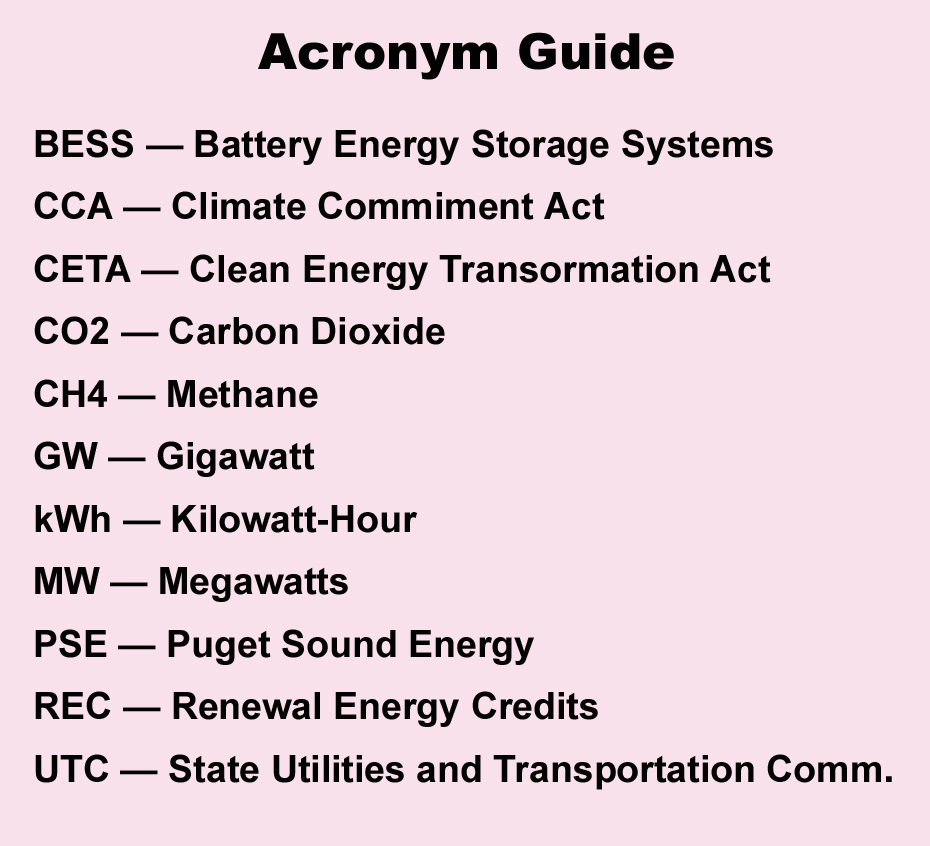
Under CETA, electric utilities are to eliminate coal generation by 2025 and meet specific percentages of utility load with renewable or nonemitting resources or renewable energy credits (RECs) by specific dates; 80 percent renewable or nonemitting target by 2030-2033; 100 percent renewable or nonemitting target by 2045. The CCA makes industries — including electric utilities and refineries — pay for carbon allowances if they are short of their emission goals. Those costs gradually increase over time to encourage compliance.
A massive buildout of new gas generation means PSE will blow right through CETA and face billions in CCA noncompliance costs over time. PSE intends to simply make customers pay for those costs. Bottom line: PSE plans on ratcheting up our rates and emissions!
PSE projects it will need up to 13,900 megawatts of winter power it does not have by 2050. PSE’s draft 2027 resource plan starts with a hypothetical renewable energy CETA compliant portfolio of 55,000 MW 4-hour battery energy storage systems (BESS), and about 6,000 MW of wind and solar generation by 2050. This is a completely unrealistic clean energy plan. No utility would build 60,000 MW of new resources for only 14,000 MW of new demand. But, because PSE assumes BESS are not very efficient, their computer model overbuilds BESS by three to one. Not only would it be hard to buy that many batteries and site them, it would also be extremely expensive. Regardless, PSE quickly declares the case against clean energy “won and done” and pivots to its preferred plan, 5,000 MW of new gas generation, with about 6,000 MW of BESS-wind-and-solar combined. With new resources more closely aligned with PSE’s forecast of new demand, PSE assumes its gas buildout plan will cost much less than clean energy.
PSE’s assumptions on BESS efficiency and costs, fly in the face of performance and market data. A top global company on energy analytics, Wood Mackenzie, just published a study showing that 4-hour BESS is now cheaper than new gas generation, according to more than 40 markets. In the United States for a 2026 commercial operation date, 4-hour battery storage is 65 percent to 75 percent cheaper than new gas generation. The economic shift is decisive and widening. Gas turbine shortages and rising fuel volatility are driving up peaking costs, while expanding battery manufacturing continues to push storage costs down. (12)
Massive Buildout of Gas Power Plants
PSE’s proposed massive buildout of new gas power plants is in sharp contrast to its 2023 Electric Progress Report, where new gas generation was only 10 percent of its preferred plan, taking backseat to load-management strategies, renewable generation, and BESS. Similarly, The Northwest Power and Conservation Council’s (13) just released 9th Northwest Power Plan, relies heavily on renewables and BESS (78 percent), and equal parts load-management strategies and new gas generation (about 10 percent each) by 2032.
PSE’s need for new electric resources is largely driven by highly uncertain data-center load growth and sharp increases in winter weather-related peak loads. The Pacific Northwest’s hardest electric reliability event is a winter cold snap lasting two to four days, like the Jan. 12–16, 2024, event in which the Northwest set a winter peak demand record near 35,500 MW and imported an average of roughly 4,900 MW across five days. That same event exposed the fuel system behind gas generation: on Jan. 13, PSE’s Jackson Prairie storage facility, the region’s largest, suffered a complete outage from failed control cables, and PSE asked customers that evening to conserve both gas and electricity. Gas plants are only as firm as the gas system behind them.
PSE needs a balanced and diverse portfolio (14) starting with a coordinated strategy that provides a roadmap for scaling up peak-oriented conservation, demand response, and distributed energy resources.
Data-center load can be managed via flexibility or curtailments, and the data centers could drive innovations in next-generation clean technologies. If subject to flexibility requirements, data center customers will face the long-duration reliability challenges first and will have an incentive to solve them.
Battery Energy Storage Systems (BESS)
PSE must also recognize that BESS is a game changer in clean energy. BESS technology has gone beyond 4-hour to 8-, 12-, 24-hour storage systems, to Google’s 100-hour battery system in Minnesota. BESS extends the usability and reach of wind and solar power by storing surplus energy during peak generation times and dispatching it when weather conditions fail or demand peaks. Similarly, BESS sited at distribution substations and industrial complexes can store surplus power and discharge at high-load/low-energy conditions. At the local level, BESS provides energy by storing surplus rooftop solar, community wind, and other distributed resources.
It is apparent that PSE is not pursuing clean energy alternatives aggressively enough. For example, in March 2026, it was reported that Amazon made the winning bid for the 1.2 GW (15) Sunstone solar plus storage project in Oregon for the rock-bottom price of $83 million. This facility would have twice as much power at peak demand — given the 7.2 GW of storage — than the Centralia coal-to-gas conversion. If PSE had submitted even a marginally better winning bid for this massive project, it would have been, by far, the largest and most cost-effective long-term clean energy resource in its current rate case. (16)
If PSE doesn’t do a credible job of modeling a clean-energy alternative, then the Washington Utilities and Transportation Commission (UTC) should require that a clean plan be modeled and independently validated. And, if PSE doesn’t do a better job of implementing a clean-energy plan, the UTC should shift CCA noncompliance costs from ratepayers to shareholders. Letting PSE out of CCA costs to try and mitigate rate impacts is like rewarding a child for bad behavior. Expensive new gas generation should be treated as a last resort option, which should only be adopted after all cleaner and cheaper options have been exhausted. These are the prudent things to do before we are charged billions of dollars to build the system PSE prefers because it maximizes returns for its shareholders.
_______________________________
Cynthia Mitchell is a retired energy economist who recently moved back to Bellingham, after a 50-year career as expert witness and consultant to state public utility commissions and utility consumer advocate offices on utility resource planning. And while she is a member of the Washington Clean Energy Coalition and on the board of the Whatcom Environmental Council, she offers these comments on her own behalf.
Endnotes:
- A megawatt (MW) is a unit of measurement for electric power that equals one million watts or 1,000 kilowatts. One MW can power for one year about 1,000 homes in the PNW.
- https://www.columbiariverkeeper.org/campaigns/williamspipeline/
- PSE Rate Case, Response Testimony of Lauren McCloy for the Joint Environmental Advocates, https://earthjustice.org/wp-content/uploads/2026/07/260005-06-jea-exh-lcm-1hct-7-28-26-r.pdf.
- kWh (Kilowatt-hour): Measures energy — the total amount of electricity used over a period of time. For instance, a typical clothes dryer running for 30 minutes uses 1 kWh of energy. A typical residential electric customer in Bellingham, Washington (served by Puget Sound Energy – PSE), uses about 1,438 kWh per month.
- https://www.pse.com/en/pages/energy-supply/thermalpower
- C. Mitchell, Sept. 2026 blog post “Just Call It Methane Gas,” https://www.whatcomenvirocouncil.org/
- https://www.iea.org/reports/global-methane-tracker-2022/methane-and-climate-change
- https://www.iea.org/reports/global-methane-tracker-2025/key-findings
- https://www.c2es.org/content/international-emissions/ According to the IEA, CO2 accounts for roughly 74 percent of total global human-made GHG emissions, while CH4 accounts for approximately 19 percent.
- Because methane is 80-plus times more potent than carbon dioxide in heating up the earth’s atmosphere, and is relatively short-lived compared to carbon dioxide (7-12 years vs. 100), curbing methane emissions should be the low-hanging fruit of the climate transition. And, because methane gas emits carbon dioxide when combusted/burned, cutting emissions from methane gas operations is our best near- and long-term climate solution. The potential for major reductions in the near term is huge: Around 40 percent of methane emissions from fossil fuels could be avoided at no net cost.
- PSE calls its new gas plants “flex-fuel peakers” because, in theory, they can burn nonemitting biogas. However, PSE’s own analysis finds renewable fuel supplies limited to 4–5 percent of the amount needed to run the peakers.
- https://www.utilitydive.com/news/4-hour-storagecheaper-than-gas-peakers-across-global-markets-woodmac/832489/
- The Northwest Power and Conservation Council, a compact formed by the four Northwest states under the 1980 Northwest Power Act, is the regional agency providing the authoritative assessment and strategy for an adequate, efficient, economical, and reliable Northwest power supply.
- The Washington Clean Energy Coalition examined PSE’s data and assumptions and found the basis of a plan that eliminates any need for new gas generation, is CETA compliant, and costs less than PSE’s preferred plan. https://wacleanenergy.org/
- 1 Gigawatt (GW) is 1,000 Megawatts (MW). One GW can power for one year about 1 million homes in the PNW.
- Ibid 2.