by Tori Lehman
Near the northern edge of Bellingham, the recently completed Little Squalicum Estuary blooms with life. The estuary, completed in 2024 as part of the City of Bellingham’s efforts to rebuild historical wetland habitat, creates foraging ground and refuge for juvenile fish. Residents can enjoy the scenic views as it spills into Bellingham Bay.
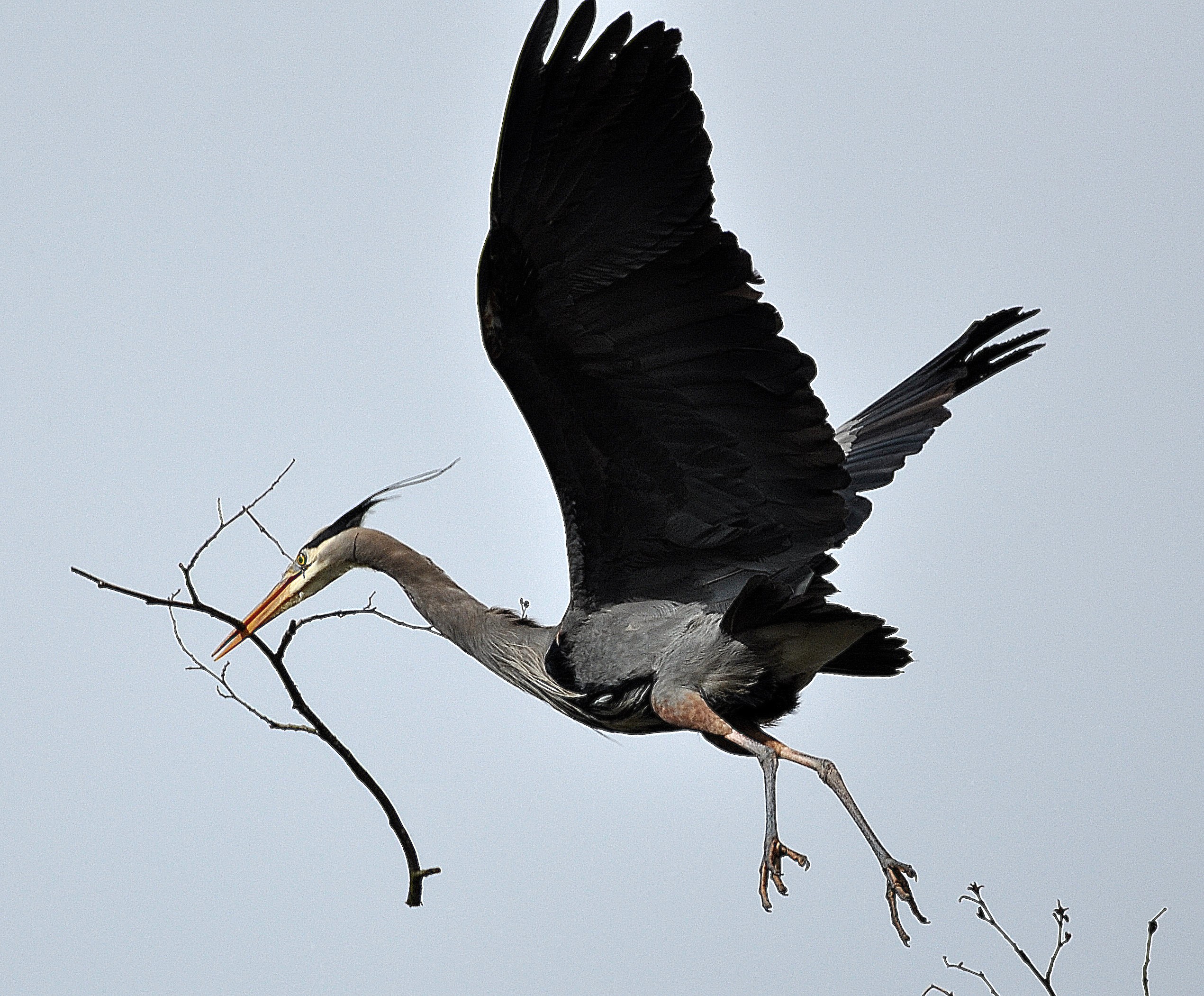
photo by Joe Meche, taken at the Post Point colony
Adult great blue heron with nesting material.
Now, fuzzy dinosaur-like locals will join them. In 2025, a new great blue heron colony was established just northeast of the estuary at Little Squalicum Park.
When monitoring began for Bellingham’s annual report on the Post Point heron colony, heron nests were identified at the park. Monitoring was already underway for the Post Point colony by mid-March when the new colony was identified, so it was not included in the city’s annual report. However, a biologist contracted by the city for monitoring at Post Point went out and identified 10 adult herons and 11 juveniles at the site.
The new colony could be the reason the Post Point colony saw a drastic decline in nests during the 2025 season. According to the city’s report, which was prepared by Hamer Environmental, the Post Point colony saw a 52 percent decrease in nesting activity and a 66 percent decrease in fledglings when compared to the 2024 report (1). The report points to the new colony attracting birds away from Post Point, as well as an intense windstorm that destroyed some Post Point nests, as likely reasons for the decline.
According to John Bower, a professor at Western Washington University with a doctorate in bird behavior, it is not uncommon for great blue herons to shift their colonies in response to human behavior and bald eagle predation.
“I’ve always wondered if those herons will abandon [Post Point] and move to a bigger colony out at Birch Bay, but so far that hasn’t happened,” Bower said. “It doesn’t surprise me that the birds would be shifting to a different colony.”
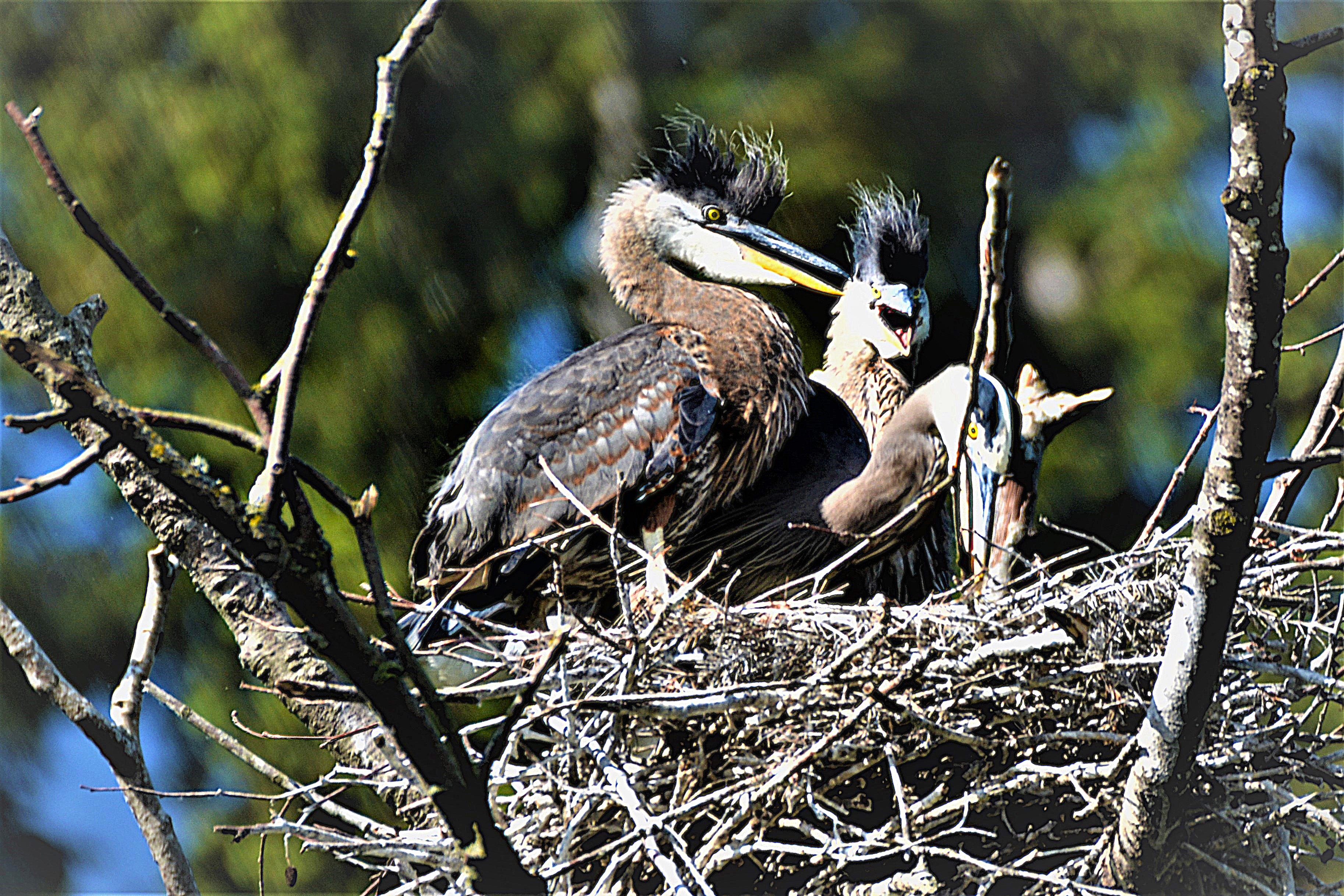
photo by Joe Meche, taken at the Post Point colony
Adult great blue heron delivering food to chicks.
Uphill Battle for the Herons
The Post Point colony first established in 2000 after their previous colony was threatened by housing development near Chuckanut Drive. They landed in city-owned property next to the Post Point Wastewater Treatment Plant near Marine Park.
“I think it’s ironic and kind of lovely that the birds, when they moved from lower Chuckanut to Post Point, landed in trees that belong to the City of Bellingham,” Jamie Donaldson, a member of the North Cascades Audubon Society, said. “So they had pseudo-protection there, just because they landed in city trees.”
The protection did not last for long. In 2018, housing development was proposed for the land adjacent to the colony with plans to create a “view corridor” through the colony’s trees. The corridor would have shrunk the colony’s buffer zone, which protects the herons and their habitat from human disturbances, and create eye-level threats.
“The gas mowers would start up and the backyard lights would shine right on the nest,” Donaldson said. “We don’t know what would’ve happened, but it certainly would’ve introduced really high threats to the colony.”
In response to the proposed development, Donaldson reported on the harm it could bring through Northwest Citizen (2), an online citizen-journalism forum, and raised over $14,000 to hire a lawyer and appeal the development’s permit.
The developers reasoned that if the view corridor shrunk portions of the buffer zone but expanded it in other places, it would average out and comply with the critical areas ordinance that applies to the colony. The appeal argued that the averaging of the buffer zone had no scientific foundation to back it up.
“It was absolutely essential to find a flaw in the permitting process in order to take on this issue,” Donaldson said. “You can’t just go to the city and say, ‘We love the birds, you’ve got to protect them.’”
The heron-lovers ultimately won and prevented the development. With $7,000 left over after legal fees, Donaldson contacted the donors and they agreed to donate the money to Whatcom Land Trust, a local land preservation nonprofit, so they could buy the land and prevent future threats.
Since the successful salvation of the colony in 2021 to the 2024 report, the Post Point colony averaged 46 nests and saw 372 herons successfully raised.
“If Jamie hadn’t done what Jamie did, that land trust colony may have been lost,” Bower said.
Birders Rejoice, City Expands Their Report
As the new colony at Little Squalicum Park was identified while monitoring was already underway, the colony was not included in the 2025 report. However, the City of Bellingham has included the colony in their 2026 monitoring and will produce a report around January 2027.
“Hamer Environmental is monitoring both heron colonies in 2026, the last year of their five-year monitoring contract,” Stefanie Cilinceon, the communications and outreach coordinator with the City of Bellingham, said. “The city will continue monitoring both colonies in future years, and the consultant will be determined through our contract process.”
The monitoring efforts assist the city in protecting and preserving the great blue herons’ nesting sites, which are identified as a priority species group under Washington State law (3) and fish and wildlife habitat conservation areas under the City of Bellingham’s Critical Areas Ordinance (4). These classifications are given to a species or habitat when they are exceptionally vulnerable to disturbances or are hazardous and in need of restoration.
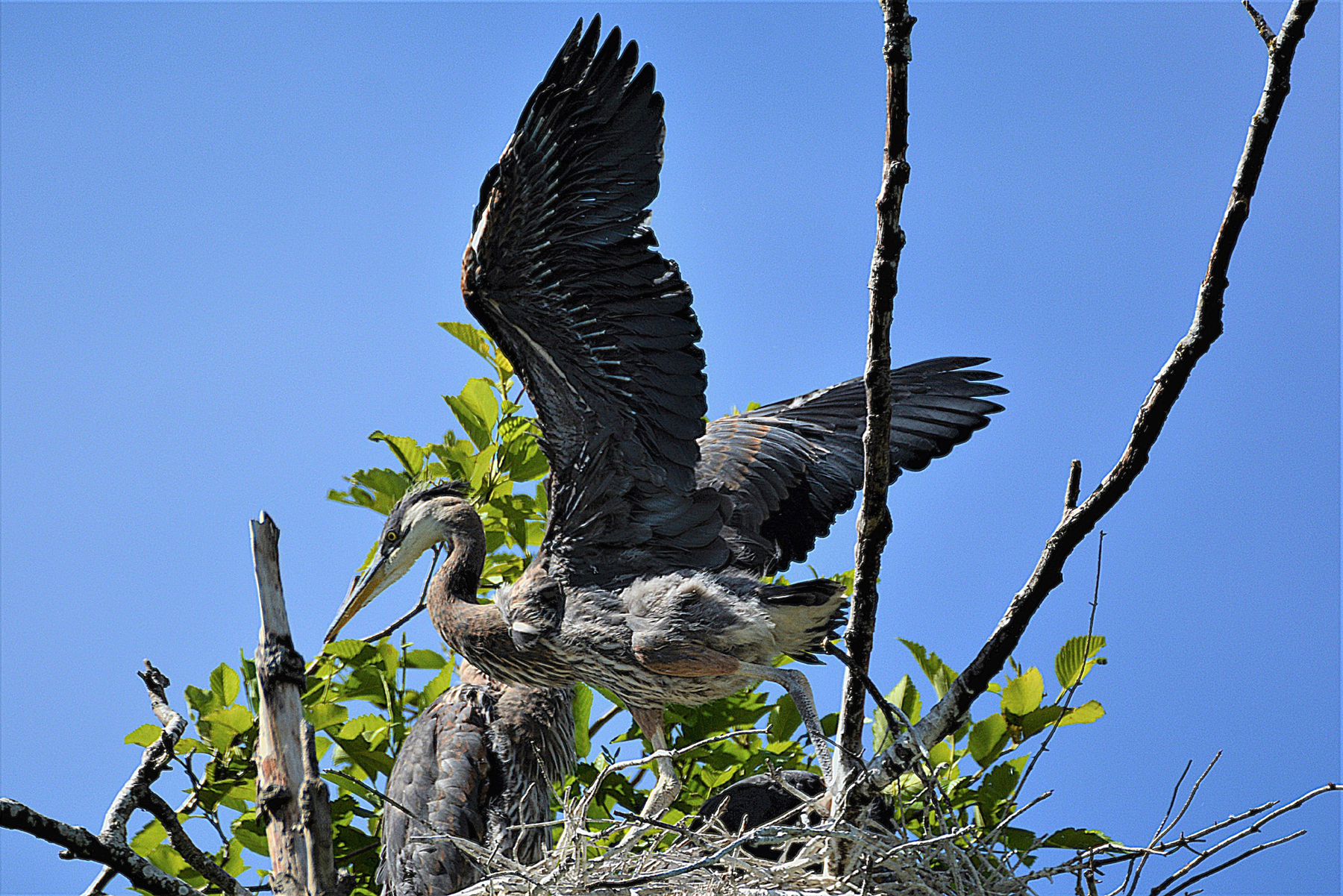
photo by Joe Meche, taken at the Post Point colony
Great blue heron chick testing its wings.
Protection efforts for the colonies include buffer zones and fences and information signs around the colonies. Modifications are planned for the disc golf course near the newly identified Little Squalicum Park colony to prevent disturbances.
According to Cilinceon, the City of Bellingham advises against using drones near the heron nests, maintaining a distance of at least 300 feet from the herons, and limiting excessive noise during the nesting season between mid-January and mid-September.
Legal requirements aren’t the only thing protecting the colonies. The herons are loved by the Bellingham community, and their expanding territory creates more opportunities for residents to admire their beauty.
“The herons have intrinsic value of their own that we should be concerned about. But herons also are one of those species that captures the human imagination,” Bower said. “It really enriches our community to have them.”
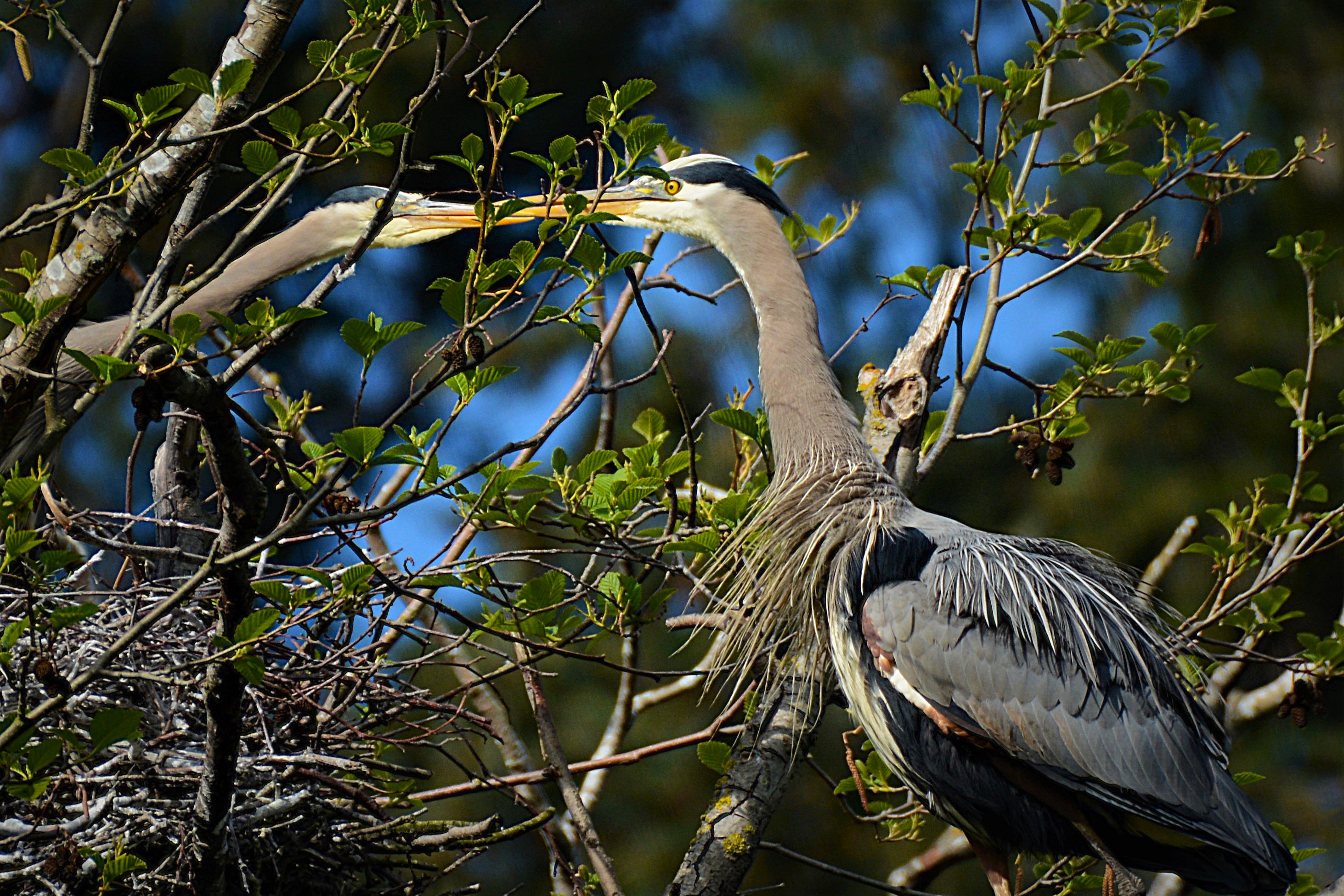
photo by Joe Meche, taken at the Post Point colony
Adult great blue herons pair bonding.
Recreational bird-watching saw an explosion of interest during the Covid-19 pandemic, but, due to social-gathering restrictions, remained a relatively solitary hobby (5). For prospective Bellingham birders, the North Cascades Audubon Society offers opportunities to engage with the community. According to Pam Borso, the education chair and volunteer coordinator for the North Cascades Audubon Society, the organization offers free meetings, classes and field trips from September through May.
“We’d love more people — more young people, more diversity,” Borso said. “It’s a great group, and we welcome anyone.”
__________________________________________
Tori Lehman is a fourth year environmental journalism major at Western Washington University and spring intern at Whatcom Watch. When she’s not reporting, she’s found bird-watching in her yard or strolling through downtown Bellingham.
References
- https://cob.org/wp-content/uploads/post-point-heron-colonyannual-report-2025.pdf
- https://www.nwcitizen.com/writers/jamie-k-donaldson
- https://wdfw.wa.gov/species-habitats/at-risk/phs/list
- https://cob.org/services/planning/environmental/critical-areas
- Michael Brock, Jacqueline Doremus, Liqing Li, “Birds of a feather lockdown together: Mutual bird-human benefits during a global pandemic,” Ecological Economics, Volume 189, 2021, 107174, ISSN 0921-8009, https://doi.org/10.1016/j.ecolecon.2021.107174. (https://www.sciencedirect.com/science/article/pii/S0921800921002329)