Local leaders, housing organizations and residents discuss what’s driving the affordability challenge and what’s been done to address it.
by Mabaindu Mbawa
Rising rents, limited home-ownership opportunities and growing demand for affordable housing have made Bellingham’s housing market one of the city’s most pressing challenges.
Following the adoption of Whatcom County’s updated Comprehensive Plan (1), a long-range blueprint for housing and future growth over the next two decades, residents, policymakers and housing organizations are weighing competing ideas for how to make Bellingham more affordable.
The plan’s Housing Chapter (2) identifies expanding housing supply, increasing housing diversity, and improving affordability as key priorities for accommodating future population growth. Yet, despite those long-term goals, many residents say the cost of living continues to outpace their incomes, making it increasingly difficult to afford housing.
For South Hill renter Gene Golden, that reality arrives every year when his lease is renewed.
Annual Rent Increase: 7 Percent
Golden, who has rented the same duplex for nearly six years, said annual rent increases have become routine despite little change in income.
“My income is not jumping, it’s the same as when I moved in,” Golden said.
Before moving to Bellingham, Golden rented in cities including Miami, New York, San Diego and San Francisco. While rent occasionally increased in those cities, he said those adjustments were generally smaller and happened less frequently than what he has experienced since moving to Whatcom County.
Golden said he questioned whether Washington’s rent stability law provided meaningful protection for tenants. Also adding that his property’s management company has treated what he described as a 7 percent annual limit as justification for raising rent every year.
“That gives them license to jump the rent,” Golden said. “They said, ‘Yep, we’re going to be raising it by 7 percent every year.’”
Although he said he hopes to remain in the South Hill Duplex, Golden worries that recurring increases will continue putting pressure on his budget.
“An American Thing”
Those affordability challenges extend beyond Bellingham, according to Todd Donovan, a political science professor at Western Washington University who teaches state and local politics.
“That’s not just, like, a Bellingham thing. That’s an American thing,” Donovan said. Donovan attributed the challenges to a nationwide housing shortage, years of under building following the 2008 financial crisis, and continued demand in desirable communities such as Bellingham.
“We’re a highly desirable place to live,” Donovan said. “The type of jobs people have don’t match the cost of housing.” He added that while local governments can influence housing through land-use and zoning policies, they have limited control over broader market forces.
Many of those policy discussions are already underway. According to the City of Bellingham’s Housing and Development Rule Updates (3), officials are pursuing zoning and land-use changes that include middle housing, parking reforms, accessory dwelling units (ADUs), and other development code updates intended to expand housing opportunities through the city.
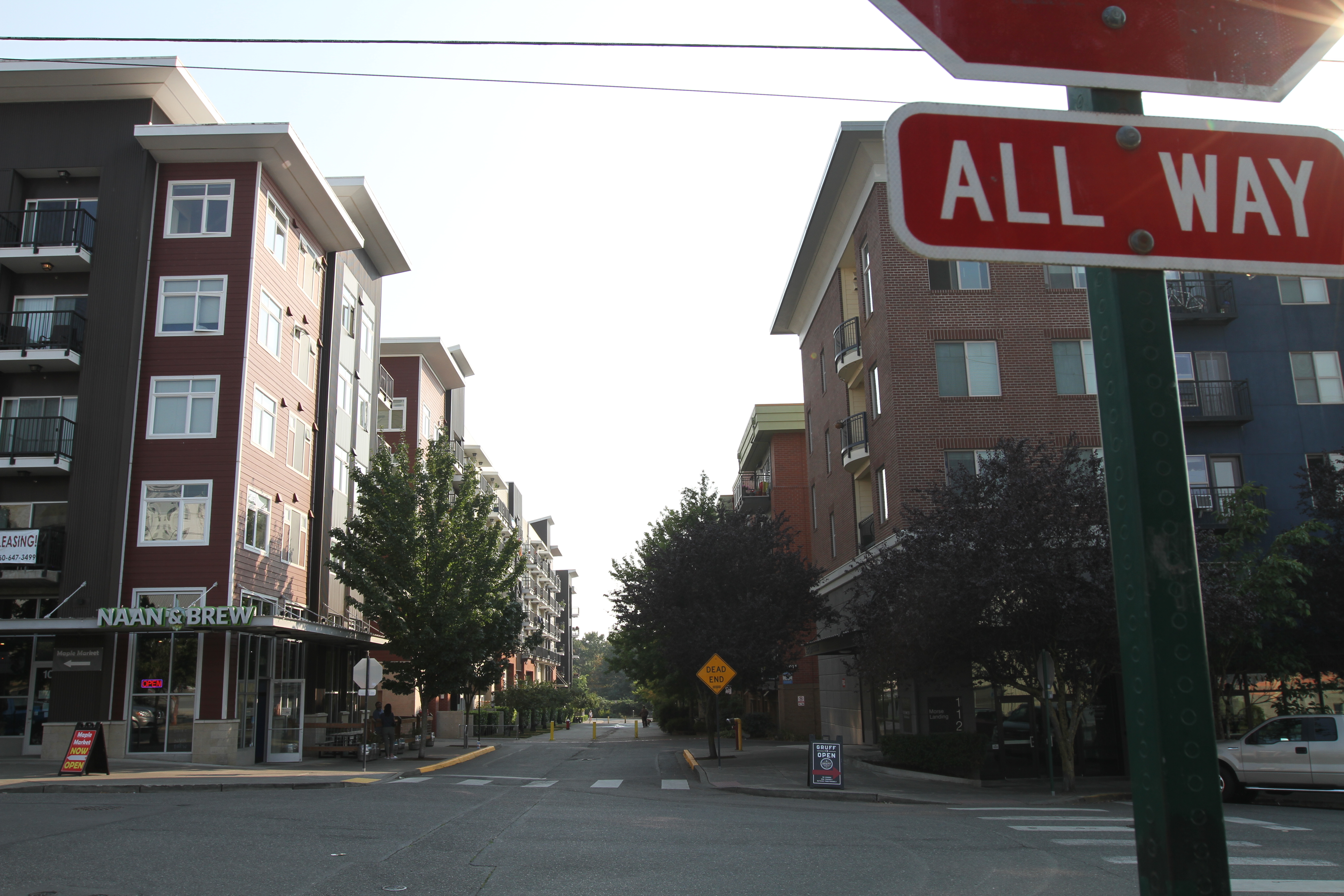
photo: Mabaindu Mbawa
Multifamily housing lines Railway Avenue in downtown Bellingham, Wash., Aug. 5, 2026. The area includes apartments and condominium developments in the city’s downtown core.
Increasing Housing Supply and Variety
For Whatcom County Councilmember Kaylee Galloway, addressing affordability begins with increasing the supply and variety of housing available to residents. Galloway, who represents District 1, said one of Bellingham’s biggest challenges is that much of the new housing being built consists of rental units, while opportunities for first-time home-ownership have become increasingly limited.
“New housing stock is just not market-based affordable,” Galloway said. “A lot of what we see being the newer stock housing are multifamily, which is great. They tend to be rental units, which again serves an incredibly important function, but for folks who are looking to own homes, there’s not a lot of entry homes anymore.”
Addressing housing affordability extends beyond land-use policy. Washington law limits the taxing and revenue tools available to local governments (4), leaving cities and counties to rely on a combination of voter-approved levies, local housing funds, state and federal grants, and other authorized funding sources to support affordable housing efforts. According to the Municipal Research and Services Center (4), those funding mechanisms can help finance housing projects, but communities often face funding gaps as housing needs continue to grow. Bellingham’s voter-approved Home Fund is one example of a local program created to help finance affordable housing developments and related initiatives.
Galloway said those financial constraints continue to make it difficult for local governments to keep pace with the community’s housing needs. While programs such as the Bellingham’s Home Fund (5) and county housing revenue sources have supported affordable housing projects, she said the available funding falls far short of meeting demands. “We’re just behind on meeting those goals,” Galloway said. “There’s just not enough funding to get those projects deployed fast enough.”
Those funding challenges are reflected in the growing demand seen by local housing providers.
Andrew Calkins, executive director and CEO of the Bellingham and Whatcom County Housing Authorities, said the organization continues to see strong demand for affordable housing from residents across the community, particularly seniors, people with disabilities, and households spending more than 30 percent of their income on housing. He said the region’s rental market remains expensive for low-income residents, while rising expenses for necessities such as food, transportation and health care continue to place additional pressure on household budgets.
“We still have a rental market that’s very, very costly for people with lower incomes, and there aren’t a lot of options,” Calkins said.
Moveable Dwelling Units
As housing organizations continue responding to growing demand, city leaders are exploring ways to increase the supply and diversity of housing available to residents. One of those approaches is expanding the types of housing available throughout the city. Bellingham City Councilmember Jace Cotton has been leading efforts to allow movable dwelling units, or MUDs, in more neighborhoods. [Movable dwelling units (MUDs), or mobile/movable dwelling units (MDUs), are transportable housing structures built on chassis or trailers.]
Cotton said the proposal is intended to create more attainable housing opportunities for families, seniors and residents who have been priced out of traditional home-ownership. “No one strategy is going to solve the problem, but together we can make real progress by taking all of these incremental opportunities,” Cotton said.
While local officials continue debating long-term solutions, many longtime residents are still navigating the rising costs of living in Bellingham today.
Financial Squeeze
Lorna McGowan-Smith, a longtime Bellingham resident who has owned a home in the city since returning in 1990, said she has watched Bellingham’s housing market change significantly over the decades, leaving even longtime homeowners feeling the financial squeeze.
“I wouldn’t want to sell my home and try to buy another house now,” McGowan-Smith said. “I have a mortgage on my house, but I only paid 2¼ percent interest.” She said rising property taxes, homeowners insurance and other costs have made staying in her home more expensive, while today’s housing prices make it difficult for many first time buyers to enter the market.
As Whatcom County moves forward with long-term housing planning, residents across Bellingham from rentals and prospective homeowners to longtime homeowners continue to navigate a housing market that many say remains increasingly difficult to afford.
“I would just encourage people to get involved in their community and help foster the community they want to live in through policy work and advocacy, or by volunteering with organizations that are helping address housing in our community,” Galloway said.
________________________________
Mabaindu Mbawa is a freelance journalist and recent journalism graduate of Western Washington University, where she earned a bachelor’s degree in journalism (news editorial) and a minor in political science. She reports on local government, housing and public policy. In her free time, she enjoys writing poetry and other forms of storytelling, photography, and expressing her creativity through fashion and styling.
Endnotes:
- https://www.whatcomcounty.us/4373/Comprehensive-Plan-Update
- https://www.whatcomcounty.us/DocumentCenter/View/21060/Chapter-3-housing
- https://cob.org/services/planning/development/housing-anddevelopment-rule-updates
- https://mrsc.org/stay-informed/mrsc-insight/august-2022/options-for-funding-local-affordable-housing-effor
- https://cob.org/services/housing/funding-opportunities
Sources:
- Todd Donovan, donovat@wwu.edu, professor of Political Science at Western Washington University, he/him (CQ)
- Kaylee Galloway, Whatcom County Councilmember, District 1, (represents Bellingham), KGallowa@co.whatcom.wa.us, she/her (CQ)
- Jace Cotton, Bellingham City Councilmember, works on housing policy, tenant protection and movable dwelling units (MDU) initiatives, jacotton@cob.org he/him (CQ)
- Lorna McGowan-Smith, Bellingham homeowner and retired human resources professional and longtime resident and community member, she/her, (CQ)
- Andrew Calkins, Executive Director and CEO of Bellingham County Housing Authorities, Andrew.Calkins@bellinghamhousing. org, he/him (CQ)
- Gene Golden, longtime renter in Bellingham, he/him (CQ)