Native Plant Neighbors
by Eric Worden
Have you heard of the tiny angler fish Photocorynus, found in deep seas worldwide? The females of the species reach about two inches in length, while the male only reaches a quarter of an inch — the smallest of all of Earth’s vertebrate organisms. Early in its life, if lucky, the tiny male finds a female and bites her on the back, and never lets go.
In the following days after biting his mate, his facial tissue merges with his mate’s skin tissue, and his own tiny body diminishes even further until he is little more than a pimple enclosing two testes. In this way do the two lovers carry on the rest of their lives. Biologists call the males of this species a parasite, though they perform their singular essential function in sexual reproduction.
Douglas Fir Provides Sustenance
In the context of our ordinary lives, the story of Photocorynus is astonishing. But nature is full of astonishing stories of all kinds, and, believe it or not, a story roughly analogous to this one plays in our forests, and you probably have seen its characters. In our local astonishing parasite story, there is a trio of characters. The first character is the Douglas fir, though other conifers commonly play the same role. This large tree, like the female fish, provides sustenance for the parasite.
Mushroom-Producing Fungus
The next character, a mushroom-producing fungus, is not a parasite, but an intermediary character. A few different mushrooms may be cast in this role, but the most common is named Russula brevipes, or the short-stemmed russula, named for the unusually short stem of this unusually large and stout white mushroom. This mushroom is the fruiting body of a much larger underground fungal organism composed of an expansive but diffuse network of microscopic living threads.
These fungal threads connect to root tips of the Douglas fir, and the two organisms share in a mutualistic symbiosis: the fungus provides water and minerals to the tree, while the tree provides carbohydrate energy — manufactured in its sun-soaked greenery — to the fungus. Scientists have clearly demonstrated that such trees grow much healthier when connected to fungi in this way. Many fungal species can’t survive at all except through this relationship, which scientists call mycorrhizal.
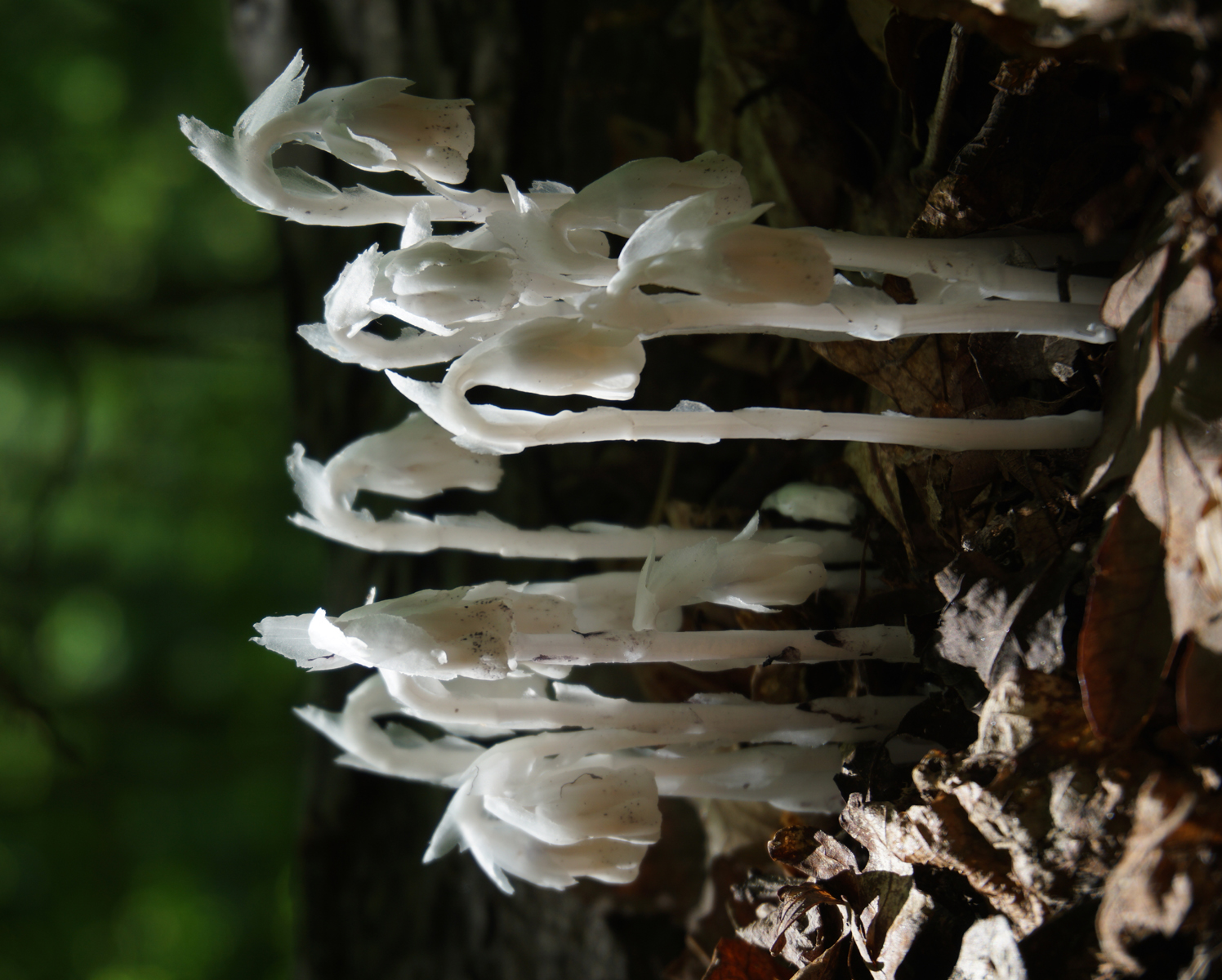
credit: Jdshide via iNaturalist, Public Domain
The ghost pipe
Ghost Pipe: The Parasite
The last character in the trio — the parasite — exploits this productive and harmonious relationship. The parasite is a small plant that you probably recognize: the ghost pipe or Monotropa uniflora. During a few weeks each year, clumps of ghostly white translucent pipes emerge from the ground, mostly featureless=====except for a ghostly white nodding flower at the top of each pipe. This strange-looking plant connects to the Russula fungal network underground, from which it extracts all of its nutrition.
The ghost pipe has no leaves and no chlorophyll, and is unable to capture sunlight for photosynthesis. The plant is eye-catching, and most people recognize it, yet many people wrongly assume that the creature is itself a fungus, rather than a plant! Next time you see it, take a closer look at the top of the pipe to see what is plainly a white flower, including a ring of anthers tipped with yellow pollen. If you’re still wondering: no fungus on Earth produces a flower.
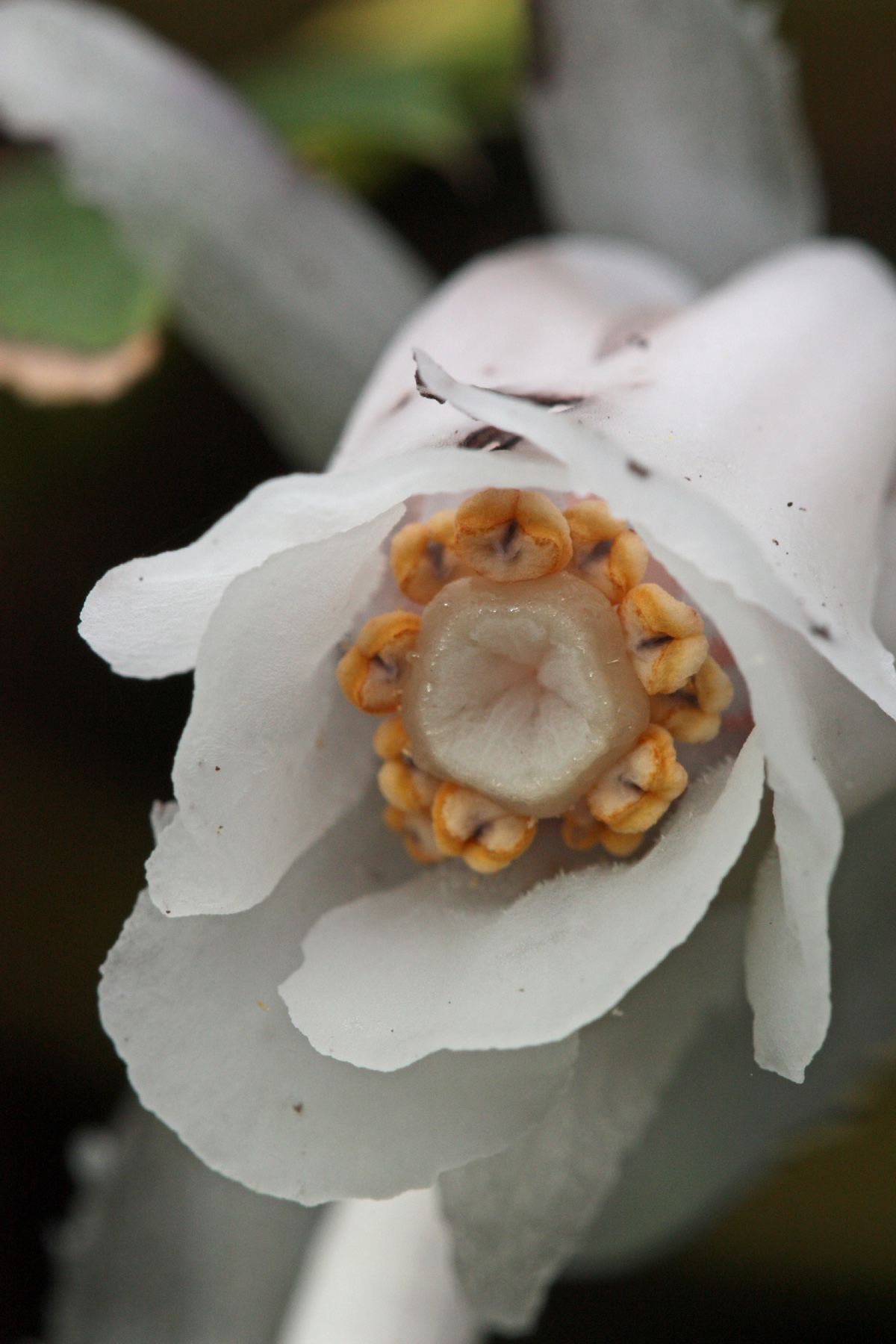
credit: Walter Siegmund via Wikimedia Commons, CC-BY-SA 3.0
Close view of a ghost pipe flower
Ordinary Flower
Except for the ghostly color, the flower is quite ordinary. It is attractive to bumblebees which pollinate it and obtain nectar. After pollination, on the desiccated pipes a dry capsule is held erect which releases tiny dust-like seeds onto the breeze. The emergence, development, and completion of pipe and flowers takes only a few weeks. For the other 40 or 50 weeks of the year, the ghost pipe resides entirely underground as a golf-ball sized clump of stubby roots, steadily sucking life from the fungal network.
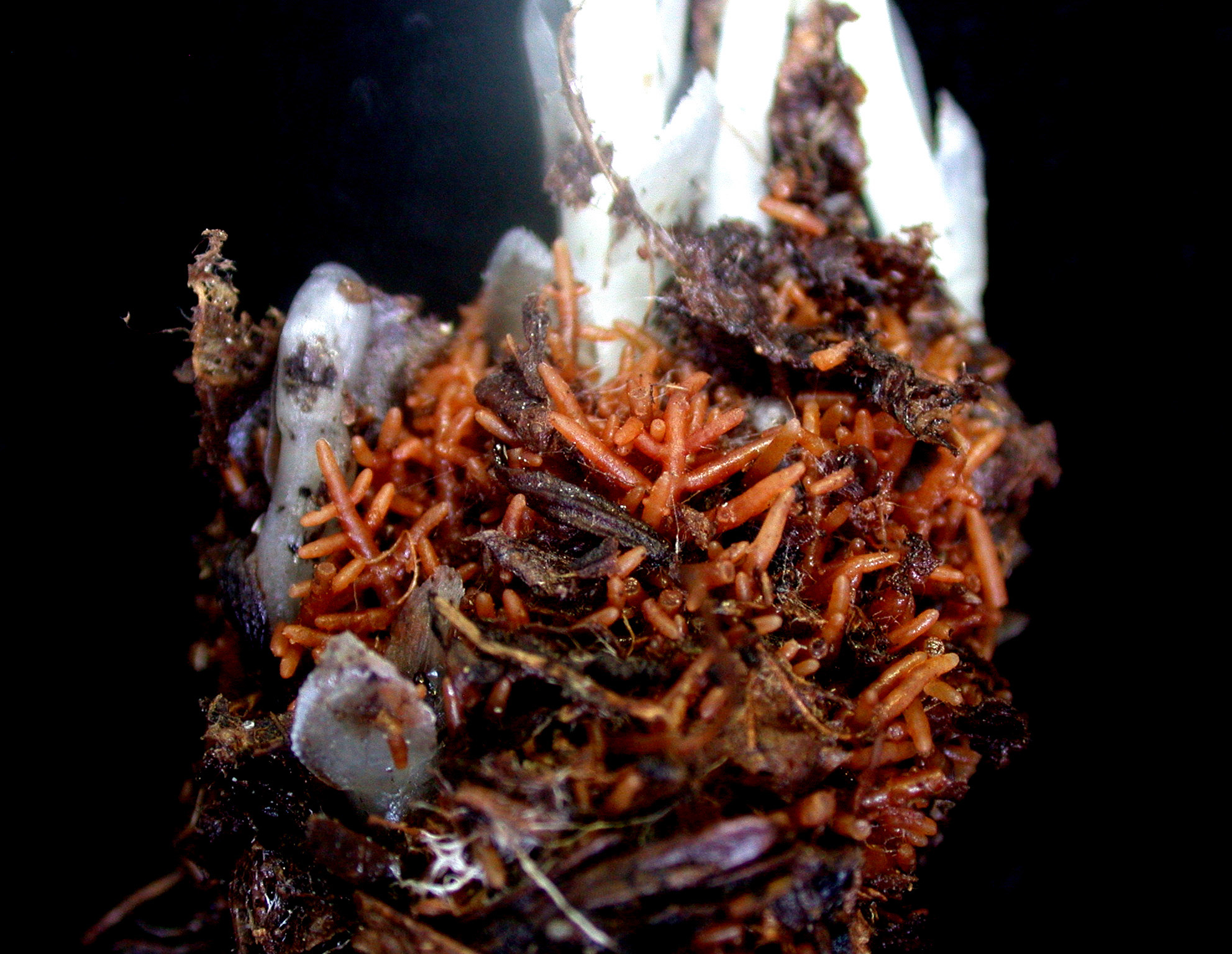
credit: Gilles Ayotte via Wikimedia Commons CC-BY-SA 4.0
Stubby specialized roots of ghost pipe
Microscopic examination of the stubby roots shows a dense sheath of fungal threads woven over each stub like a wool sock. Scientists haven’t yet uncovered the mechanism whereby the plant induces the fungus to remain so vigorously and detrimentally connected.
Ghost Pipe’s Relatives
The ordinary appearance of the flowers has an ordinary but unexpected explanation: the plant is closely related to some other very ordinary plants: rhododendrons, blueberries, salal, and madrones. These plants are all members of the heath family, or Ericaceae. The family is notable for unique types of mycorrhizal fungal relationship shared with certain fungi. These relationships allow most of these plants to grow in dry, acidic, or otherwise poor soils, or even no soil at all: the well-known local red huckleberry can frequently be found growing on rotten conifer logs in dark shade. Water and nutrients shared by their fungal partners allow these plants to thrive in these harsh conditions. The ghost pipe seems to have developed this superpower more in a super-villain direction.
Before vilifying the ghost pipe, understand the bigger picture: like most parasites, this one seems to limit the toll taken on its host. Both its host fungus and the connected host trees seem to thrive even while parasitized.
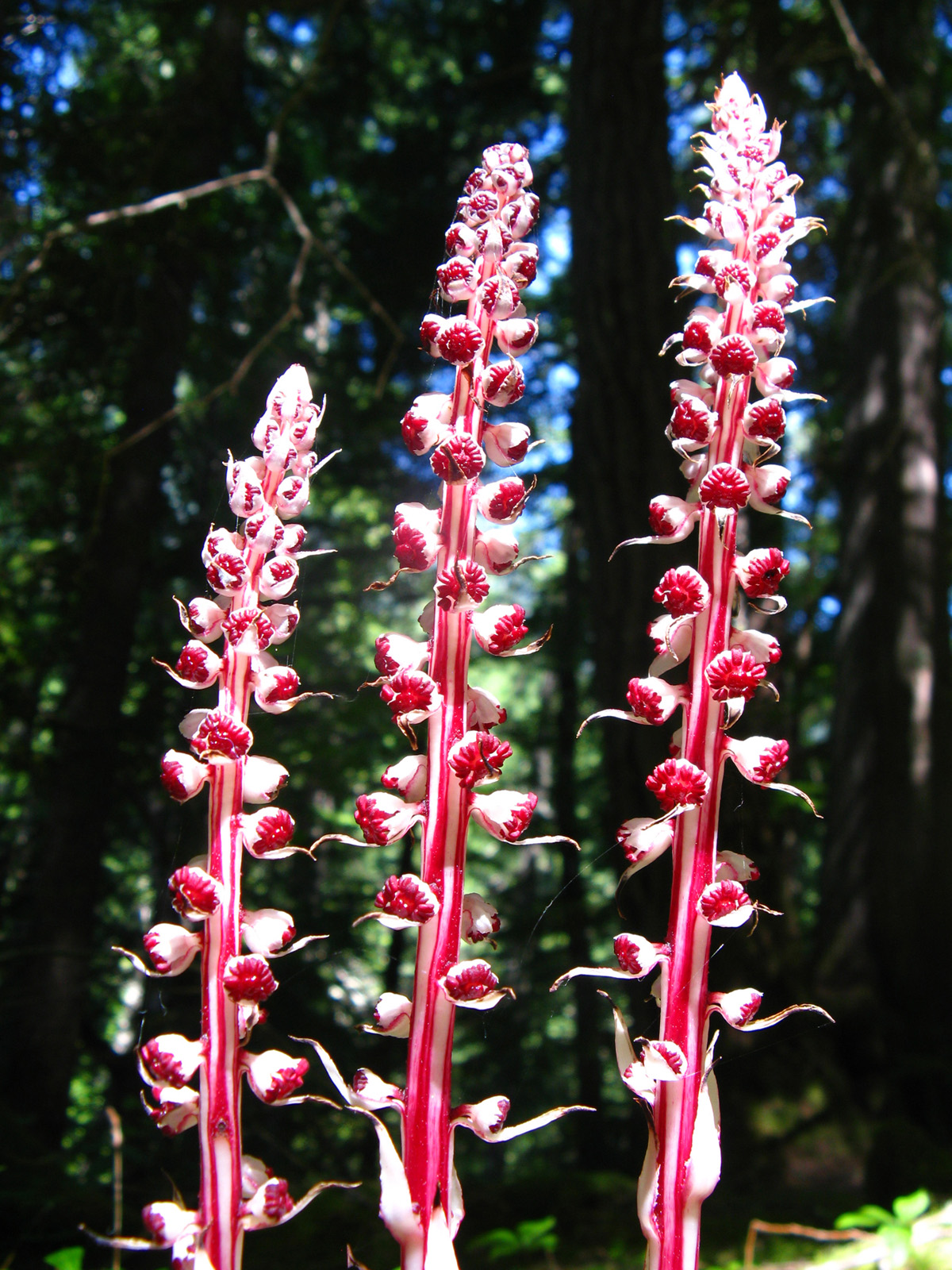
credit: Mount Rainier National Park, CC-BY 2.0
Candystick, another parasite of fungi
Candystick and Hanging Closed Bells
Also, the ghost pipe is in good company: there are five other local species of similar parasitic plants, also within the same family. Listed by their common names, these are the pinesap, fringed pinesap, pine drops, candystick, and gnome plant! All are small plants found in our forests, all emerge for a short time to bloom, and then return underground like the ghost pipe. All the plants are colored some combination of white and/or red and completely lack chlorophyll, and they are even more visually striking than ghost pipe, especially the zany candystick.
Each plant has its own specific fungal host: pine drops parasitize puffball mushrooms in the genus Rhizopogon; pinesap parasitizes Tricholoma mushrooms; the candystick is specific to matsutake mushrooms, which are a species of Tricholoma. The pinesap, pine drops, and candystick all produce flowers that are very similar to blueberry, salal, and madrone flowers: all in the form of dainty, hanging closed bells.
Finally, while we tend to regard parasites with disgust or disdain, remember that the parasite needs a healthy natural environment and thriving host in order to survive. When you see any of these ghostly plants in the forest, remember to envision the thriving network of fungal threads permeating the soil, and the connected network of healthy tree roots supporting healthy trees overhead. You will find these plants in greatest abundance in old-growth forests, and least abundantly in timber plantations.
_____________________________
Eric Worden is a lifelong amateur naturalist and the chair of the Koma Kulshan chapter of the Washington Native Plant Society.
References:
- Massicotte, Hugues & Melville, L & Peterson, R. (2005). Structural features of mycorrhizal associations in two members of the Monotropoideae, Monotropa uniflora and Pterospora andromedea. Mycorrhiza. 15
- “Allotropa,” Wikipedia
- “Hemitomes,” Wikipedia
- “Monotropa hypopitys,” Wikipedia
- “Monotropa unifl ora,” Wikipedia
- “Photocorynus,” Wikipedia
- “Pleuricospora,” Wikipedia
- “Pterospora,” Wikipedia