by Liam Walsh

In 2024, nine authors and six organizations put together a study/paper arguing for the restoration of Sumas Lake near Abbotsford, British Columbia. (https://www.frontiersin.org/journals/conservation-science/articles/10.3389/fcosc.2024.1380083/full) The lake was drained in 1924, and researchers argue its restoration would bring a wide range of benefits.
In 2021, an atmospheric river flooded the Nooksack River in north Whatcom County. Floodwater swelled into the Sumas Lake bed, and the lake temporarily returned, causing property damage and killing livestock. This event was the catalyst for the study. The Lower Fraser Fisheries Alliance, UBC Conservation Decisions Lab, West Coast Environmental Law and the Raincoast Conservation Foundation worked together to create the study.
Dr. Tara Martin, a professor at the University of British Columbia, is in the department of Forests and Conservation Sciences, and she is one of the authors of the study. “We need to alleviate the risk to land holders that are living in the lakebed. There’s no indication that we are able to stop the water from returning,” Martin said. “That lake will provide habitat for five species of salmon and over 70 other species that are at risk of extinction, and giving that land back, or in this case a lake back, is a part of reconciliation with indigenous communities.”
“It was a social, economic and ecological approach to what climate adaptation and flood management look like in the future.”
History
For thousands of years, Sumas Lake was a shallow body of water in what is today the Sumas Prairie. It supported salmon, sturgeon, many species of birds, and created large areas of wetlands habitat. The Sumas First Nation have lived in the region for thousands of years, and relied on the lake for fishing, hunting, and cultural practices. Settler farmland surrounding the lake flooded constantly, and the solution to that problem was to remove the lake. In 1920, a series of dykes and canals were built to redirect the Vedder River, and water was pumped out of the lake. Throughout the years, the lakebed flooded, and better dykes and pumping systems were installed to maintain the farmland.
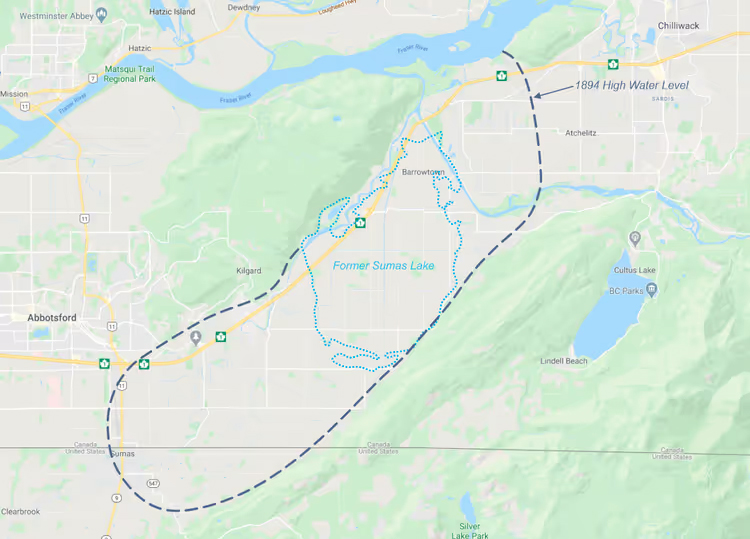
courtesy: The Daily Hive
Map of the baseline size of the former Sumas Lake and the historical extent of the lake (outlined in bold dotted line). The historial border inundated what is now Sumas. https://dailyhive.com/vancouver/sumas-lake-sumasprairie-barrowtown-pump-station-abbotsford-flooding.
Restoring an Ancient Lake
One of the primary focuses of the paper (arguing for the restoration of Sumas Lake) was to analyze the cost of restoring the lake and compare it to the cost of maintaining current flood prevention systems. The paper proposes a managed retreat of the lakebed area and a restoration of the historic lake.
Kristen Walters, director of Salmon Habitat, Climate, and Policy at the Raincoast Conservation Foundation explained what that process looks like. “We looked at the cost of buying out all properties in the lakebed that flooded versus the status quo that’s used by the municipalities and provincial government which aims to harden and build more infrastructure like dykes,” Walters said.
The study found that buying all the property in the lakebed area would cost close to one billion dollars, while the city of Abbotsford’s plan would cost up to 2.4 billion dollars. The researchers argue that their strategy would be cheaper in the short term and in the long term. Martin argued that the process of managed retreat is not an uncommon strategy for at-risk areas. “It’s a strategy that’s being applied around the world in light of increasing climate change related impacts like fires and flooding,” Martin said.
If the proposed managed retreat took place, the next steps would be the removal of infrastructure, decontamination of the area and re-flooding of the lakebed. “The only reason that the lake is dry 24/7 normally is because the pump stations are working 24/7 to pump the water away,” Martin said. “Bring the water in, that’s the easy part, the more challenging part is moving the people and the infrastructure.”
Salmon Habitat Restoration
Another point argued by researchers is that the lake’s restoration would be beneficial for salmon populations and the broader ecosystem. “The Fraser River is one of the most productive salmon ecosystems in North America and salmon have been declining for some time. One of the major drivers of their decline has been a loss of freshwater habitat,” Martin said.
According to Martin, the lake’s return would be the largest habitat restoration project for salmon ever, restoring 13 percent of their total lost habitat. “It once was an incredibly thriving lake that supported all five species of salmon along with hundreds of internationally important migratory birds,” Martin said. Salmon are also a key food source for endangered orcas across the region. An increase in salmon habitat and populations stands to benefit orca populations.
Flooding
While researchers argue for many benefits of the lake’s restoration, the proposal is ultimately a solution for increasing flooding in the region. “We know from climate science that the frequency intensity and severity of the atmospheric river events will increase,” Walters said. “Relying on the status quo and infrastructure isn’t a pragmatic solution over the long term because that infrastructure can and will fail. We have seen that happen in 2021, but also in dyking infrastructure elsewhere.”
“If we want to be proactive in preparing our communities for increased risk from climate change related events like atmospheric rivers, we need to think about moving away from the status quo,” Walters said.
Another element of the flooding problem is Washington state. “The other piece is that flooding is really driven by the Nooksack [River] and there’s very little interest in stopping that water from coming into Canada because that would just increase flooding in the United States,” Martin said.
Indigenous Reconciliation
Another focus of the paper is indigenous law, and the argument that the lakebed is stolen indigenous land. The lake represented a vital indigenous food system, and it was replaced without the consent of the Sumas people and surrounding nations.
The article states: “The draining of Sumas Lake was one act in a Canada-wide process of land dispossession and genocide carried out by colonial governments on Indigenous Peoples across Canada. Land governed and stewarded by Indigenous People for millennia was stolen and given to settlers or retained by the crown and used for resource extraction.”
Looking to the Future
Walters and Martin both acknowledge that the study has shortcomings. Primarily, the study does not look into the loss of revenue from agriculture that would take place if the lake were restored, or the potential revenue created by new fisheries. “Our goal with the paper was to start the conversation. In the future, there certainly is the opportunity for further research to do a more in-depth economic analysis,” Walters said.
_________________________________________
Liam Walsh is a senior at Western studying journalism with a news/editorial focus. In his free time, he plays on the Western rugby team and enjoys hiking and swimming.