Native Plant Neighbors
by Eric Worden
The red alder is an invisible and hard-working tree. To explain “invisible,” I’ll start by inverting a common saying: the red alder is invisible because people often “can’t see the tree for the forest.” This was my own experience for many years after first moving to western Washington from the desert center of the state, where we didn’t think much about trees. In Seattle, on my daily bus commute, I would pass a hilly greenbelt near the freeway. Through the bus window, I would sleepily regard the wooded carpet of trees and half-think, “mmm, trees.” After repeating that scenario for a few weeks, on one more alert morning, I finally realized, “ … but what tree is that?” I had finally seen the invisible tree but did not recognize it. It hadn’t the distinctive lobed leaf of the maple or oak, nor the fragile and flickering appearance of poplars, nor the craggy appearance of locust, nor the flowers, fruit, or bark of cherry. In fact, I couldn’t find anything distinctive about this tree at all. I wasn’t much of a botanist in those days, so my mystery remained unsolved for many years.
I won’t be too hard on my former self ’s lack of botanical acumen because I had few opportunities to see a red alder tree except through a bus’s window. Red alder is infrequently found in urban settings or gardens. Like many of our local native plants, it only grows in the mild low-elevation areas near salt water from British Columbia to northern California. Even though when young it’s a modestly handsome — if aesthetically unremarkable — tree, it’s found almost exclusively in wild settings. That’s because in the sub-optimal conditions of urban settings, after a couple of decades, it starts to break and lose limbs, and becomes shabby looking. So, no one plants it intentionally, and shabby-looking trees are quickly cut down.
Hard-Working Tree
Now, bravo to you, good reader, for continuing this far, because in nature this ordinary-looking tree has extraordinary ecological value, and I call it “hard-working.” Its unique value is to quickly and reliably colonize and return life to bare soils in devastated areas like clear-cuts, burns, flood washouts, roads, and excavations. In pre-settlement times, red alder was a minor forest character, limited to stream sides, some other wet areas, and as a first-stage colonizer after fire. Since then, red alder has greatly expanded its population into vast areas where humans have aggressively cleared and disturbed the land. Even though foresters routinely herbicide clear-cut tracts to kill red alder seedlings, by 1988, the species occupied 13 percent of coastal commercial forestland in Washington and Oregon.
Where the red alder evades human extermination, it fosters life in multiple ways. Its tiny seeds blow in from far away and grow on barren soil where few other plants can thrive. A special relationship with specific soil bacteria grants it this special ability; the bacteria — an actinomycete called Frankia — are harbored in special root nodules, where the bacteria convert atmospheric nitrogen into ammonia which the plant uses to manufacture essential protein. By essentially fertilizing itself, red alder can grow rapidly. Its spreading roots stabilize the soil, and, in a few years, it deposits abundant litter onto the soil which also helps stabilize it. This litter is nitrogen-rich. It improves the soil, making it hospitable to other plants, including a second wave of tree species: studies show that Douglas fir trees grow larger where red alder grew previously. Red alder is not shade-tolerant though, so after the first generation rises in one area, no others rise there. Other more shade-tolerant species take its place.
It seems that, if red alder did not exist in our area, many areas of human devastation would remain barren much longer. My anthropomorphizing mind calls red alder “invisible” and “hard-working” for the tremendous ecological service it provides, and respects its modest appearance and its unappreciated life away from people.
Physical Appearance
Now that we’ve established its subjective value, what does it really look like? In ideal conditions — that is, wet — it’s a large and broad erect tree as tall as big leaf maple; generally though it is smaller. The trunk is usually straight, with smooth bark, giving an appearance of solidity. The smooth bark is colored medium gray, though the medium gray is rarely seen because the bark is generally covered by a subtle patchwork of lighter gray lichens. These lichens have such a smooth, low profile that uninformed people always assume that the bark itself is colored with a light gray patchwork. In size, form, and color, red alder trunks remind me of elephant legs — a fanciful image to hold while walking down the trail. Under the surface, the trunk contains a soft , fine-grained, tan wood that is perfect for fashioning pieces of particular shapes, such as for furniture. For that reason, red alder is the most commercially important hardwood timber in our region. Indian people of our area carve miscellaneous implements from it. They also value its mild taste and lack of pitch, and so use it for spoons and serving-ware, and for cooking and smoking meat.
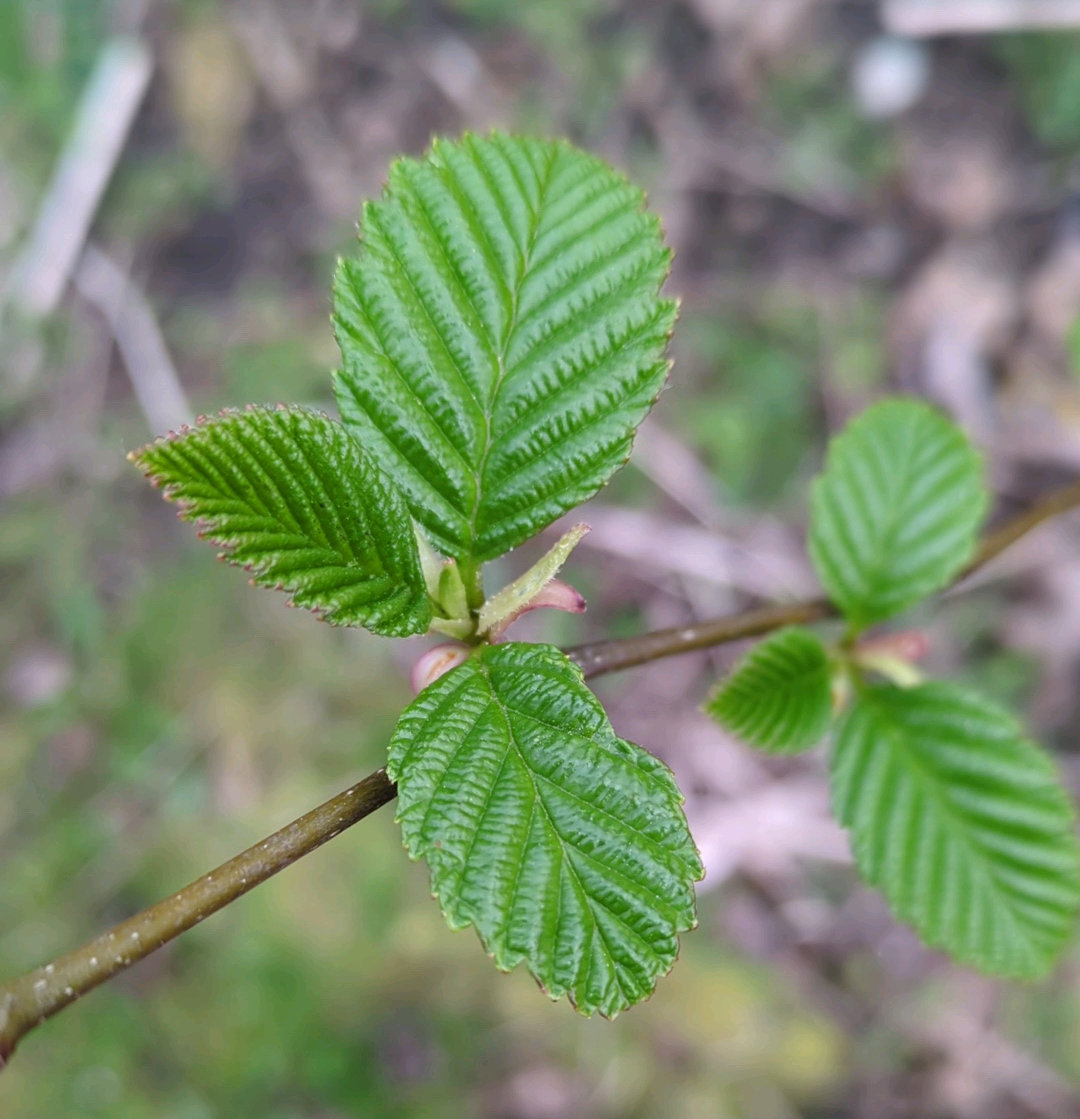
photo: Eric Worden
Fresh spring leaves.
In the spring, red alder leaves sprout and unfold like bilateral accordions; after completely unfolding, leaf veins mark each of the parallel pleats, along with a notch on the leaf edge. Red alder flowers appear before the leaves in the spring. What, you’ve never seen the flowers? Yes, you probably have seen the dangling, flexible, finger-shaped male flowers, called catkins.
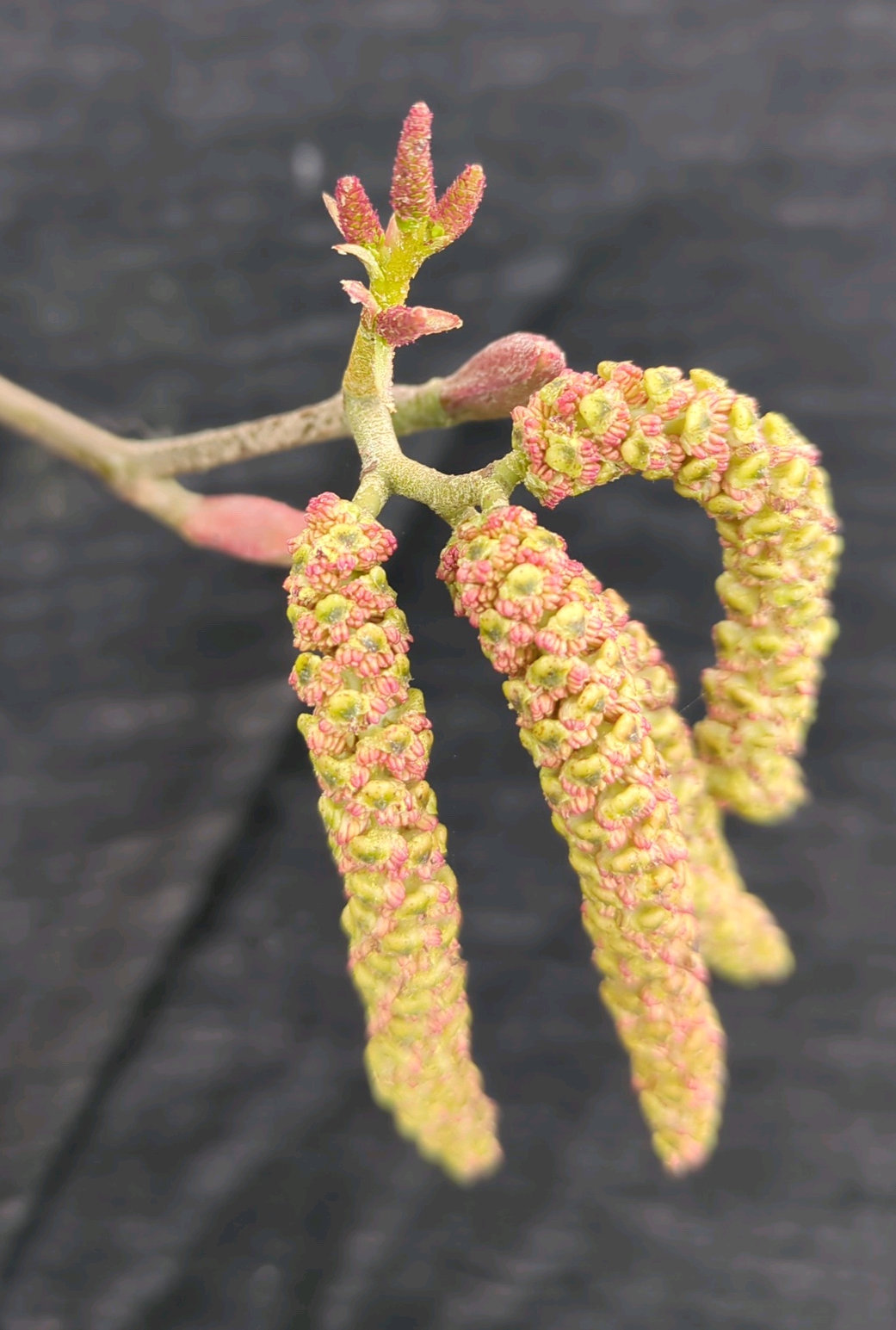
photo: Eric Worden
Female (small) and male (large) red alder catkins.
Though they have no petals and don’t attract bees, they are flowers in terms of anatomy and function: reproduction. The male catkins release pollen into the air, which lands on the tiny reddish female flowers, which initially look like purposeless stubs. Shortly after, the male catkins wither and fall to the ground, and the female parts slowly grow into a woody cone-like shape, eventually drying in the fall and releasing tiny seeds to the wind through the winter. I find it poetic how, in plants as well as animals, the male part initially and suddenly appears large and assertive, but quickly falls away, while the small, hidden female part slowly grows to more spectacular completion.
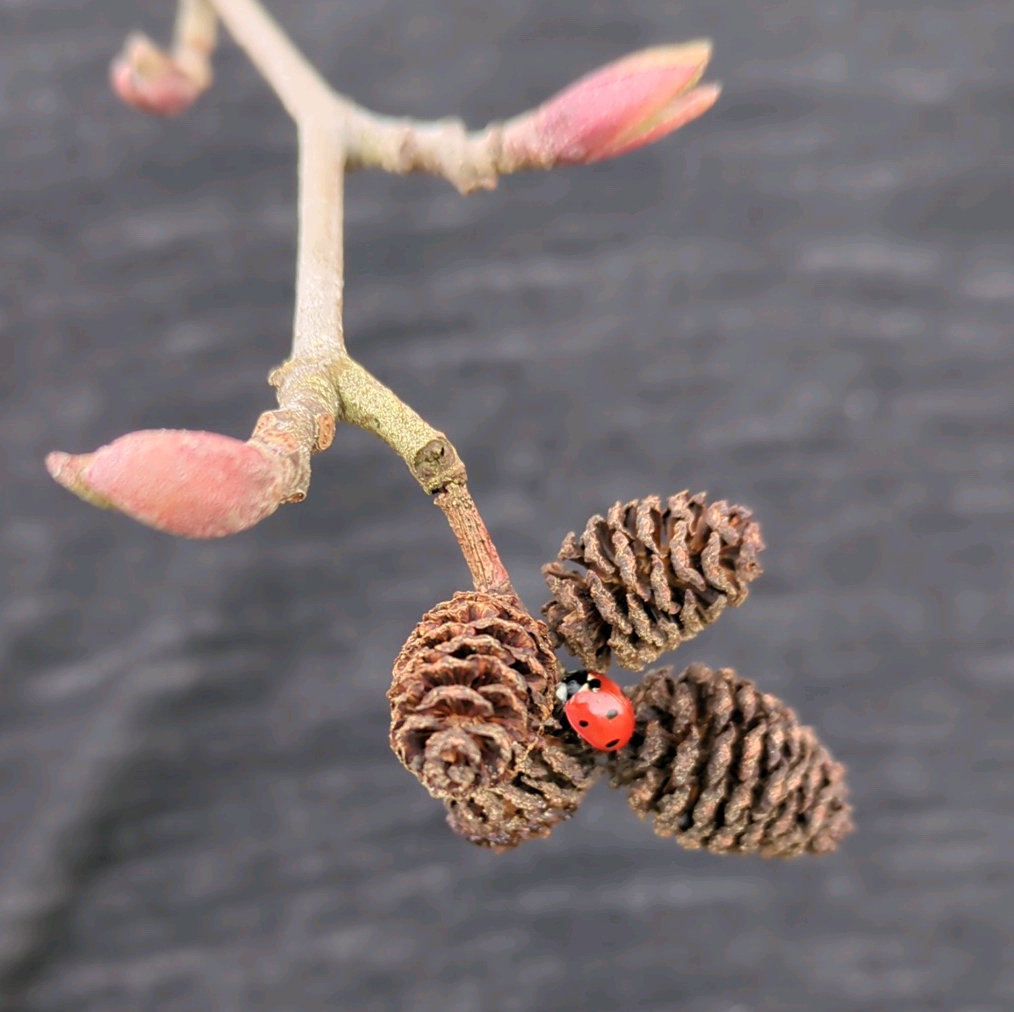
photo: Eric Worden
Exhausted female catkins remaining from last fall.
Exterior Modesty and Interior Richness
Red alder stimulates my personal bias for exterior modesty and interior richness: just under the plain gray bark surface lies a brilliant orange-red substance, the red alder’s namesake. The substance seems poorly documented in amateur scientific circles, though it was chemically characterized by an Oregon State University doctoral student 50 years ago in 1975. He identified the red substance as an diarylheptanoid xyloside, and he named it oregonin. Some contemporary sources incorrectly identify tannins as the source of color. It has been studied extensively since its original characterization, and found to have anti-herbivory and anti-inflammatory properties.
In the past especially, this colored substance, concentrated in the bark, was highly valued for dyeing and even making red paint. The bark was traded to people living in distant non-coastal regions. To obtain the most vivid orange-red color, the bark was boiled in urine! Nancy Turner also relates that the “Haida, Nuuchah-multh, and Kwakwaka’wakw produced a bright red for cedar bark by chewing the alder bark, spitting the saliva into a container, and bringing it to a boil by adding redhot rocks.” I have a pet interest in biological pigments because they link fascinating stories of history, culture, biology, chemistry, and even quantum physics. You may be able to find future articles from me further exploring these aspects of oregonin, and my own dyeing experiments.
To learn more about red alder and other native plants, visit the Washington Native Plant Society at wnps.org.
___________________________________________-
Eric Worden is a lifelong amateur naturalist, and the chair of the Koma Kulshan chapter of the Washington Native Plant Society.
References:
- “Alnus rubra,” US Fire Effects Information System, https://www.fs.usda.gov/database/feis/plants/tree/alnrub/all.html
- Joseph John Karchesy, (1975) “Polyphenols of Red Alder: Chemistry of The Staining Phenomenon,” Oregon State University
- National Center for Biotechnology Information (2026). Pub-Chem Compound Summary for CID 14707658, Oregonin. Retrieved April 5, 2026 from https://pubchem.ncbi.nlm.nih.gov/compound/Oregonin.
- Nancy J. Turner, (1998). Plant Technology of First Peoples in British Columbia, Royal BC Museum