Community Service Spotlight
As climate pressures rise and progress stalls, People for Lake Whatcom returns to restore public oversight, scientific clarity,
and shared responsibility.
by Kerri Burnside and Natalie Elmore
Bellingham’s identity is closely tied to Lake Whatcom. With its majestic beauty and wealth of recreational opportunities, it’s a place where generations have learned to swim, gather, and grow up. Yet, beneath that familiar surface lies a longstanding truth our community has carried for decades: the lake has been in trouble for a very long time. Elevated mercury in fish, industrial debris on the lake bed, the remains of old mills and logging operations, contaminated sediments, early sewage disposal, and shoreline development have all left a legacy of harm.
These impacts aren’t new discoveries; they’ve been part of local knowledge for generations. And, they tell us something essential: the lake’s decline is not recent, and neither is our responsibility to address it.
For years, the development surrounding the lake (the homes, roads, and clearcuts) were treated as an inevitable part of the landscape. It wasn’t widely understood that other communities safeguard their drinking water by limiting exactly these kinds of impacts. Today, more residents recognize that we must do the same.
Origin of People for Lake Whatcom
In the mid-90s, a group of community members began organizing, researching, and demanding action. Their work led to the creation of People for Lake Whatcom. They pushed for accountability, transparency, and science-based decision-making, and their efforts helped shape many of the protections we rely on today. Nearly 30 years later, the pressures on the lake increased. The need for a strong, unified, community-driven coalition is clear. It is time to reactivate People for Lake Whatcom.
In 1998, Lake Whatcom was declared Impaired (officially listed on the Department of Ecology’s 303(d) list). That designation triggered the creation of a Total Daily Maximum Load or TMDL which is essentially a pollution budget required under the Clean Water Act. When a water body is listed as impaired, the state must determine how much of a pollutant it can receive while still meeting water quality standards. The Lake Whatcom TDML sets strict, legally binding phosphorus and fecal bacteria reduction targets for each jurisdiction in the watershed and requires ongoing monitoring, reporting, and adaptive management. The TMDL is not a suggestion or long-term aspiration; it’s a regulatory mandate. To accomplish this objective, it is crucial to have coordinated action, transparent data, and consistent public oversight, all of which are areas where community involvement remains critical.
At the request of the governing bodies tasked with the creation and implementation of the TMDL, People for Lake Whatcom patiently watched for two decades for the changes to show themselves. It is now clear that the efforts to meet the TMDL requirements are insufficient. People for Lake Whatcom appeared to fade from public view, but many community members continued to push for stronger protections, better data, and sustained progress. Their persistence kept the issues alive through the years while public interest waned.
April Markiewicz
April Markiewicz was one of those steady voices; her Whatcom Watch articles carried the scientific truth even when the political will to hear it diminished, but she was far from alone. A committed group of residents kept showing up, testifying, researching, and demanding accountability. Now it’s time for the rest of us to join them and do our part to protect the lake we all rely on.
The broader context is increasingly hard to ignore once you sit with it. The watershed spans 36,000 acres, most of it outside city limits. About 18,000 people live within its boundaries, nearly half of them in Sudden Valley. The lake is fed by dozens of streams, and, despite its size, is impaired (too much phosphorus, too much bacteria, not enough oxygen, and the added strain of a warming climate compounding older legacy pollutants like creosote and benzene).
There are many systemic problems facing the health of Lake Whatcom. Lack of coordination between the jurisdictions, development, forestry, climate change, and recreational use are causing an imbalance of restoration efforts.
Phosphorus and Fecal Bacteria
The City of Bellingham has made progress on phosphorus reduction, but doesn’t report on fecal bacteria reduction. The county’s progress has lagged on both. These uneven efforts and the lack of a shared reporting framework reveal a deeper problem: the jurisdictions responsible for protecting Lake Whatcom are not working from the same playbook. Without coordinated goals, consistent data, and aligned accountability, progress in one area is undermined by inaction in another. This fragmentation fuels dysfunction across every other part of the watershed recovery effort.
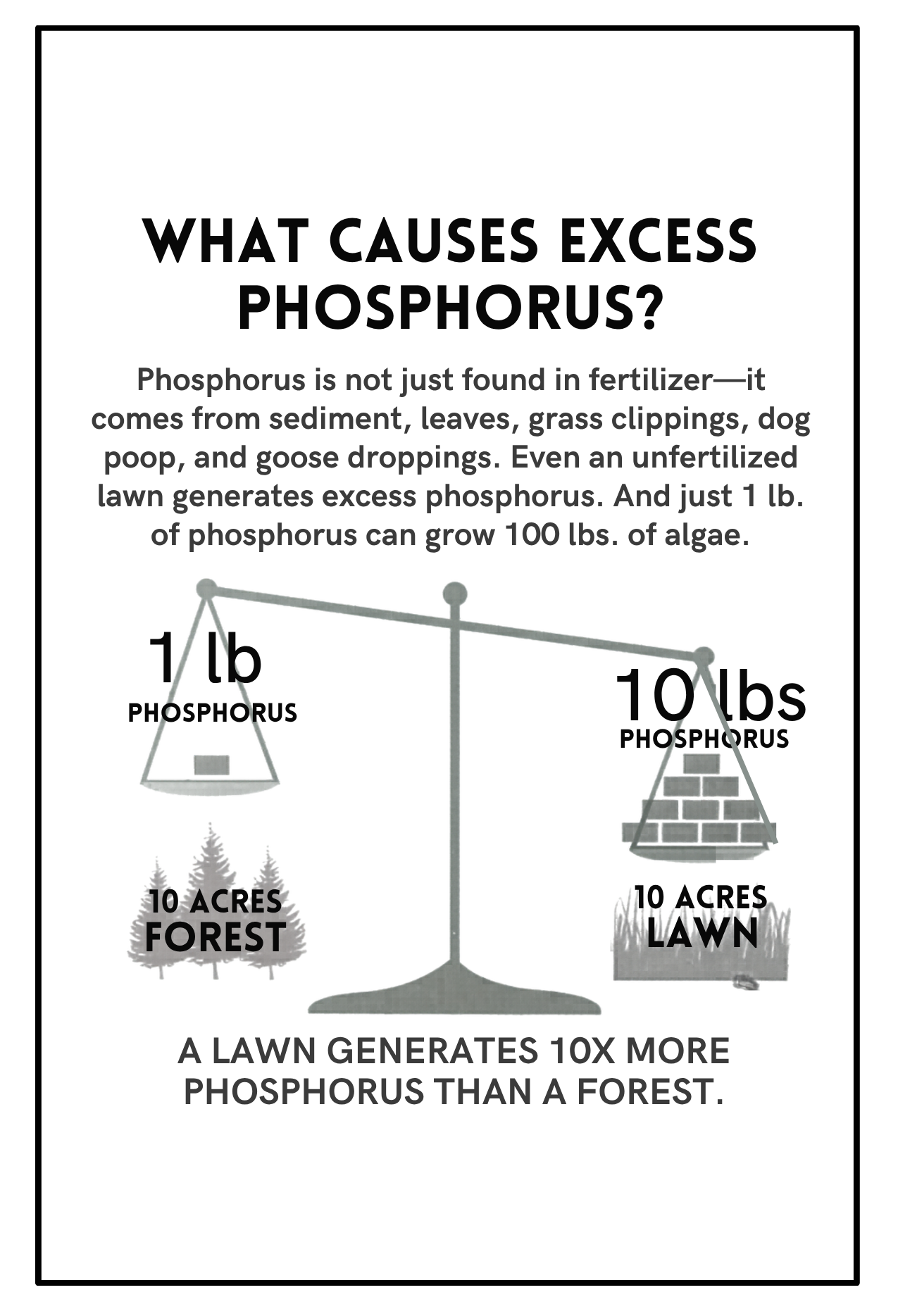
Development plays a major role in the lake’s deterioration. Everything we do on the land shows up in the water eventually. Lawns, driveways, rooftops: they all add phosphorus and bacteria in ways forests never did. We have a goal of phosphorus-neutral development, but are a long way off from successfully achieving this.
Forestry tends to sit in the background of most conversations about Lake Whatcom, overshadowed by the more visible pressures of development. But logging is still happening in the watershed, including on private land governed by rules that don’t offer the same protections as the Lake Whatcom Management Plan. Clearcuts, new roads, loose soil — all of it sends sediment and phosphorus downhill. Aerial herbicide spraying adds its own concerns.
What makes this harder is that the Lake Whatcom Landscape Plan; the document meant to guide forestry decisions is more than two decades old, written before climate change reshaped the assumptions we used to rely on.
Climate Change
Climate change, meanwhile, is the quiet force threading through everything. Longer periods of stratification with warming water and algae in the top layers and declining dissolved oxygen in the deeper levels, shrinking snowpack, higher wildfire risk, and more intense storms with flooding all funnel into the same outcome: a watershed more vulnerable each year. Without planning that anticipates these shifts, the lake will continue to decline.
Recreational use also plays a significant role in the lake’s health. Lake Whatcom is a beloved destination for swimming, boating, paddling, fishing, and shoreline access; but without careful management, these activities contribute to erosion, fuel and oil leaks, shoreline disturbance, and the spread of invasive species. Increased motorized use, heavier summer traffic, and year-round pressure on fragile access points all add stress to a system already struggling to meet water quality standards. Recreation is an important part of community life, but it must be managed in a way that protects the lake rather than accelerates its decline.
The lack of progress on these systemic problems is the catalyst for why People for Lake Whatcom has returned. Reactivating the coalition isn’t symbolic; it’s practical. The watershed can’t afford further impairment. What’s needed now is a unified, science-literate citizen group that can hold the county and city to their TMDL obligations, push for long-term maintenance of stormwater systems, and bring real public oversight to forestry decisions that shape everything from sediment loads to cultural resources. The coalition can also help move long-overdue policy reforms forward: a more effective Homeowner Incentive Program, education and enforcement, and clearer, more transparent data practices.
People for Lake Whatcom’s Goal
It is the goal of People for Lake Whatcom to bring collaboration that spans the entire community and addresses the watershed in its entirety. The work is too complex and too interconnected for any one group to shoulder alone. This isn’t about one shoreline or one basin or one pocket of the watershed. It’s about the drinking water source we all rely on and the integrity of the land we all love.
Our vision of what the watershed could look like if we chose to work together with intention — we picture a lake where phosphorus no longer creeps in from every lawn and driveway. A watershed where stormwater systems are built to last, not just to pass inspection. A forest managed for the climate we live in now, not the one we hoped we’d have. And a recreation system that protects the lake even as people enjoy it. This is the future we know is possible, if we choose it.
We are working for a future where the city and county meet their TMDL targets, where the decline finally slows, where residents understand in a real, felt way, how their choices shape the water they drink. None of this is out of reach. It’s simply the difference between choosing a future and drifting into one.
People for Lake Whatcom is rising again because the lake needs all of us. Not as isolated neighborhoods or competing jurisdictions. But as one community, bound by the water we all rely on. The lake is calling. It’s time to answer — together.
_________________________________________
Kerri Burnside is a lifelong Bellingham resident, member of People for Lake Whatcom, community organizer, and housing advocate. She serves in multiple local leadership roles and is engaged in advancing policies that support housing affordability, environmental protection, and community accountability.
A longtime Bellingham resident, Natalie Elmore is a graphic designer and freelance technical writer who believes clean water is essential for all forms of life.