photo: Whatcom Land Trust staff
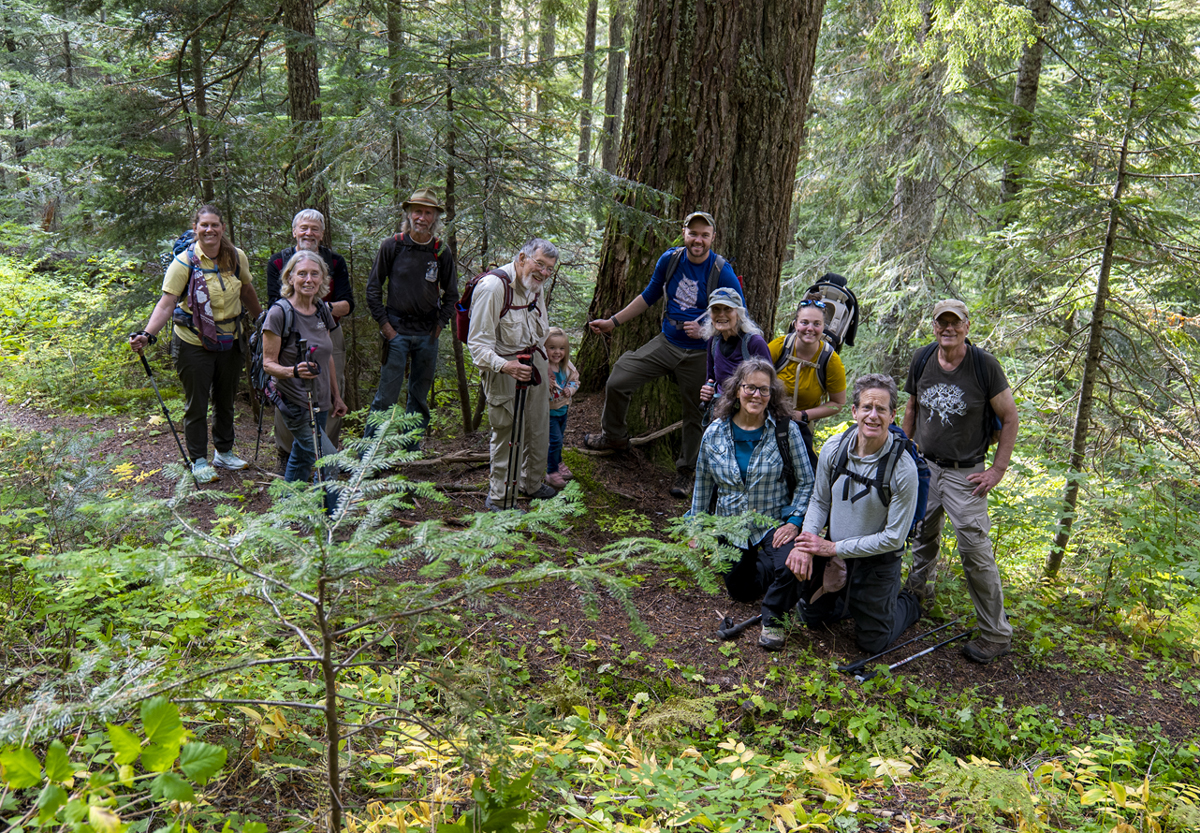
Whatcom Land Trust staff and volunteers support Rand Jack on a hike to see the Canyon Lake old-growth forest again.
by Claire Johnston
In 1998, negotiations over protecting Canyon Lake Community Forest with trees over 1,000 years old hit an obstacle. The land was held by a timber company, the cost of the conservation deal was huge, and the County Council wasn’t sold on the project. So, Whatcom Land Trust (the Land Trust or the Trust) co-founder Rand Jack did something simple — he took the council on a hike.
“It was not going well,” recalled Larry Simkins, who spent 30 years with Whatcom County Parks, the last 15 working directly alongside Jack. “So he came up with the idea: well, let’s get all the council, and we’ll take them up there. We had lunch, and he had them all surrounded by the trees, and he convinced them that the forest was something absolutely necessary to preserve. That’s just one of many, many projects that he dealt with.”
Canyon Lake Trail Renamed
It’s the kind of story that led the Whatcom County Council to vote unanimously to rename Canyon Lake Community Forest’s 3.5-mile main trail the Rand Jack Forest Trail. The trail renaming honors Jack, a Whatcom Land Trust co-founder, who has spent more than four decades protecting land in Whatcom County, including more than a dozen county parks.
For Simkins, the lunch on the ridge wasn’t a one-off trick; it was Jack’s whole way of working. “He is, when he gets an idea on something that he wants to preserve, tenacious,” Simkins said. “But, he goes after it in all the right ways. He doesn’t just overpower people. He is always able to read the room. Rand is arguably one of the smartest people I’ve known in my life, and he’s always going to be smarter than everybody else in the room, but he would never, ever make you think that. That is why he was so effective dealing with the council, with Conservation Futures, and getting the money and donations to procure the lands he felt were essential to preserve.”
On Tuesday, Aug. 11, the County Council unanimously approved the renaming (see page 20, vote #218). County Executive Satpal Sidhu’s letter of support said: “Over Jack’s nearly 50 years in our community, his tireless efforts have resulted in protection of nearly 20,000 acres of conservation lands, including many, such as Teddy Bear Cove, Lily Point Marine Park, and Stimpson Family Nature Preserve, that are treasures providing passive and nonmotorized recreation for residents and visitors alike.”
The idea to rename the trail came from Simkins and another former Whatcom County Parks colleague, Pat Milliken. “It isn’t just Whatcom County that has benefited so much from Rand’s efforts; he has set a high bar for other land trusts around the U.S.,” Milliken said. “We are lucky to have him. Under Rand’s vision and leadership, Whatcom Land Trust has come a long way since the initial meetings at the Dutch Mothers restaurant in Lynden and the Trust’s first project, the Miller Farm.”
What Simkins and Milliken describe is the foundation for a decades-long partnership between Whatcom Land Trust and Whatcom County government that has quietly shaped the landscape of Whatcom County for 40 years. The Land Trust identifies and negotiates the protection of an important place, then Whatcom County steps in as the long-term landowner and manager. As Rand puts it: “Whatcom Land Trust has changed the nature of Whatcom County.” Two projects in particular show how that partnership has taken shape over the years: Canyon Lake Community Forest and Stimpson Family Nature Preserve.
“You’re Thinking Too Small”
Whatcom Land Trust was still a young nonprofit organization in the 1990s. Jack remembers a time when “the Land Trust had a hundred dollars in the bank. That was our sole asset.” So when two hikers, Mike and Pat Savatgy, discovered an unusually old forest on a ridge above Canyon Creek, the idea of protecting it presented a challenge that could not be ignored.
“To me, the Canyon Lake Project tested our potential,” Jack said. “There we had a 2,250-acre forested property that included 750 acres of trees over a thousand years old, a purchase price of $3,620,000, and a tight deadline to make a deal. It just seemed crazy at the time, something difficult to even imagine.”
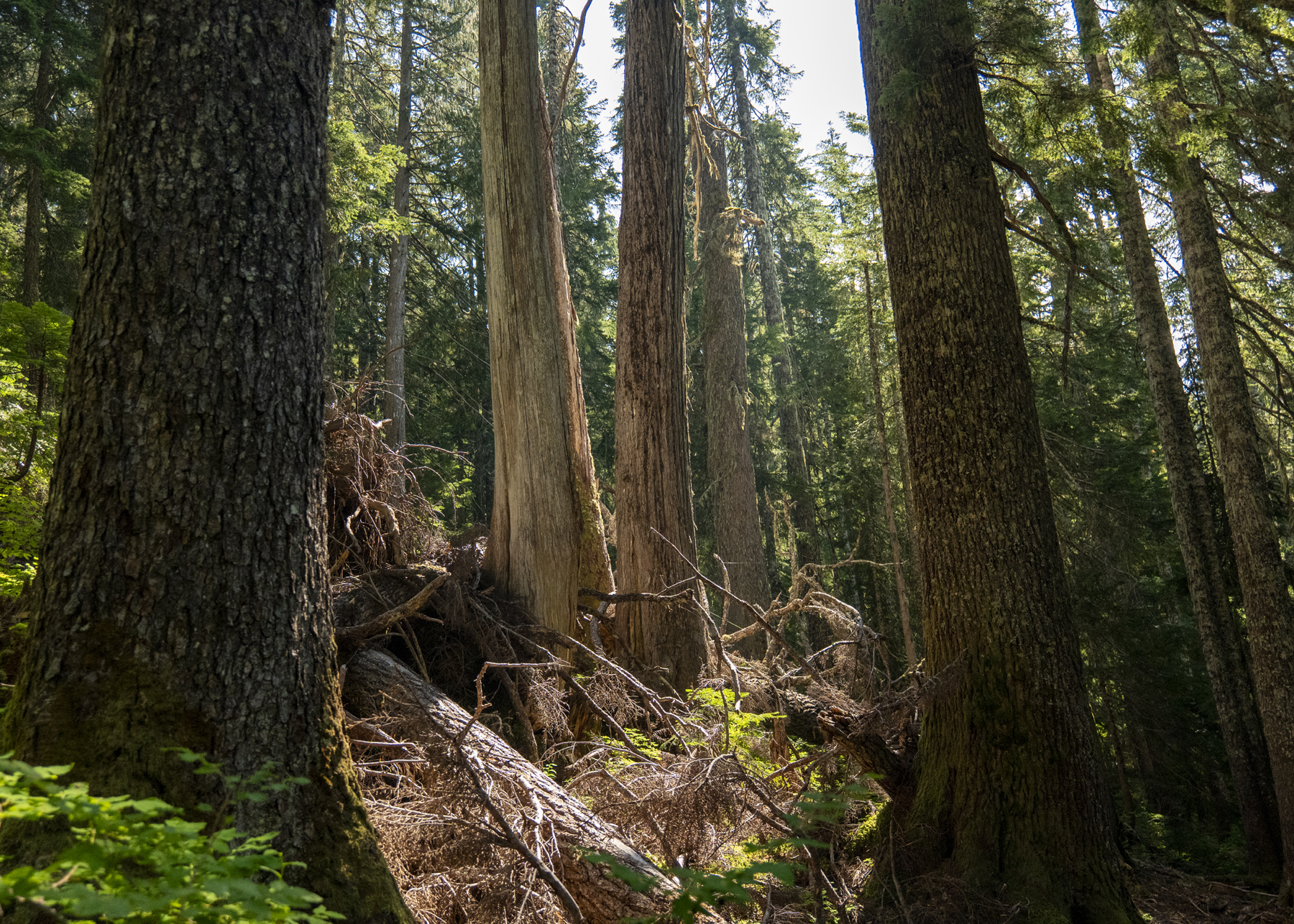
photo: Whatcom Land Trust staff
A view into the old growth at Canyon Lake Community Forest.
James Agee, a University of Washington forest ecologist, took core samples, counted the growth rings under a microscope, and confirmed the antiquity of the ancient trees. Agee confirmed that “the parcel is one of the oldest forest stands in the Pacific Northwest.” As quoted in The Seattle Times, he said: “When I sanded them down and counted the rings, I thought, Oh, my God, these are very old trees … what I’m seeing is rare because they are so old.”
With help from Craig Lee at the national Trust for Public Land, Whatcom Land Trust arranged an on-site meeting with Bill Pope representing the Paul Allen Forest Foundation. Jack recalls sitting on a boulder overlooking the Canyon Lake Creek Valley with Pope, who asked, “What is it that you want to buy?”
Jack pointed out the ancient forest stand and said, “This is what we want to protect.”
Pope responded, “You’re thinking too small. You need to buy the whole valley, and we’ll give you half the money.”
Jack recounts, “I have not thought too small since.”
This triggered a one-million dollar pledge from an anonymous longtime Land Trust supporter, and then-Whatcom County Executive Pete Kremen told Jack that the Land Trust “could expect to see a substantial amount of money from the Whatcom County Conservation Futures Fund. This is exactly the kind of project the Conservation Futures Fund was made for.” The County Council approved the allocation, and additional funds were rounded up to close the sale in December 1998, in the nick of time.
Ownership of the 2,250-acre property, including the 750-acre stand of ancient trees, was given jointly to Whatcom County to facilitate public recreation and to Western Washington University to encourage research. Whatcom Land Trust holds a restrictive conservation easement to protect in perpetuity this sacred place.
For Jack, the significance goes well beyond the acreage. “When I first walked there, I was in awe,” he said. “I felt like this is a sacred place, a sanctuary that needs to be cared for, something we’ve been entrusted with.” He has compared the old-growth grove to the cathedrals of Europe, with “a moral imperative to be protected and looked after.”
Note: Canyon Lake Community Forest doesn’t currently have vehicular access to the trailhead.
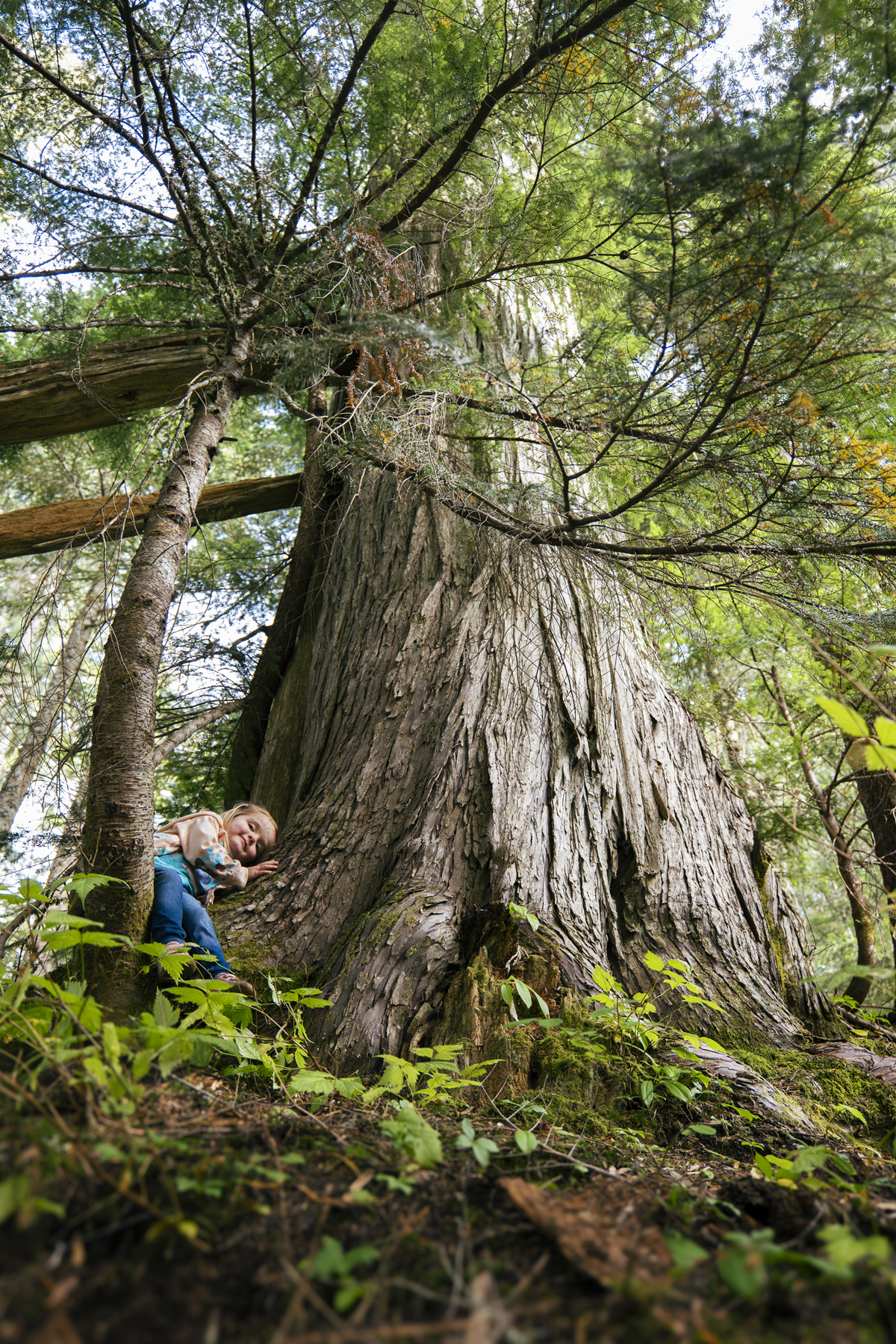
photo: Whatcom Land Trust staff
A young girl hugs an old-growth tree at Canyon Lake Community Forest.
Stimpson Family Nature Reserve
A very different process led to the creation of the Stimpson Family Nature Reserve.
When Kitty Stimpson died in 1998, she left Manning’s Camp, a 136-acre forested family heritage property, to her seven adult children who had grown up using the property as their playground. They had all followed their own life’s paths and had widely varying views as to the future of Manning’s Camp. The catch — they were committed to a unanimous decision.
The saga began when siblings Edward Stimpson, now the family patriarch, and his sister Susan Trimingham invited Whatcom Land Trust Board member Rand Jack to meet them at Manning’s Camp to talk about conservation. Trimingham was a highly regarded civic activist and the only sibling still living in Bellingham.
While Trimingham worked to bring the siblings together around the idea of what would become a public access nature reserve, Jack enrolled fellow board member Bruce Smith and Land Trust staff person Gordon Scott to help figure out how the nature reserve could come together. The family opted for conservation and wanted Whatcom Land Trust to own the property. The commitment was to a nature reserve, not a park, a place where people of all ages could immerse themselves in the luxurious natural environment of the place.
Guided by then-County Executive Pete Kremen, Whatcom County agreed to purchase from the Land Trust for $500,000 a public recreation easement and an easement to protect water quality in nearby Lake Whatcom. The County Parks Department and Whatcom Land Trust worked together to develop a public recreation plan to be managed by Whatcom County Parks. The Trust used part of the $500,000 to purchase an additional 80 acres to add to the Nature Reserve and used the rest to help pay for infrastructure there. Russ Pfeiffer-Hoyt built a masterful trail and oversaw the building of two foot bridges as part of an Eagle Scout project.
The next big step was in 2002 when Whatcom County signed an agreement with the State Department of Natural Resources to incorporate the 138-acre, environmentally rich Lake Louise Natural Resource Conservation Area (NRCA) into the Stimpson Family Nature Reserve.
At the last minute, the Trust discovered that a critical 16 acres were not included in the reserve, land that housed the parking lot and provided access to the NRCA. In fact, Western Washington University owned the 16 acres. Jack went to Vice President George Pierce at Western and asked for a gift of the property to the Land Trust. With little ado, the gift was made, and the Stimpson Family Nature Reserve totaled 404 acres.
Governors Point Partnership
That same Land Trust and Whatcom County partnership is unfolding today at Governors Point, where 98 acres of coastal forest and shoreline (nearly three-quarters of the point) were donated to the Land Trust by landowner Randy Bishop. The Trust is working with Whatcom County to open the new Bishop Family Nature Reserve, which will include a public trail with beach access.
When asked what he’d want people to take away from four decades of this conservation partnership, Jack called for “people to actively support things they believe in, and not just passively, not just read the paper and say, ‘that’s a good idea, that’s sad, that’s happy,’ but to actually get involved in trying to promote constructive ideas and constructive organizations,” he said. “Educate yourself, not only about the Land Trust, but about organizations — whether it’s supporting unhoused people, access to healthcare, or respect for our tribal neighbors — find what matters to you and act on it.”
________________________________________
Claire Johnston is the Whatcom Land Trust communications director. Claire holds a B.S. from the University of Washington in Environmental Science and is a master’s student in Urban Planning at Western Washington University. She thinks globally and acts locally to protect the people, wildlife, and land we love.