by Liam Walsh
On March 25, Whatcom County announced it had entered into an agreement to buy a property on Hannegan Road for their proposed jail. The site is part of the Lower Squalicum Creek watershed, and contains several wetlands, and a Native Growth Protection Area. The purchase agreement marks a shift from the previous site on La Bounty Drive.
Despite these environmental challenges, Whatcom County officials are confident that the new property will be cheaper and quicker to build on than the previous site.
The new jail is a part of the county’s Justice Project, which includes a behavioral health center as well as other projects. Th e new site is located at 4160 Hannegan Road.
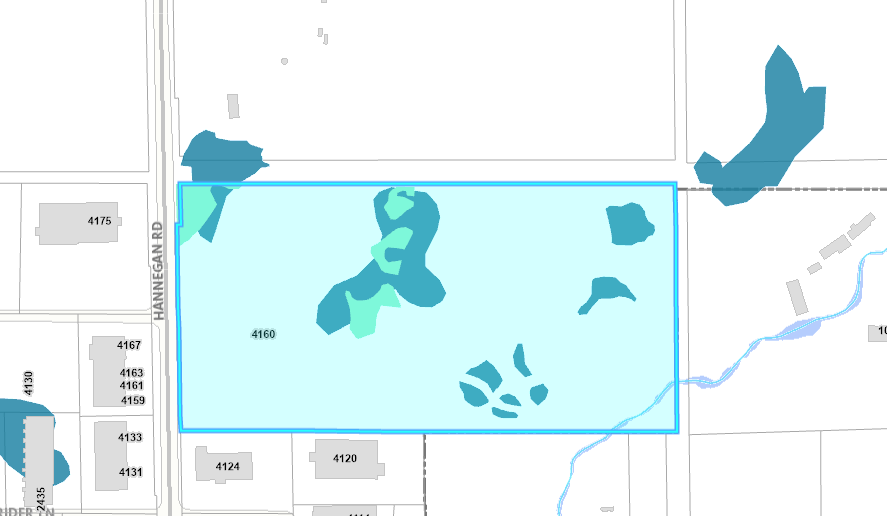
courtesy: CityIQ website
A map of the proposed jail site on Hannegan Road. The map includes wetland areas and Squalicum Creek.
New Site Less Difficult
Despite the environmental challenges for the site on Hannegan Road, Whatcom County Project and Operations Manager Robert Ney argues that the previous site would have been more difficult. The previous site for the jail was on La Bounty Road near Ferndale. Ney explained that the site came with significant wetland mitigation, and soil concerns.
“The site has become considerably wetter, more regulated, and what we were finding is that it was very problematic for us to mitigate,” he said. “It was going to cost us quite a bit of money to mitigate roughly nine acres of wetlands so that we could build upon the site.”
Ney also highlighted that the previous site would have required thousands of cubic yards of soil to be moved, as well as a deep pile foundation.
“Whereas, at the site in Hannegan, we did some preliminary soil testing, and it’s much more conducive for traditional shallow footings,” he said. “You have soils that are much more conducive for a big, heavy building, and jails are heavy.”
According to the county website, the new location will create $2,500,000 in capital construction cost savings, and have a compact construction timeline.
“Everything is leading to a much quicker construction timeline, which is going to save us money,” Ney said.
Validation Period
“We are currently in the process of what’s called the validation period,” he said. “We are working on defining exactly what the jail building will look like. We’re defining how big it’ll be, what kind of square footage it’ll have, roughly how many cells are going to be within and how big the kitchen is. So finding the elements that are included and a desired size.”
According to Ney, the validation process could end in late August or early September.
Per the City of Bellingham CityIQ website, the Hannegan site contains several wetlands. One is located on the northwest corner, two in the center, and the rest are concentrated in the eastern half of the property. Additionally the eastern portion of the site contains a Native Growth Protection Easement, which is protected land.
According to Ney, the county plans to build strictly on the western section of the property.
“Every indication with the city is that if we hold that line and we don’t try to move further east and develop further east of that conservation easement, that we actually don’t have any wetland problems.”
According to Ney, the previous owners of the property, Bellingham Christian School, mitigated the few wetlands on the western section, clearing a pathway for easier building.
“Right now there’s a binding site plan on the property that they did a few years back, which identifies basically the western build zone and an eastern no build zone, “ Ney said. “Th ey mitigated the very few wetlands that were on the western side.”
Wetland Impact
According to Ney, a boundary was negotiated with the city of Bellingham, the Army Corps of Engineers and Department of Ecology determining an area on the west of the property that is available for construction.
“If you ask us, what are we doing about wetland impact, we have zero wetland impact if our site plan all fi ts on that western side,” he said. “Th at 11 plus acres on the western side is a buildable area per the current binding site plan.”
Ney did however mention that one wetland on the northern boundary could potentially require mitigation.
“The one thing that might come into play, on the northern boundary, is Ross Road,” he said. “On the other side of the Ross Road site, we believe there’s a wetland. If there is, we would have to mitigate a buffer, and we would do that.”
While mitigation might still need to occur on the northwest corner of the property, Ney argues it would be signifi cantly limited compared to the mitigation required on the previous site.
“It only relates to road construction,” he said. “We can delay the road construction while we’re building other parts — it would impact our construction schedule much less.”
Stormwater Management
Another environmental aspect that goes into a large project like this is stormwater management. Former Bellingham Planning Director Bill Geyer explained what goes into the process.
“The storm water management side of it will be one of the most detailed and problematic reports that will have to be produced for this project,” he said. Part of the construction of the jail will require a stormwater runoff facility or a connection to the city’s stormwater capacity.
“If you have a large facility like this, a good engineer would separate how they manage stormwater runoff, because, if you mix the nonpollutant flow into the polluting flows, you have drastically increased the stormwater facility that you need to build on site to purify and clarify your discharge.”
Geyer is also concerned that the site’s stormwater could potentially flow into Squalicum Creek, which flows through the southeast corner of the property. However, Geyer has worked on similar projects in the past and is confident such a facility is possible.
“A properly built stormwater facility should not be detrimental to Squalicum Creek. Otherwise, the city and the state would not approve the stormwater facility.”
A positive aspect of the new site is its proximity to the Whatcom County Triage Center on 2026 Division Street.
“By moving to the site, it’s closer to our behavioral care campus. It’s closer to the City of Bellingham, which is the biggest user of the jail, and transportation to the jail is going to be cheaper,” Ney said. “The timeline to get this operational is going to be better. So, there are so many overwhelming things that are in the positive category.”
Geyer also agreed with the sentiment, saying “it makes sense to put it in the urban center of our county.”
_________________________________
Liam Walsh is a senior at Western studying journalism with a news/editorial focus. In his free time, he plays on the Western rugby team and enjoys hiking and swimming.