Where Do Our Local Plant Communities Get This Crucial Element?
by Theodore Hoss
Take a deep breath. Over 78 percent of the gas you just breathed in is nitrogen. Nitrogen is critical for life on earth, playing a role in the production of proteins and enzymes, and serving as a core component of the very genetic coding of all living things. In the plant world, nitrogen serves another crucial role; it is one of the most important elements in the molecule chlorophyll, which is the basis for photosynthesis.
Without nitrogen, plants could not convert sunlight into the forms of energy required by most of the life on this planet. So, to put it mildly, nitrogen is a pretty important component of our local ecosystems! This article is a quick look into where our plant communities in Whatcom County get the nitrogen they need, and how we as humans impact the natural flow of this key element.
The lack of readily available nitrogen for plant communities may seem like a bit of a paradox, but, in many cases, nitrogen is a limiting nutrient. Even though the element is abundant in the atmosphere, most life forms cannot simply extract the nitrogen from the air. We as animals have an easy way to acquire the nitrogen we need to survive; it is a part of the food we eat.
How Plants Obtain Nitrogen
Plants, however, don’t usually have such a straightforward means of obtaining their nitrogen. Instead, the nitrogen in our local forests and farmlands reaches these plants through a variety of fascinating and variable pathways! One of the most important things to understand is why nitrogen cannot be absorbed straight out of the atmosphere by the plants of the world. Nitrogen gas is actually composed of two nitrogen atoms joined together by three strong chemical bonds. Since the chemical bonds holding those atoms together are quite stable, they require a lot of energy to split apart.
It is far easier for plants to access nitrogen in a form that can be extracted with less of an investment in energy that can otherwise be used for growth, reproduction, and defense. So instead of taking nitrogen from the air, plants generally acquire their nitrogen from the soil, usually in a solid form like ammonium or nitrate.
This soil nitrogen is constantly leaving the soil by a variety of pathways. Growing plants capture the nitrogen for themselves and lock it away in their tissues, out of reach for other flora. Precipitation and runoff dissolve soil nitrogen and carry it into streams and waterways. Microbial processes and high soil temperatures can release nitrogen back into the atmosphere. This means that soil nitrogen is in continual need of replenishment, a process known as nitrogen fixation.
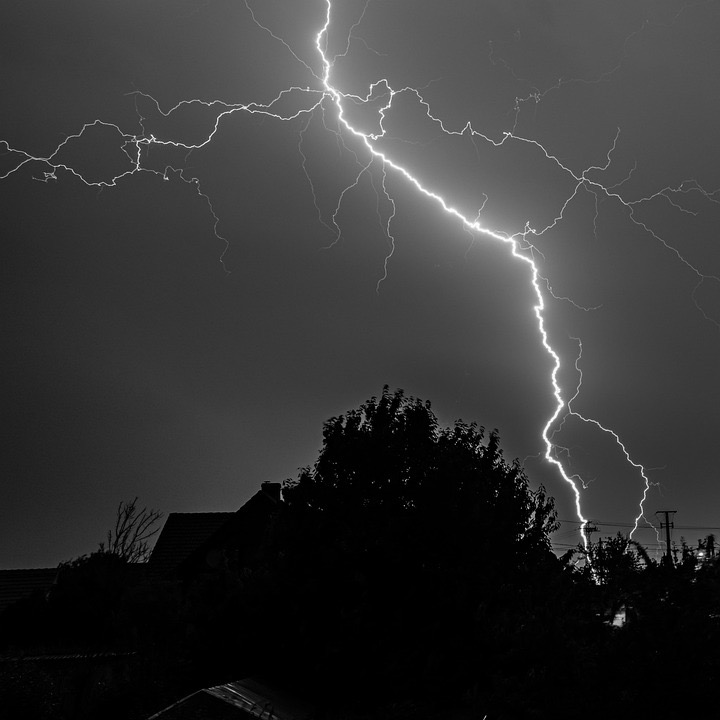
Stock photo
Although lightning is quite effective at creating forms of nitrogen that are useful to plants, it is somewhat rare and unpredictable in Whatcom County.
Nitrogen Fixation: Lightning
Perhaps the oldest method of nitrogen fixation is lightning. Recall that the bonds holding atmospheric nitrogen together take a lot of energ y to split. Lightning is up to the task, heating the air to temperatures as much as 50,000 degrees Fahrenheit, hotter than the surface of the sun and plenty enough to break the bonds of atmospheric nitrogen and convert it into a form that falls to earth.
Although lightning is quite effective at creating forms of nitrogen that are useful to plants, it is somewhat rare and unpredictable, especially in the Pacific Northwest with our somewhat infrequent thunderstorms.
Consequently, most of our local nitrogen fixation actually occurs through one of several organic pathways. Plants and animals may not be able to access atmospheric nitrogen, but some other life forms have become quite adept at it. In Washington, one of the most important sources of soil nitrogen is type of bacteria called Frankia; these organisms are able to take nitrogen from the atmosphere and break it apart into ammonia, a form far more accessible to the plants. This is very helpful, but it presents a bit of a problem for the Frankia bacteria. Nitrogen fixation takes large amount of energy, and can only be accomplished in specific soil environments.
Frankia and Red Alder
Frankia have found a solution to these conundrums by linking up with red alder (Alnus rubra), one of our local tree species, in what is referred to as a mutualistic symbiosis. Mutualistic symbiosis describes a relationship between two species where both organisms benefit from the interaction. In the case of Frankia and red alder, the bacteria receive energy and protection while living inside the roots of the tree, and the tree receives a continuous supply of the limiting nutrient nitrogen.
Due to this special relationship, red alders can grow in harsh soil environments where nitrogen supplies are not adequate for other types of plants. Thanks to Frankia, red alder can also afford to be less scrupulous with its supply of nitrogen. While most deciduous trees break down their chlorophyll for winter storage to avoid wasting their nitrogen supply, red alder has an abundance of this critical element, and releases its fall leaves with abandon.
We can see this wealth of nitrogen ourselves; next fall, see if you can find an alder and notice that, as the other trees turn red and yellow while breaking down their chlorophyll, the red alder’s leaves remain resolutely green even as they drop to the ground. As these nitrogen-rich leaves break down into the soil, they help replenish nitrogen supplies! Thus, red alders, and their Frankia allies, are a critically important part of our northwest forests.
Treetop Lichen: Lungwort
The Frankia and red alder relationship isn’t the only symbiosis serving as a critical part of our local nitrogen cycle. In many of Washington’s western forests, alders have a hard time growing as their coniferous neighbors overtop them and cast the lower trees into deep shade. In these older forests, one of the major pathways to nitrogen replenishment is accomplished by a type of treetop lichen known charmingly as lungwort (Lobaria pulmonaria).
All lichens are the product of a symbiotic mutualism between a fungi and an algae, with the fungi providing structure and protection and the algae photosynthesizing to capture energy that is then shared with the fungal host. Lungwort, however, is extra special because it is a type of cyanolichen, meaning that the fungi and algae have taken on a third roommate, a cyanobacteria. This cyanobacteria acts much in the same way as Frankia does with the alder, absorbing nitrogen from the atmosphere in exchange for a bit of energy from its hosts. As with the alder, this benefit is not restricted to L. pulmonaria alone. When lungwort is ripped from the canopy where it grows by a windstorm or a branch falling, it follows gravity down to the forest floor where, in the act of being decomposed, it releases its nitrogen into the soil.
Natural Nitrogen Replenishment: Salmon
The final major form of natural nitrogen replenishment in our Pacific Northwest forests is perhaps one of the most fantastic. As water flows through the soil and into the streams and rivers of our region, it carries away a large amount of nitrogen. However, this flow of nitrogen towards the ocean is not unidirectional! Each year, the rivers and streams of our region host the return of salmon. Salmon spend most of their adult lives at sea, accumulating nutrients through the food they eat. When they return upstream to spawn, they bring those nutrients with them, including a substantial amount of nitrogen.
Since most salmon die after spawning, that nitrogen is generally released far inland, and, since so many other animals love to eat salmon, many of these nitrogen transporting fish end up carried off deep into the forest to release their nutrients. Studies of vegetation in Washington have indicated that 22-80 percent of all nitrogen in streamside forests plant species was carried there by spawning salmon. Thanks to the work of bears, eagles, and other salmon predators, thousands of these salmon end up over a kilometer into the forest, depositing nutrients well beyond the streams they inhabit in life. This incredible animal-mediated fertilization can be observed in tree growth rings, with higher spawning years correlating with greatly increased rates of forest growth near salmon streams.
Human Beings
In the last century, the local nitrogen cycle has been greatly modified by a new nitrogen fixation pathway, human beings. Our species has had a massive impact on all parts of nitrogen cycling. Some of our actions lead to a decrease in the amount of natural nitrogen in the system. Clearcut logging practices expose topsoil to erosion and cause increased runoff, carrying nutrients like nitrogen into local waterways and out of the soils.
Air pollution kills lungwort, explaining its rarity in urban environments. Pollution, historic overfishing, and development have significantly reduced the number of salmon returning to our rivers to spawn, thus limiting upstream flow of nitrogen. Our fertilizing practices and nitrous oxide emission from fossil fuels can create the opposite problem; an excess of nitrogen that reduces the viability and value of natural nitrogen fixers such as Frankia.
As we contemplate the ways in which nitrogen moves around the ecosystems we inhabit, reflecting on our own place in that system can help us consider sustainability in a more informed light. The next time you find yourself out and about, keep your eyes open for a red alder tree, or a patch of lungwort on the trail, or perhaps a salmon swimming upstream, and remember how each of these processes contribute to the lifegiving nitrogen around us, and the role we play in mediating that cycle.
__________________________
Theodore Hoss is an environmental educator at the Raven’s Roots Naturalist School. An alum of the University of Washington and Oregon State University, he has a background in environmental science, biology, and natural resource management. In his free time, he loves hiking, kayaking, printmaking, and finding new plant friends!