Time for Reform?
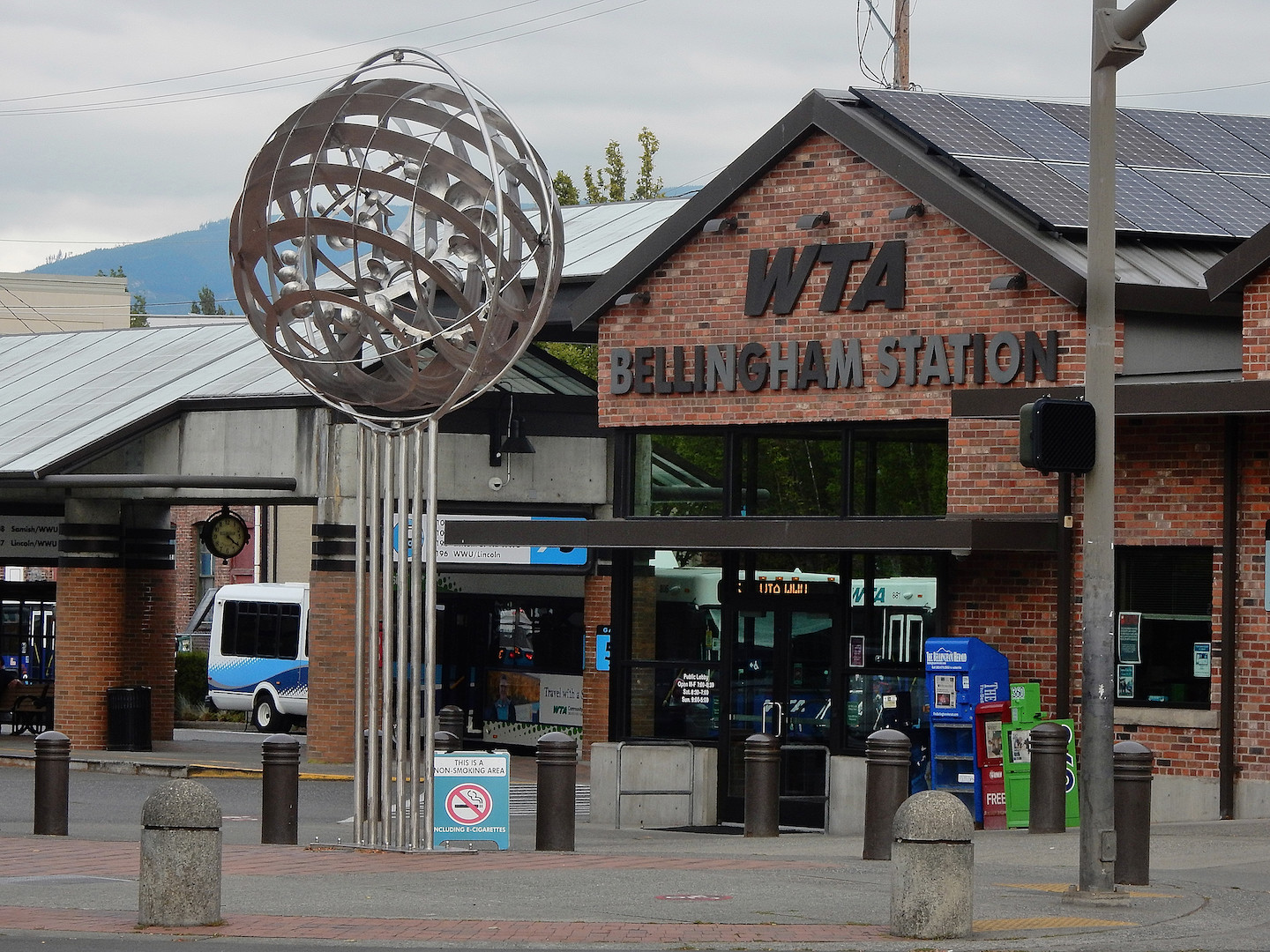
photo: Joe Meche
Whatcom Transit Authority bus depot on Railroad Avenue.
by Preston L. Schiller
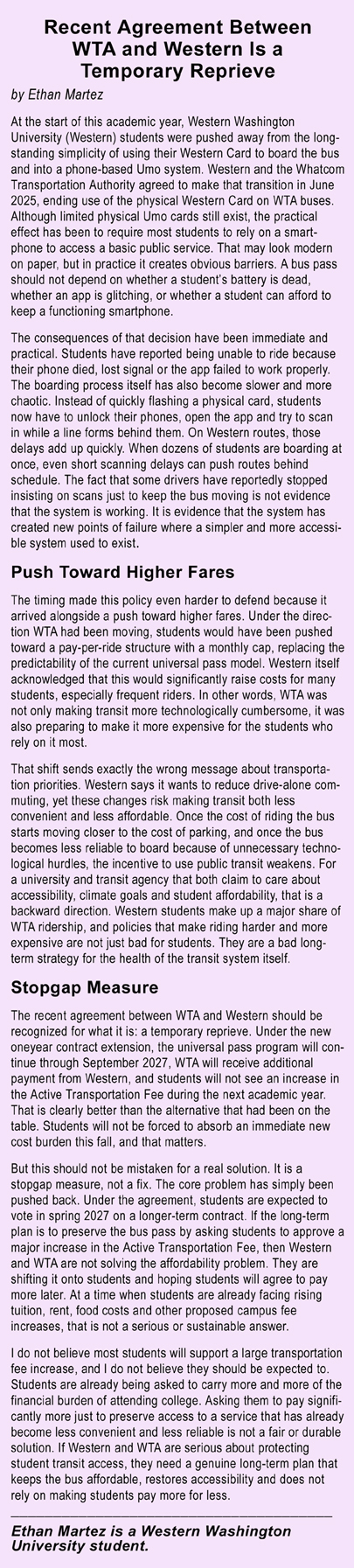
On December 4, 2025, the Whatcom Transportation Authority’s (WTA) Board of Directors held an open house for public comment about its proposed steep fare hikes. Over 225 citizens attended, the vast majority of whom were Western Washington University (WWU) students, with several advocates for senior and disabilities groups also in attendance. Such a high attendance, especially at 8 a.m., is highly unusual, possibly unique.
Yet the WTA board still limited the hearing to only one hour rather than extending it to be as inclusive as possible. There was only sufficient time to hear a small number of attendees — the board then high-handedly invited citizens to leave their remaining comments until the end of the next day.
A week later, the board voted 6 to 2 in favor of the rate hike, with only Bellingham Mayor Kim Lund and Whatcom County Councilperson Todd Donovan opposed. Whatcom County Executive Satpal Sidhu was absent. Last December, Satpal Sidhu resigned from the board. Under the new plan, fixed route (bus) fares would double from $1 to $2 per ride, with a daily fare cap of $6 and monthly cap of $60 — but fare caps will only apply to those who use an electronic pass.
Somewhat reduced rates, daily and monthly, would be in effect for low-income, elderly and disabled persons — many of whom now ride for free. Youth under 18 will continue to ride for free. This article will explore what is wrong with WTA’s fare hike, offer possible alternatives that should have been considered, or were mentioned, but peremptorily rejected by its board.
Such hikes may undermine some laudable initiatives that WTA wants to introduce, such as a few Bus Rapid Transit routes and several service improvements. It will examine some of the problematic aspects of the ways in which WTA is organized and governed — as mandated by what can be perceived as flawed and unhelpful state legislation. It will offer some strategy and reform suggestions.
It will also explore whether Bellingham and its citizens and transit riders are subsidizing expensive, and often lightly used, transit services outside its city limits. It should be noted that WTA and WWU have, as this article goes to press, extended their student bus pass program for another year with WWU paying WTA an additional $100,000. (https://engage. ridewta.com/wta-wwu-contract) Please see the article below by Ethan Martez for more details.
Fare Hike Flaws
What’s wrong with this fare hike? A few of the most outstanding issues around WTA’s doubling of fares have to do with how it violates conventional wisdom in transit planning as well as going against the grain of what it’s proper mission should be:
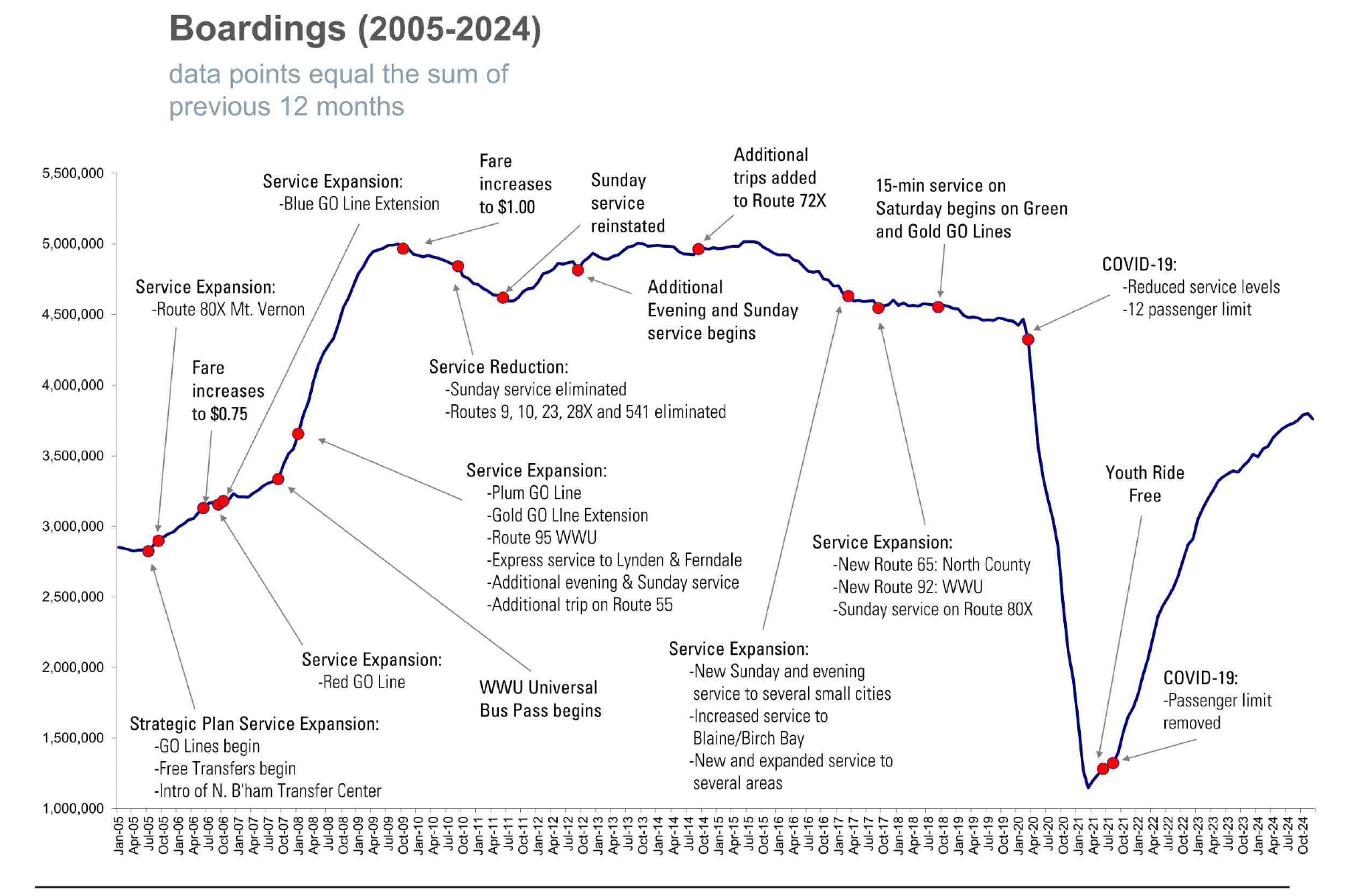
- Raise fares, lose riders: Isn’t it the mission of transit agencies to grow ridership? It is a truism of transit planning that fare hikes trigger losses in ridership. Elasticities in transit fares are such that even a relatively small fare increase can trigger a corresponding percentage drop in ridership. WTA’s data compiled over several decades (1) demonstrates that even a relatively small (25¢) fare increase in 2008 followed by the 2010 cessation of issuing transfers — itself a major fare hike in that it charged an extra $1 for each boarding followed by the cessation of Sunday services shortly thereafter — led to a significant ridership loss. (2)
- Bellingham citizens rescue WTA from itself. This negative-trend ridership due to fare hiking and slashing of Sunday service was interrupted by the 2010 Bellingham’s citizens’ initiative that created a tax-funded, citywide Transportation Benefit District (TBD, now known as the Transportation Fund or T-Fund), that, at its inception, divided a significant sum of money equally between helping WTA restore Sunday service and funding cycling and pedestrian improvements.
The 2010 initiative passed by a large margin, almost 60 percent, and was renewed for another 10 years in 2020 by an even larger margin, 80 percent. Well-targeted and well-crafted initiatives can be very successful in Bellingham while almost every and any countywide tax initiative is generally doomed outside of Bellingham — no matter how important or reasonable it may be. WTA began receiving TBD funds in 2011 that enabled it to restore the Sunday bus service it had cut in 2010. By 2016, WTA’s financial situation had improved such that it no longer needed the TBD funding. (3)
The Perils of Pulsing
Too many transfers and too many routes spoil the ridership broth.
- WTA started as a pulsing system or “beehive” decades ago — and has mostly stuck with it although its ever-expanding number of routes (35 now) have forced it to do some creative schedule tweaking and juggling for its limited bus bay space at its downtown Bellingham Station (BS).
[Bus service “pulsing” refers to a scheduling system where multiple routes arrive at a central hub simultaneously, allow passengers to transfer, and then depart together, facilitating easy connections. This “pulsing” method minimizes transfer times and works best for infrequent service (every 30-60 minutes) to maximize connectivity, often used in suburban areas.]
As a result of both the pulsing system and the desire to provide as much service coverage as possible across the county, the WTA route map seems to resemble a bowl of spaghetti poured upside down on a city and county map with a knot in its middle for the downtown Bellingham Station. Routes are sometimes direct, but mostly meandering around low density areas in search of occasional riders.
Pulsing routes, the majority of WTA’s services, can only go so many minutes out from the downtown transit center before they have to turn around and scurry back to pulse with numerous other routes. WTA was sold on the coverage notion by consultants decades ago and has been discussed in previous analyses. (4) Pulsing works against the goals of frequent service.
There are many service anomalies created by the pulse system. For example, the highly used frequent routes serving WWU and (WCC) do not connect to Fairhaven Station — a major destination that hosts several inter-city bus and Amtrak services and is relatively close to the Alaska Ferry terminal.
Instead, it is only directly regularly served by the WTA Route 1 (Fairhaven) service which has a frequency of only one bus every 30 minutes. As a result, persons using bus, rail and ferry services need to either make a cumbersome and time-consuming transfer from their more convenient WTA route to the WTA Route 1 or walk several blocks to and from a bus stop on 12th Street (often with heavy luggage). Or, get a ride to the station, thus adding more traffic and vehicular pollution to city streets.
Need Rider-Oriented System
- During the years that I was a probono advisor to Kingston Transit (Ontario, Canada) and helped it to double its ridership within 10 years of major changes (5), I was able to persuade it to try a bus that directly connected the campus of Queen’s University with the train and inter-city coach stations with buses that were timed to meet trains and many coaches. Queen’s U. has a large student and faculty population that frequently travels by train or inter-city bus. To do so, Kingston Transit would have to design a service that did not pulse with the many routes that met up in its downtown, but, instead, try to pulse with arriving and departing trains and inter-city coaches. It took the chance and continues as a success.
- As a result of its complicated map and pulsing and scheduling practices favoring fleet optimization, WTA can be seen as a bus- or operations-oriented system rather than a rider-oriented system. A rider-oriented system would have simpler maps, possibly one that met the cognitive expectations of ordinary users and scheduling that aligns with user expectations. Schedules should conform to “clockface” and come at set frequencies that are easy for the rider to remember, as many WTA routes do for part of the day. But, because of fleet scheduling practices, including “interlining” (6) schedules and frequencies for many routes may vary according to time of day — a source of confusion for riders.
- WTA’s system orientation can be seen as efficient in terms of the maximization of its fleet scheduling and deployment, but it may not be so convenient and efficient for riders. As a transfer-based system, it forces many or most riders to transfer, thus incurring the added penalties of inconvenience for many and extra fares for all transferees. As a result of its plethora of routes and schedule complexities, it is not as transparent and intuitive as the average rider might wish. Fortunately for riders, WTA offers an 111-page comprehensive Transit Guide (7) replete with maps, schedules, and important information about using the system.
Annual Bus Ridership 2005-2024
Understanding Transit Fares
- Free fares vs. fare collection costs:
These days, many transit systems are lowering or eliminating fares rather than raising them. WTA has already eliminated fares for youth under 18 years of age which led to increased bus riding for this demographic. Fare lowering or elimination is being done for several reasons: - To attract more riders — although some experts and advocates claim that better services, including greater frequency and expanded hours of weekday and weekend service would be even more attractive than free fares;
- To eliminate the farebox because;
- It allows much quicker boarding; both doors can be opened or, as during Covid, when fare collections were suspended, only opening the rear door so as to protect the driver;
The farebox is a major source of conflict between riders and drivers, as it can occasion haggling over fares, discount eligibilities, or whether riders can be barefoot!
- Free fares and easy-to-use passes:
It costs money to collect money. - Many decades ago, the author learned from Jim Lair, then manager of Skagit Transit (SKAT) that, when Jim had been at King County’s Metro Transit in a financial management capacity, he discovered that a good deal of cash was disappearing between the farebox and the bank, thus shrinking further the relatively small contribution that fare collection was making towards operating expenses. This led to him pushing for free fares when he came to Skagit Transit. SKAT unwisely abandoned this practice many years after Jim Lair left and it has lost considerable ridership as a result.
- Fareboxes are complicated, expensive machines and costly to maintain (8);
- While there may be some issues with free fares, and some transit agencies have gone back to charging fares, this option should not be dismissed out of hand. WTA does not charge riders under 18 years of age and this does not seem to be causing problems.
- The “psychology” of transit fares and “choice” riders, and out-of-pocket versus “sunk” costs
Several persons supportive of the WTA fare hikes question why there is an objection to what they perceive as modest increases among riders, including students. Whatcom County Executive Satpal Sidhu, in conversation with me, declared that college students should be objecting instead to the extremely high and ever increasing tuition fees they must pay or add to their already burdensome debt. Fair enough (or fare enough?), Satpal, but such arguments ignore the psychology of out-of-pocket versus “sunk costs.” Both motorists and transit riders assess the “cost” of a trip by their different modes in terms of their out-of-pocket or “marginal” costs, not in terms of the totality of their costs as students or motorists.
Sunk costs for motorists refer to the amounts invested in the purchase and amortization — depreciation, insuring and maintaining a motor vehicle. These alone can amount to several thousands of dollars per year, incrementally dozens or even hundreds of dollars for some motor vehicle trips. Yet, this is ignored by motorists when they evaluate a potential trip only in terms of how much gas and parking, if paid, might cost. Similarly, students can understandably chafe at a potential doubling of their out-of-pocket cost for a transit trip. Students who find it “necessary” to own a motor vehicle may be even more short-sighted about true costs of transportation. Ignored as well are the environmental costs of all the “cradle-to-grave” pollution associated with motor vehicles.
- Understanding transit riders:
“choice” versus “transit dependent”
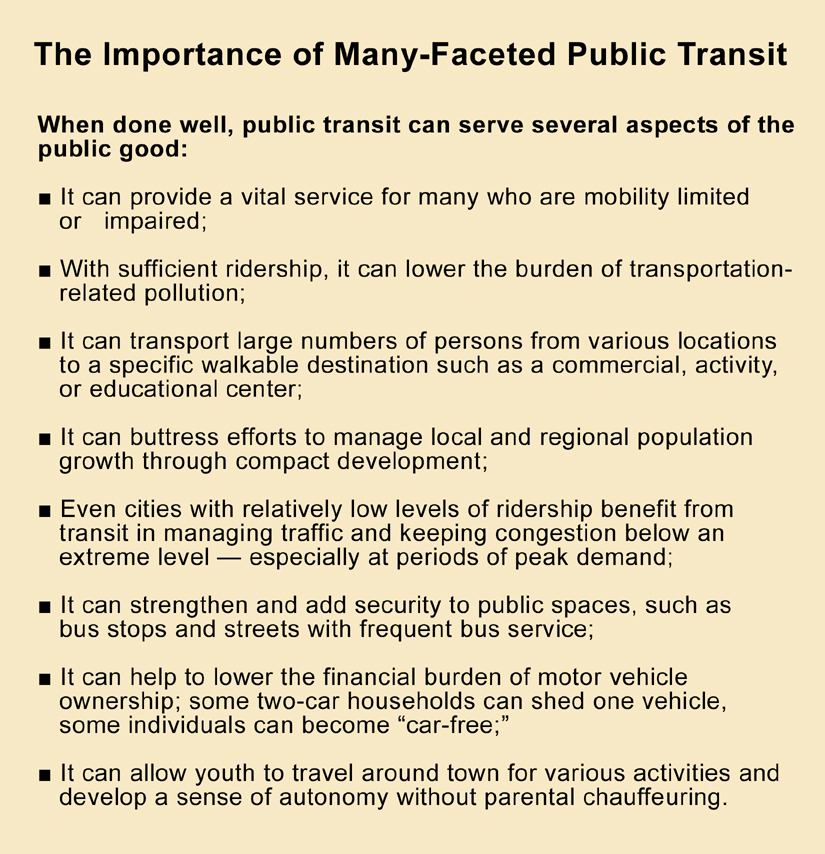
Persons who cannot own and drive personal motor vehicles (PMVs) and do not have a close friend or relative who can transport them to important destinations often depend on transit for basic mobility needs. These riders are often termed “transit dependent” by agencies. In decades past, WTA appeared to view its primary mission as serving them. The problem with this orientation is that it narrows the market for transit from what it should and could be.
For transit services to attain robust patronage, they must serve both transit dependent and “choice” riders — those who have a motor vehicle at their disposal and can afford the expense of the average vehicle trip. Such riders are also key to valuable political and financial (direct or indirect) support. While Bellingham’s traffic congestion is not serious enough to push choice riders onto transit, other minor inconveniences such as greater out-of-pocket expense, needing to have an additional fare card or pass, or other ways of complicating access, such as moving bus stops farther apart on non-frequent routes may push some choice riders back into their personal vehicles.
Understanding WTA’s Governance
And, the burden of Washington’s transit governance legislation:
- No doubt state legislators were well-meaning a few decades ago when they passed the first iteration of the Public Transportation Benefit Areas (PTBAs) act. (9) And, no doubt Bellingham’s best and brightest minds at City Hall were similarly well-intended when they folded their municipal bus system, established through a citywide initiative and funded by a relatively small increment added to city water bills — possibly a better way of funding transit but not available countywide — into the newly forming PBTA.
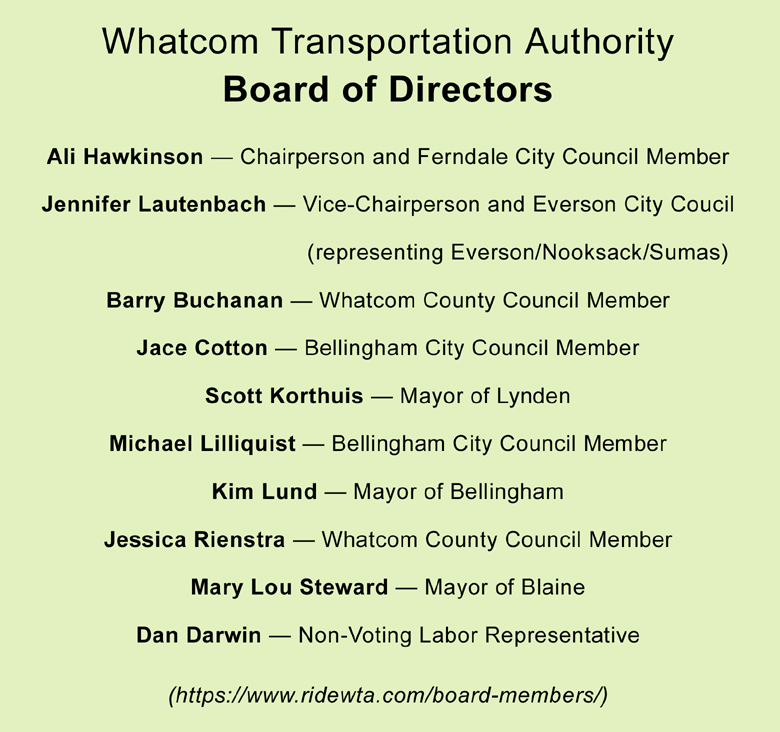
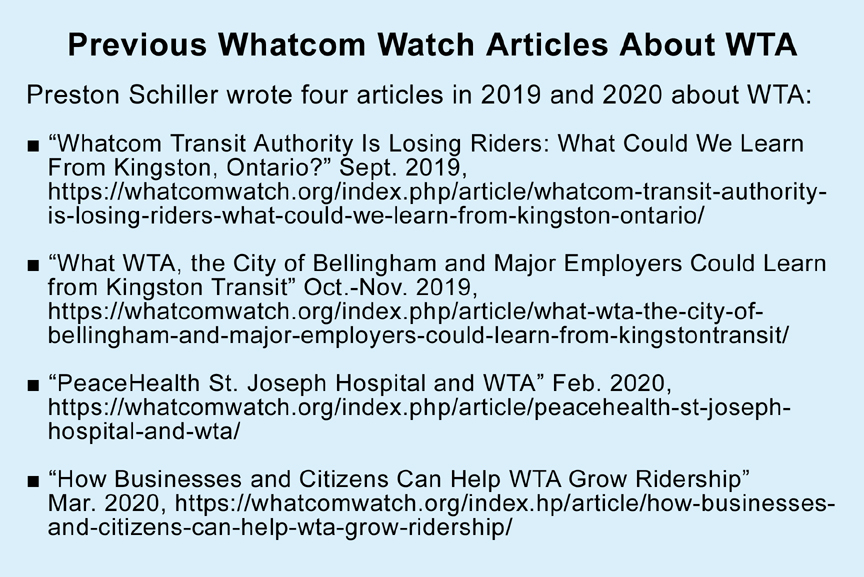
- Readers who wish to understand the serious issues associated with WTA governance, especially its non-representativeness and nonresponsiveness to the almost completely Bellingham funding and uses of it, are referred to my article in the Whatcom Watch Oct.-Nov. 2019 issue (blue box below). It may also be that recent legislative efforts that elevated the previously nonvoting transit union member as well as adding two citizen representatives to board voting status will further increase the non-representative nature of how the board is formed. (10)
WTA’s Current Situation
- Finances: While it is accurate to characterize WTA’s financial situation as facing constriction, it does not appear to be in an emergency. The losses in sales tax revenue due to the diminishing of cross-border visiting caused by the current U.S. administration’s insulting and injurious treatments of Canada are real, but they appear to have stabilized. Past experience also indicates that such revenues can fluctuate widely, even increasing in ways unrelated to Canadian visiting. The farebox contributes only approximately $1.6 million (or 5 percent) of the $31 million fixed routes’ annual total costs. It is conceivable that local and regional population growth may substantially increase sales tax revenues in coming years and eliminate any short-term deficits.
WTA reserves are currently as robust or more robust than in many recent years. While their forecast is for declining funding and reserves over the next few years, some (or much) of that decline might be mitigated by politics at the federal level. Rep. Larsen has been quite successful in obtaining funding (earmarkings or set-asides) for new buses for WTA for several years. That is likely to continue or expand as it is probable that Democrats will be in a majority in the House (possibly the Senate) after the 2026 mid-term elections and he likely will be the chair of the House Transportation and Infrastructure Committee.
Should the Democrats win the presidency in 2028, there will probably be much better funding for public transportation — which is suffering or vanishing under MAGA transportation budgeting.
- Trends: Ridership, while still not quite back to pre-Covid levels, is growing at a good pace (7 percent, 2024 vs. 2023), and, if uninterrupted by a down-turn triggered by an ill-advised fare hike, should continue its robust recovery. Again, why raise fares steeply at this time?
- Importance of cash and “unbanked” riders: At present almost one-third (29 percent) of WTA’s fare collections are in cash. This demonstrates the crucial importance of those who may be “choice riders” or “unbanked” (those who do not carry credit cards or are unable to buy passes in advance). These riders will be considerably influenced by fare hikes and will not be able to take advantage of proposed fare-capping, which can only be achieved electronically.
- As expensive (or more?) fares than Sound Transit (ST)? ST has a single ride fare of $3 ($1 for reduced fares) for a system of 63 miles of light rail and hundred of miles of express buses connecting major regional hubs throughout 53 cities in King, Pierce and Snohomish counties. At these rates, ST is still recouping a higher percentage of its costs, double or more, than is WTA.
Bellingham Subsidizes WTA for the Rest of Whatcom County
- Several decades ago, the City of Bellingham abandoned its own bus system in favor of joining the newly forming countywide WTA. Former Mayor Mark Asmundson, then a Bellingham City Councilmember, once confided in me that he spoke to some of the drivers about how that might be a mistake. Whether it was a mistake for the drivers is an interesting question, but one could easily argue that it has been a mistake for Bellingham.
- While WTA does not seem to present its revenue and ridership data in as detailed a manner as might be desired for certain analyses, it is generally accepted that between 80 and 90 percent of its sales tax revenue and ridership are generated within Bellingham.
- Supposed $9 per ride subsidy: There are virtually no transit systems in North America that can support themselves solely from their fare collections. Like almost all other public services, transit needs a fair amount of taxpayer support to continue to serve the public. WTA staff and board claim that there is a $9 per ride subsidy for fixed route passengers. This claim merits much closer scrutiny.
- Not all rides and routes are equal: A review of recent WTA performance and budget reports indicates that county routes (those outside of Bellingham) make up 10 percent of ridership at most, but 20 percent of the revenue hours (the time the bus is in service) per route — in other words, they eat up at least twice as much or more of the clock than do the Bellingham routes. (11) Routes outside Bellingham are carrying far fewer passengers per revenue hour and transporting them for much longer distances than routes within the city — therefore requiring far more subsidy than those within Bellingham. At least double the subsidy, perhaps triple.
- Some routes are “stars” and some are “dogs” — Examining WTA’s “Boardings Per Revenue Hour by Route” data (12), one is struck by the large range of variance in their performance. Any route serving or connecting WWU and WCC with downtown, each other, or a significant destination such as downtown are clearly “stars” in terms of their total annual ridership as well as their boardings per hour. With all due respect to my canine friends, I will refrain from identifying any particular “dog” but leave it the reader to peruse the WTA data.
Paratransit
- The costliness of paratransit: WTA’s fixed route buses are its “workhorses,” comprising approximately 95 percent of its boardings, but consuming only 70 percent of revenue hours and 84 percent of passenger miles (13), indicating that they are very efficient. Paratransit, the services which help mobility- challenged persons travel around town are accepted as costly and time consuming but necessary for transit. WTA provides paratransit as: “required by the Americans with Disabilities Act of 1990 (ADA), WTA provides paratransit service within 0.75 miles of required fixed routes. Paratransit provides curb-to-curb minibus service for people whose disability prevents them from riding fixed route buses.” Riders must demonstrate that they qualify and be approved to ride. But, does paratransit need to be as expensive and inefficient as it is at WTA? Can WTA do better than 3 passengers per hour compared to 24 on average for its fixed routes? Or an average number of passenger miles per trip of 5.7 compared to 2.9 for fixed routes (which includes stars and dogs)? Or 17 passenger miles per hour compared to 70.5 for fixed routes? (14) Demand for paratransit service is growing substantially; possible ways of managing its cost better will be taken up in the “suggestions” section below.
A few modest proposals for solutions that should be explored. More/better funding is needed; no doubt WTA faces some financial difficulties, but it needs to look into alternative funding sources and making itself more efficient, even if difficult. Raising fares may seem easier in the short term but is unwise, as previously discussed, in the long term, as it will likely lead to ridership losses. It also postpones investigating a variety of funding possibilities, albeit some may be politically challenging — especially given the anti-tax bias of many living outside of Bellingham, but these could add more balance to WTA’s financing in the long term. Here are a few options that could or should be explored, and there are probably more:
Real Estate Taxes and Zonal Fares?
- How about adding a small increment to the Real Estate Excise Taxes (REET) that are currently applied at a very low level to property sales? At present, the average price of a property sale has skyrocketed to a level beyond the reach of most moderate- and low-income residents. A well-designed proposal that taxed some of the massive profits from property sales applied both to more affordable housing as well as improved transit to serve that housing might prove to be very popular with voters.
- Tap into property taxes at a very small level? Good transit service generally increases property values despite some prejudiced anti-transit views. A very small tax on the huge value of Whatcom County property values, graduated so as to not burden low- and middle-income residents, could generate a robust and stable amount for WTA.
- Introduce “Zonal Fares” (or distance-based fares): these divide a service area into zones with higher fares for areas that are further from the urban center where most transit is least costly to provide. This is a well established practice in transit globally.
- Re-form WTA’s board: the board should not be over-represented by small city/rural interests, however well-meaning they may be, and the Whatcom County Councilmembers on it need to be reminded that they represent Bellingham as well as outlying areas. The City of Bellingham members should have one more member added and they could band together with Whatcom County Councilmembers, especially those on it whose districts largely represent Bellingham residents to better represent the strong role that Bellingham plays in generating the vast majority of income and ridership for WTA. As noted elsewhere in this article, the PTBA framework is inherently unrepresentative and in violation of “one person, one vote,” but even some simple reforms could help make it more representative and responsive to the citizenry it serves.
- If the current political configuration of WTA — its domination by and catering to small town and rural interests — cannot be overcome, then Bellingham should explore the possibility of breaking away from the WTA PBTA and having its own transit system again. This would free it of the drag that much of Whatcom County outside of Bellingham has on progressive funding initiatives that might otherwise pass if only put to a vote in Bellingham — often by large margins as the experience of the Transportation Benefit District votes that rescued WTA’s Sunday service has shown.
- Promote a more efficient system that would attract more riders: Reduce the number of routes by yoking some together into longer routes, eliminating some unproductive and meandering segments that exist mainly to serve the pulse system. Yoking some routes together is already done to a certain extent with WTA’s process of “inter-lining” some routes, so that when a route comes to the downtown transfer center under one number and one time budget, it then leaves as a different route with a different time budget. This is done in service of pulse system efficiency, but it may not be that efficient for passenger service. Yoking routes together, eliminating meandering and unproductive segments and linking more major destinations together could make the system more transparent and user-friendly and help grow ridership.
Suggestions for WTA’s Future
- It is admirable that WTA is attempting to attract riders by offering services in such rider-unpromising-corridors such as Roeder Ave. or low density sprawl neighborhoods on Bellingham’s periphery, but these need careful evaluation and possible reconfiguration or abandonment if they don’t gain ridership after a short period of experimentation.
- There is a great need to reform WTA’s extremely costly paratransit: Its eligibility criteria need to be carefully scrutinized — perhaps by a committee of outside experts. Its loadings need to be greatly increased, perhaps through the sharing of some services between those who are seriously mobility challenged and others who just need an easier way to access transit. The use of ride-hailing services for some persons who are not severely mobility challenged should be explored. Mandating that taxi and ride-hailing services offer the possibility of some wheelchair-accessible vehicles in their fleet could be explored by local government as is being done in some North American jurisdictions. Paratransit vehicles’ long trips could be shortened by transporting mobility-challenged riders to the nearest transit hub where they could access frequent fully equipped buses.
- PeaceHealth/St. Joseph, our absentee-owned community hospital and medical center, should step up to subsidize better transit and paratransit services. (15) PeaceHealth could also help fund housing close to its facilities for persons who need to access these frequently, thus reducing some of the financial burden of paratransit for areas outside Bellingham. This might be a better use of some of its land than its ever expanding oceans of asphalt welcoming all with “free” parking.
It is unfortunate that WTA’s board did not discuss further some ways of addressing financial problems other than a drastic and poorly considered fare hike. Perhaps it can challenge its staff to compile more possible solutions and do better in the future with some better information and deeper deliberation.
____________________________________
Preston L. Schiller, Ph.D., has been a frequent contributor to Whatcom Watch since 1997. In 2011-2012, he wrote a series of articles alerting the public to the dangers of coal trains and the coal terminal proposed for Cherry Point, north of Bellingham, and in 2019-2020, he wrote a series of articles about WTA. He has taught courses in transportation planning at Western Washington University, Queen’s University (Kingston, Ontario, Canada) and the University of Washington, Seattle. He is the principal author of “An Introduction to Sustainable Transportation: Policy, Planning and Implementation,” 2nd Ed., 2018, Routledge, Taylor & Francis.
Endnotes:
- See chart for WTA boardings 2005-2024 at ridewta.com
- note: conveniently ignored as an additional fare hike in WTA’s public utterances
- City of Bellingham: 2023 Transportation Report on Annual Mobility, Chapter 6, and; truth-in-advertising: the author was closely involved with the crafting of and campaigns for both initiatives.
- See blue box for previous articles about WTA
- See Schiller, Plan Canada and transit sections of Schiller, et al (2018)
- Having a segment of a route with one number that changes at the downtown transit center.
- Available at the Bellingham Station office and online at https://www.ridewta.com/transitguide/
- U.S. Federal Transit Agency (FTA) guidance on fare collection
- Chapter 36.57a RCW
- cf, Charles Prestrud’s critique from a conservative perspective
- WTA 2024 Performance Report; Boardings by Route pp.10,11, ridewta.com
- WTA’s “Boardings per Revenue Hour by Route” 2024 Performance Report
- ibid.
- WTA budget and performance reports 2024
- See blue box for link to “PeaceHealth St. Joseph Hospital and WTA” article
References:
- City of Bellingham; 2023 Transportation Report on Annual Mobility, Chapter 6; https://cob.org/wp-content/uploads/TRAM-Chapter-6.pdf?pdftype=e
- Preston L. Schiller; “How Kingston doubled its transit ridership within 10 years,” Plan Canada – Volume 59, Number 2 (Fall 2019); https://www.viurrspace.ca/items/23379c6f-0c2e-4452-9808-6a7971d167d2
- Chapter 36.57a RCW ; Public Transportation Benefi t Area (PTBA); https://app.leg.wa.gov/rcw/default.aspx?cite=36.57A)
- Charles Prestrud’s https://www.washingtonpolicy.org/publications/detail/transit-agencies-needaccountability-not-increased-state-subsidy)
- WTA budget and performance reports available for many years at ridewta.com
- Preston L. Schiller (principal author with Jeffrey R. Kenworthy) “An Introduction to Sustainable Transportation: Policy, Planning and Implementation, 2nd Ed.,” 2018, Routledge, Taylor & Francis