by Dean Longwell
Forgotten City of Bellingham obligations and a misinformed Bellingham Hearing Examiner have assumed a shellfish bed in North Chuckanut Bay (Mud Bay) is not protected by the tribes and/or city park regulations.
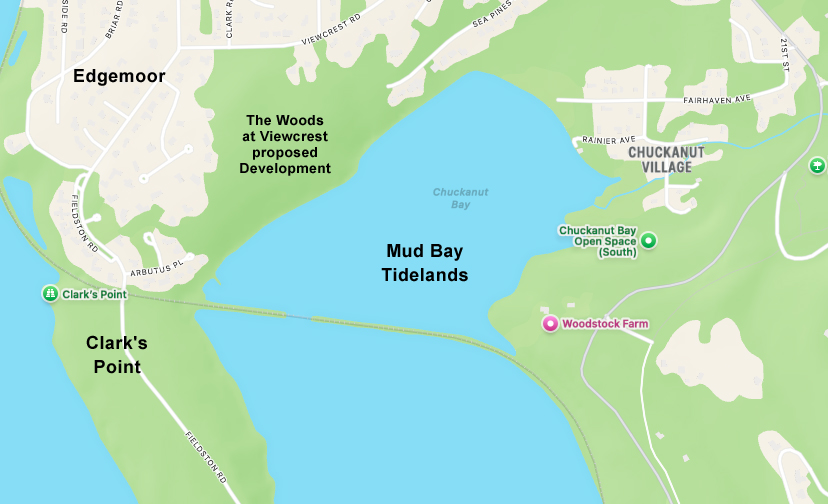
credit:Apple map
Since the inception of the 1855 Treaty of Point No Point, the Indian Tribes of Washington State have experienced a long, slow decline of resources guaranteed by treaty. A portion of the loss is attributed to a loss of fishery habitats and/or a loss of access to fishery habitats of ecological and cultural importance to the tribes. A once bountiful fishery has changed.
Olympia Oyster Restoration Project
In signing a Washington State Joint Aquatic Resources Permit Application (JARPA) in 2018, the City of Bellingham joined a collaborative partnership between the federal government, the state and the tribes for the purpose of restoring a delicate and sensitive fisheries ecosystem in North Chuckanut Bay.
A JARPA approval requires an extensive governmental review, which included a required appeal process before a living aquatic species is placed next to the property of an abutting landowner. At Chuckanut Bay, each shoreline property owner was notified and given the chance to appeal the city’s decision to reintroduce the Olympia oyster on city-owned tidelands. (In this case, none appealed the city’s decision.)
Since 1987, federally recognized Indian Tribes have been empowered by Congress with a “Tribes as State” (TAS) status or “Same as State” status for protecting a tribe’s treaty rights or interests. This status allows a tribe to apply a more stringent Clean Water Act standard on non-Indians than those required by a state.
The Clean Water Act is a comprehensive statute which is designed to “restore and maintain the chemical, physical, and biological integrity of the nation’s waters” through the reduction and eventual elimination of pollutant discharges into those waters. Section 101(a), 33 U.S.C. 1251(a) of the “Act” anticipates a partnership between the federal government, the states and the tribes in cleaning up those waters.
Under Section 101(b), 33 U.S.C.: 251(b), a treaty tribe can enable “a more stringent water quality discharge standard” on non-Indians as a means of protecting a tribe’s welfare and/or a tribe’s cultural heritage. (City of Albuquerque v. Carol Browner, or her successor as Administrator, United States Environmental Protection Agency, No. 93-2315 United States Court of Appeals, Tenth Circuit. Oct. 7, 1996.)
City Council Resolution 37-1984 (Park Purchase)
In 1984, the City of Bellingham accepted a conditional donation (for a park purpose) from the Trillium Corporation to purchase Chuckanut Bay tidelands from the Trillium Corporation in exchange for a reduced price. In following-up, the City Council directed the city to seek funding for purchasing the bay’s tidelands with State of Washington money which had been exclusively earmarked for “outdoor recreation.”
In theory, by picking Chuckanut Bay (Mud Bay) for a pilot restoration project, Washington Department of Fish and Wildlife (WDFW), Whatcom County’s Natural Resource Department and Whatcom County’s Marine Resources Committee (MRC) had stumbled onto an ideal shellfish bed for restoring an ecosystem because the bay as a whole is fully protected by multiple park regulations.
In Bellingham, every city park is protected by BMC 8.04.100.A, which prohibits litter, and BMC 8.04.100.D, which defines litter as “garbage, refuse, rubbish, or any other waste material, which, if thrown or deposited as prohibited in this section, tends to create a nuisance which annoys, injures, or endangers the health, safety, or comfort of the public. As a “trusted partner,” it appeared a stormwater contaminant intervention by a stakeholder would never be required as a means of protecting a tribe’s interests in a city park.
However, the city has forgotten its public health obligations to the public and its trusted partnership obligations with the tribes for restoring and maintaining a delicate and sensitive ecosystem in a city park. In this particular case, the city had become a creature of habit with allowing stormwater pollution into Chuckanut Bay and has taken a position that the city will not change its behavior until the public and/or the tribes force a change in behavior.
With regards to the city misguiding the hearing examiner, the city erred in an open public hearing by stating “The city owns the tidelands, but the tidelands are not a city park.” At the public hearings, due to the formal time constraints of a public hearing and the formal protocols of evidence submission, the hearing examiner never saw or reviewed the terms and conditions of City Council Resolution 37-1984 which created Chuckanut Bay Tideland City Park. As a result of this misstep, the hearing examiner stated: Chuckanut Bay is not a city park subject to the protections of park regulations.
Habitat Restoration
Olympia oyster enhancement efforts in Puget Sound — ranging from seeding to full-on habitat enhancement projects have been underway since 1999. The purpose of restoring a large-scale oyster habitat is to restore a living fisheries ecosystem for the benefit of the public and specifically for the Indian tribes, which are ecologically and culturally dependent by treaty rights on having a healthy fishery.
Whatcom County’s Marine Resources Committee (MRC) in partnership with the Puget Sound Restoration Fund and Whatcom County’s Natural Resources Department began a pilot project to recreate a lost Olympia oyster bed in North Chuckanut Bay in 2018.
Pacific oyster shells with approximately 59,000 of genetically diverse hatchery Olympia oyster seeds (brood-stock) were planted on an environmentally damaged shellfish bed within a city park. [The larger and faster growing Pacific oyster is a non-native oyster from Japan.]
Tribal Volunteers
After a successful MRC feasibility study, tribal volunteers from the Lummi Nation, the Swinomish Indian Tribe, the Upper Skagit Indian Tribe and students from the Northwest Indian College have placed nearly 500,000 of Olympia oyster larva in Chuckanut Bay. In this instant case, Pacific oyster shells with oyster larva attached were spread out on the shellfish beds next to the areas first studied by the MRC.
These oysters are not being planted as a food source for humans or for an immediate economic gain by the tribes. Rather, they are being planted as a way of recreating an important fisheries habitat that naturally filters tidal flats and the waters of saltwater estuaries for the purpose of creating a living, sheltering habitat for food-chain species so other larger indigenous species can grow and thrive.
Olympia oysters are filter feeders:
- Individuals can filter 8-12 gallons of water per day. (A Pacific oyster can normally filter up to 25 gallons of water per day.)
- By removing nutrients from water, Olympia oysters reduce the frequency of algal blooms that are harmful to marine life and tribal members.
- Olympia oyster gills filter out a smaller-sized food particle (phytoplankton) than those consumed by the Pacific oysters, so they play a different filtration role in the environment for controlling algal blooms within Puget Sound.
In the coming years, their survival and growth as a living shellfish bed will be monitored. Their genetic data will be continually surveyed and cross-checked against the bay’s existing oysters as a means of verifying whether these newly planted hatchery oysters are of the exact same genetic trait as the original remnant populations in the bay.
Mud Bay: Vulnerable Tidal Lagoon
North Chuckanut Bay (Mud Bay) is a vulnerable tidal lagoon due to a railroad causeway which has blocked the bay’s ability to self-cleanse. In this case, the causeway blocks the natural cleansing actions of wind and waves within the bay. At the moment, the bay has no ability to cleanse stormwater heavy metals, stormwater chemicals, and other stormwater sediments from the bay. To counter these effects, Pacific oyster shells with Olympia oyster larva already attached are being placed above the sediments so future generations of oysters can grow on a hard substrate above the mud and sands of the bay.
The restoration effort in North Chuckanut Bay fulfills the “trusted partnership” goals of the Northwest Straits Commission [The Northwest Straits Commission uses a “trusted partnership” to unite local citizens, tribes, and governments for marine conservation. By using a “bottom-up” approach, the commission avoids top-down rules. Instead, it empowers communities to lead shoreline restoration and protect local ecosystems], the National Fish and Wildlife Foundation, Washington Department of Fish and Wildlife, Puget Sound Restoration Fund, the Lummi Nation, the Swinomish Indian Tribe, the Upper Skagit Indian Tribe and several Marine Resources Committees for the reintroduction of a fisheries support species in North Puget Sound.
Threats to Oysters in Mud Bay
The primary threat to the Olympia Oyster Restoration Project in Mud Bay is the loss of a “trusted partnership” with the city. Without the protections of park regulations, a developer can lawfully drain or degrade a tideland habitat which is needed by a species of oyster that has suffered from a loss of habitat due to pollution.The key components of a loss of fishery habitats are: knowledge gaps, regulatory gaps, and a general indifference by non-Indians for known and unknown stormwater pollutants. In a modern day society, the public and the tribes are experiencing an ever-growing challenge with the following:
- The never-ending additions of numerous small, modern day stormwater outflows or discharges which may contain tens of thousands of chemicals, most of which will remain unidentified and lacking in toxicity information.
- Efforts by the state, cities and the tribes to identify and mitigate a hazardous stormwater chemical are typically reactionary, occurring long aft er contaminants have accumulated, and are frequently stymied by mixture complexity.
- The eventual cost of a cleanup by the state, a city or a tribe for the purpose of restoring an Indian Tribe’s Treaty Right or an Indian Tribe’s guaranteed access to an ecological resource is typically costly, challenging, and, in most cases, ineffectual.
- Stormwater regulations fail to restore and maintain the recreational needs of the public in a city tideland park (shellfish gathering for human consumption) along with a failure to consider the needs of a “trusted partnership” with the tribes for restoring and/or maintaining a park’s ecosystem so other species of economic value can grow and thrive.
6PPD-Quinone
A case in point is 6PPD-quinone, which was first discovered by the Puyallup Indian Tribe in late-2020 and has since been identified by the Department of Ecology as the second most toxic stormwater chemical to aquatic life ever measured.
The City of Bellingham’s Public Works Department first noticed Urban Runoff Mortality Syndrome (URMS) of coho salmon at the Bellingham Technical College (BTC) fish hatchery in Maritime Heritage Park in the late-1990s/early 2000s and did nothing. URMS is the prespawn mortality of coho, which is caused by an “extremely small amount” of 6PPD-quinone in stormwater. Recent studies by the tribes, the Department of Ecology and others have confirmed 6PPD-quinone harms public health, shellfish larva, juvenile fish development and general aquatic life.
Starting in the 1950s, 6PPD has been infused in the rubber of road tires to prevent degradation caused by ozone. Without the additive, road tires are known to crack and degrade. For more than 20 years, salmon biologists have known coho salmon were being killed by a chemical in stormwater, but the cause remained a mystery until late-2020. That’s when eco-toxicologists finally demonstrated that 6PPD-quinone was the single compound responsible for the deaths and/or the mutilation of untold numbers coho, and, upon further research, untold numbers of other forms of aquatic life such as the Olympia oyster.
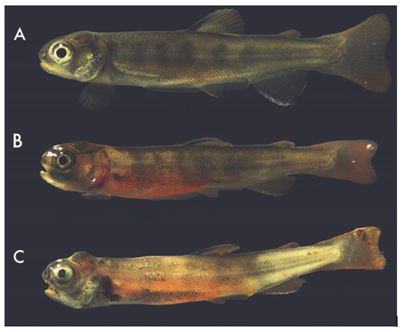
photo: Nathan Ivy, Washington State University, Eco-Toxicologist
Representative images of coho fry from 2024-2025 study at Miller Creek. A) Control fry reared in clean water, B) decreased fry reared in stream water showing undeveloped opercle, C) decreased fry reared in stream water showing cranial bulging.
A Call for Action by the Public:
Since it appears that the City of Bellingham has forgotten the terms and conditions of City Council Resolution 37-1984, the best thing the public can do is to remind the City Council that the shellfish beds in Chuckanut Bay were quasi-donated to the city for a “park purpose” and paid for with state funds earmarked for “outdoor recreation.”
In addition, the City Council needs to be informed of the following health and safety rules: Whenever there’s a conflict between federal, state and city regulations, the most stringent regulation shall govern. In this instant case, the city has a generalized stormwater regulation which allows placement of stormwater pollutants in Puget Sound with minimal public safety treatment and the city also has a city park regulation which specifically prohibits the disposal of any waste material in a city park which tends to be a nuisance and/or a threat to the health and safety of the public in a city park. In this particular case, the park regulation governs whenever a state guideline allows a harmful bacteria, virus, chemical, heavy metal, etc. into a city park.
With regards to the Olympia Oyster Restoration project, the 2026 City Council may not be aware of a trusted partnership obligation, thus the public needs make the council aware that, by signing a Joint Aquatic Resources Permit Application (JARPA) in 2018, then-Mayor Kelli Linville formally joined the City of Bellingham with a collaborative partnership between the federal government, the state and the tribes for recreating a delicate and sensitive fisheries habitat in North Chuckanut Bay.
In addition, the 2026 council may not be aware of the following: when the city purchased the shellfish beds from the Trillium Corp. in 1984, the shellfish beds were returned to the public domain where tribal members can harvest shellfish for personal consumption and/or cultural reasons. In this instant case, multiple tribes, at their discretion, can simply request compensation from the city for an infringement on their treaty rights while simultaneously forcing the city into a permanent reduction in stormwater contaminates in the bay.
_____________________________
Dean Longwell is a retired architect, familiar with the requirements of protecting the health, safety and welfare of the public in multiple states. His experience includes managing construction and resolving complex environmental concerns on EPA superfund sites in Washington, Idaho, California and Connecticut.