Beaks and Bills
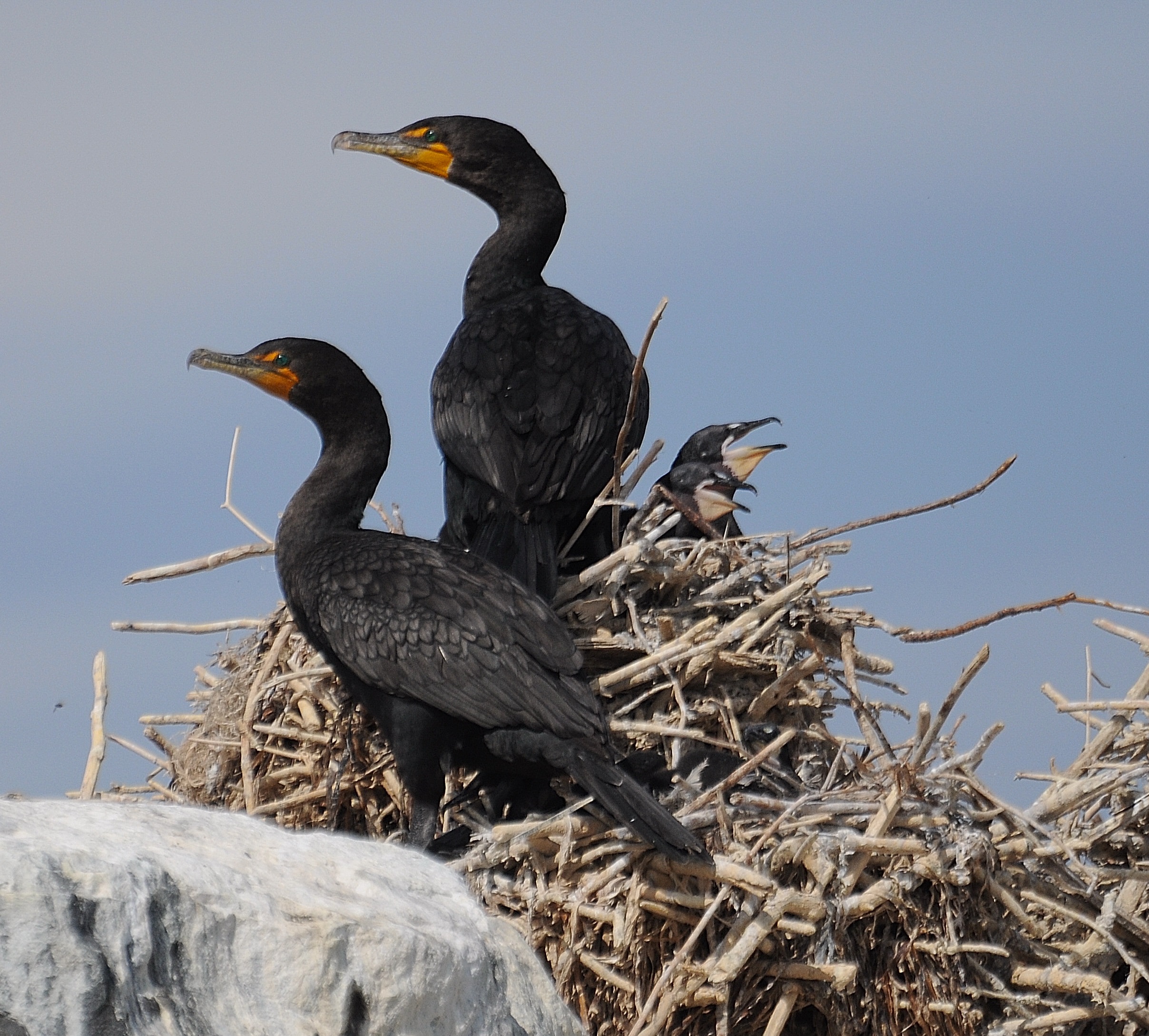
photo: Joe Meche
Double-crested cormorants
by Joe Meche
At this time of year, the majority of bird species that migrate seasonally have already done so. The birds that we enjoyed through the long winter months have packed their feathered bags and headed to northern and eastern breeding grounds in Canada, Alaska, and some only to the dryer and quieter side of the Cascades to eastern Washington. And, just like clockwork, the birdwatcher favorite Neotropical songbirds have arrived from southern climes to feather their respective nests and fill the air with their lovely songs. With all the avian activity in the air, our resident birds are simply joining in with the chorus … without having to go very far.
Quite a few species have already begun the seasonal process of courtship, nest building, and egg laying. This is followed of course by the seemingly endless task of feeding and nurturing this year’s crop of hatchlings. Needless to say there’s still quite a bit of activity that spills over into June. Certain species are already moving toward laying a second clutch of eggs, to ensure the continuation of their respective families. Barn swallows are famous for multiple clutches and the first round of young help in the nurturing process of their younger siblings. It’s somewhat similar to human families if you think about it.
No matter how many seasons have come and gone and how familiar these scenes are in spring as well as in fall, I’m still as fascinated as ever by the process of bird migration as a whole. If you’ve read this column at all during the past 24 years, you might recall my fond reminiscences about growing up on the confluence of the Mississippi and Central Flyways in southwest Louisiana. As a victim of geography, I became a birdwatcher almost by default. The sights and sounds combined with a grandfather who knew the names of the birds I was seeing and hearing left me totally hooked on birds at an early age. I always mark that milestone at the age of eight … so that makes me a /bird birdwatcher for 75 years!
Unlike the almost imperceptible quiet of fall migration, spring brings with it melodies we haven’t heard for six months! Perhaps one of our most notable and vocal of the early singers are the white crowned sparrows. They have one of the most easily recognized of bird songs … a good one to learn if you get into birding by ear. Today, I was in line at the car wash and over all the sounds of the soap and suds and roaring brushes, that familiar song caught my ear. I spotted the singer at the top of a small cedar, just outside the entrance. These birds, like many others, enjoy a nice high perch to deliver their medleys.
All of our swallow species have been accounted for in the open areas of the county, along with a few of our favorite woodland species, like the inimitable Pacific wrens and the Swainson’s thrushes. A walk into Whatcom Falls Park near the main falls will certainly put you in a great position to hear them along with the noisy Wilson’s warblers. Continue walking upstream from the falls and past the Derby Pond and you’ll encounter nesting wood ducks and hooded mergansers, both of which utilize the nesting boxes placed along the creek as part of an Eagle Scout’s project several years ago.
Once you get to Scudder Pond, you have only to be patient and wait for the sounds of two very secretive wetland birds … the sora and Virginia rail. Along with green herons, American bitterns, and pied billed grebes, these species are part of a statewide study by the Puget Sound Bird Observatory to update the status of these rarely seen birds that populate the wealth of small wetland habitats. The study covers more than 200 wetlands spanning 11 counties in western Washington. Scudder Pond is also one of the more reliable places in Bellingham to enjoy the robin-on-steroids melodies of the black headed grosbeak.
Glaucous winged gulls, our most common gull species, are nesting in a variety of locations, and most offer viewing opportunities for those of us who are interested in all birds. They seem to be so driven to nest that you’ll often find them in any number of peculiar locations. Aside from most rooftops in the harbors on Bellingham Bay, north and south, they nest on precarious ledges of downtown buildings. When we lived downtown, they nested and raised their young just outside our rooftop door. I even had occasion to rescue a few chicks that had left the rooftop nest too early and ended up on street below.
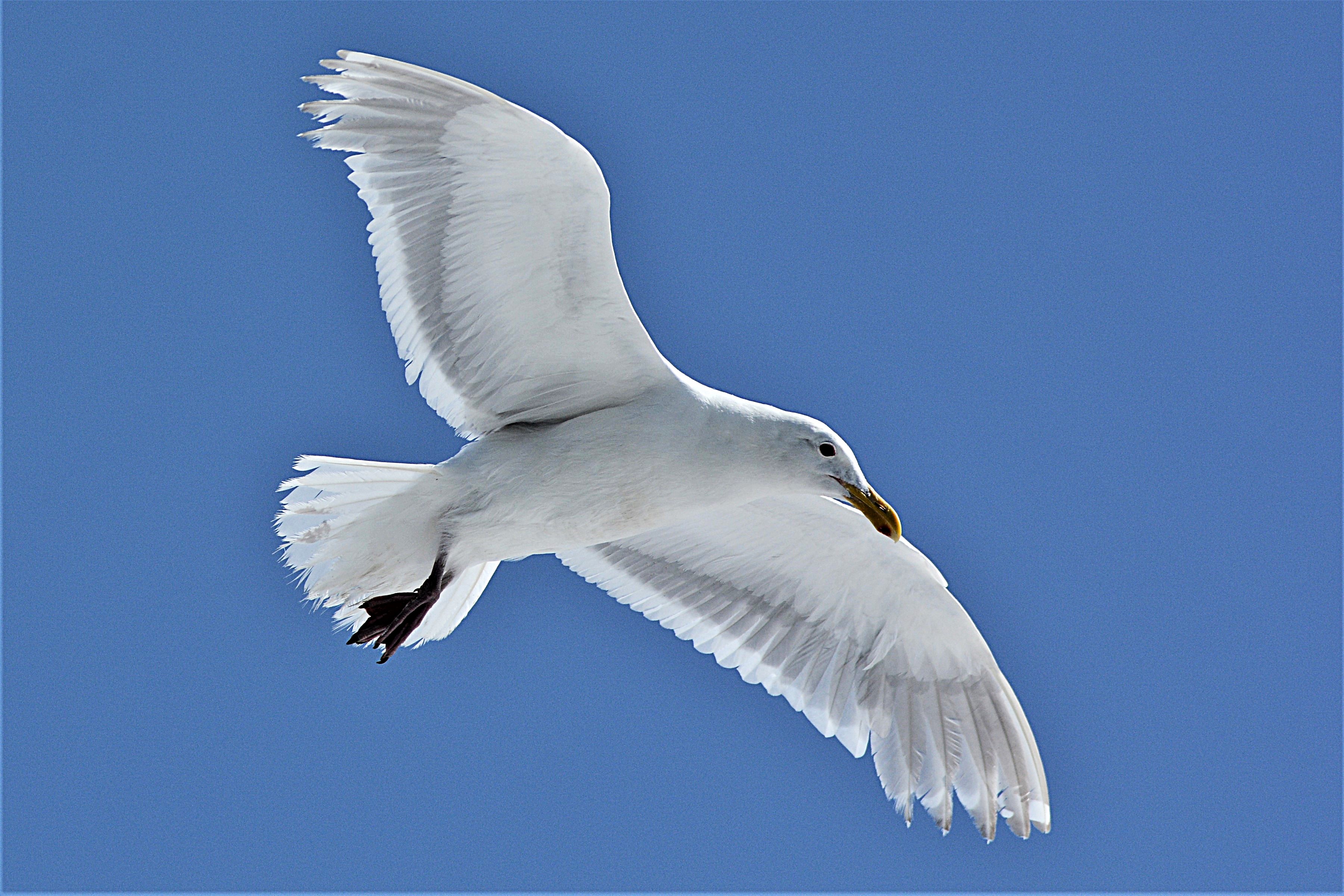
photo: Joe Meche
Glaucous-winged gull
For the sixth year in a row, I have found pelagic cormorants nesting underneath the cruise terminal on Southside. From the deck outside the terminal building, you can watch the cormorants flying in and out with nesting material and eventually with food to feed their nestlings. On several occasions, I’ve kayaked underneath to observe the process first hand. The most interesting part of it all is that most people are totally unaware of what’s going on just below their feet as they walk the pier.
On the subject of cormorants and while you have your kayak loaded, head up to Blaine Harbor to observe one of the largest nesting colonies of double crested cormorants on the West Coast. One season’s count tallied over 600 nests on the harbor breakwater. If you multiply that by two adults and three to four chicks, the numbers are difficult to comprehend. With double crested, pelagic, and Brandt’s cormorants nesting close by, we’ll never see a shortage of cormorants in Whatcom County. As you paddle along the breakwater, you also see a multitude of nesting gulls and perhaps a couple of pairs of black oystercatchers, with young secreted in the rocks.
After many years of gaining protection at Post Point, the large great blue heron colony appears to have relocated to Little Squalicum Park. On my last two visits, I did not see a single heron on or around the old nests. So far no one has developed a theory, but it’s yet another fascinating observation in the bird world. Previous abandonment at the site was caused by bald eagles but that was only temporary. By now, there usually would have been scores of nestlings waiting to be fed. Their smaller cousins, the green herons, are now nesting on Padden Creek, upstream from the Harris Avenue bridge. For these shy birds, the crowds at Marine Park became a bit much to bear.
The short version of this potentially longer story is that spring has arrived in our shared backyards in a big way … which is as it should be. Increased activity during the nesting season is commonplace and well worth a trip to any of the destinations mentioned here as well as numerous other locations in varied habitats. As the weather improves to almost summer like conditions, get outdoors and enjoy our avian bounty!
________________________
Joe Meche is a past president of the North Cascades Audubon Society and was a member of the board of directors for 20 years. He has been watching birds for more than 70 years and photographing birds and landscapes for more than 50 years. He has written over 250 columns for Whatcom Watch.