Part 1
by Hope Rasa
Two beautiful pieces of the Bellingham waterfront have been closed to the public for over 25 years. These overlapping properties are the RG Haley and Cornwall Avenue Landfill sites, situated between downtown Bellingham and Boulevard Park. Right now, they’re sectioned off with chainlink fences, and huge white tarps blemish the rocky beach at the Cornwall Avenue Landfill site..
Lately, Bellingham residents may have noticed an increase in noise, construction equipment, and vehicle traffic in the area. Construction began in early January 2026 for the new Salish Landing Park, located at the RG Haley and Cornwall Avenue Landfill sites. Construction is expected to be completed in approximately three years. Salish Landing will be 17 acres, three times the size of Boulevard Park..
This is Phase 1 of the construction, which is taking place concurrently with the ongoing environmental cleanup of the RG Haley and Cornwall Avenue Landfill sites.
“It can be tricky, but generally, we kind of look at the construction and cleanup as being the same thing,” Anthony Wenke, a site manager with the Washington State Department of Ecology’s (DOE) Toxics Cleanup Program, said. Wenke said this isn’t always the case, but near the end of a cleanup like this, when boots are on the ground for construction, it’s like a milestone in the cleanup process. “Construction — we often say in ecology — is one of the most exciting times because it’s years of hard work and effort finally coming to fruition,” Wenke said.
Decades of industrial activity have led to pollution at both sites. Today, the DOE is conducting cleanup efforts along with the City of Bellingham, the Port of Bellingham and others.
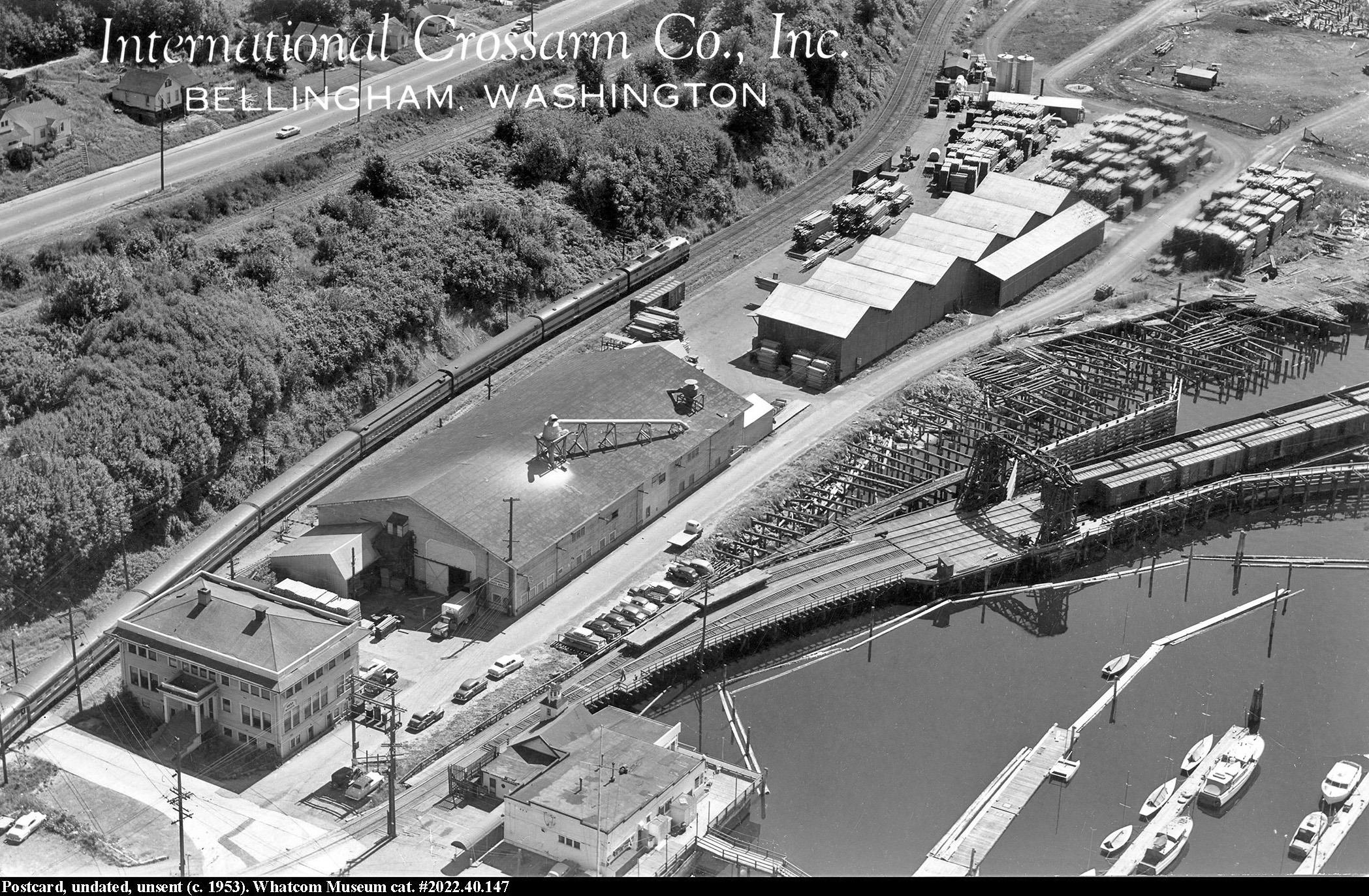
photo: courtesy Whatcom Museum
A postcard for Bellingham, dated 1953, pictures the RG Haley site in a former use.
Construction
Phase 1 construction of Salish Landing will include trails, 27 parking spaces, and other features. These need to be constructed concurrently with cleanup efforts to avoid future interactions with contaminants. As mentioned earlier, construction is expected to last for three years once it starts.
Future phases of Salish Landing’s construction depend on funding availability and haven’t been budgeted yet, Parks & Recreation Director for the City of Bellingham, Nicole Oliver, said over email. Future phases will follow an update to the master plan (1) for Salish Landing, Oliver said over email.
Salish Landing will include a small area of beach known as Glass Beach, which sits on the north end of the RG Haley site. Glass Beach will keep its local name even after it becomes part of Salish Landing. (2) Glass Beach and its adjacent parking lot will be inaccessible during the entire construction process, Oliver said over email.
The ambitious project to clean up the Cornwall Avenue Landfill and RG Haley sites and build a new park started in 2009 when the City of Bellingham bought the land. The Bellingham City Council awarded the $49 million Salish Landing project bid to IMCO General Construction at its meeting on Sept. 15, 2025. (3) Funding for the construction of Salish Landing comes from the DOE via the Remedial Action Grant Program, Park Impact Fees, Greenways Funds and Real Estate Excise Taxes. (4)
Although there are no homes adjacent to the work area for Salish Landing, Oliver said over email that there will be increased noise and vehicles in the area during construction.
Formerly referred to as “Cornwall Beach Park,” Salish Landing’s new name reflects its proximity to the water. The Bellingham City Council adopted Salish Landing as the park’s new name at the regular meeting on Jan. 23, 2023. The Bellingham Parks and Recreation Board recommended the new name after crowdsourcing 500 potential name submissions through the city’s Engage Bellingham website. (2)
In 2025, the Bellingham City Council approved the $15,000 purchase of 0.66 acres of land between Cornwall Avenue and Wharf Street. (5) The city will use the land to connect Salish Landing to the South Bay Trail and Boulevard Park.
Clean-up
The DOE is managing cleanup efforts at 12 sites on the Bellingham waterfront, all affected by industrial pollution. (6) The Bellingham Bay area was a hub of industrial activity for over a century, leaving behind contaminants in the water, sediment and soil. Remedial Investigations of the RG Haley and Cornwall Avenue Landfill sites revealed polycyclic aromatic hydrocarbons (PAHs), pentachlorophenol (PCP) and other contaminants. (7)
Kristen Forkeutis, the DOE’s community outreach and environmental education specialist, said contamination overlaps between the RG Haley and Cornwall Avenue sites. “It’s not like a straight line all the time, where it ends here and begins here,” Forkeutis said.
Pollution from nearby areas, like the Whatcom Waterway site, also bleeds into the RG Haley and Cornwall Avenue landfill sites. (8)
The effort to clean up these 12 sites became a consolidated effort in 2000 with the Bellingham Bay Comprehensive Strategy. (9) This strategy calls on the DOE and multiple other local and state agencies to clean up the dozen sites under Washington state’s environmental cleanup law, the Model Toxics Control Act (MTCA). The Bellingham Bay Comprehensive Strategy was developed by participants of the Bellingham Bay Action Team (BBAT), a multiagency effort aimed at reducing contamination around the bay. (9)
The 12 sites are in various stages of completion. Two have been completely cleaned up, monitoring progress, and one is awaiting cleanup. (9) The others are somewhere in the MTCA cleanup process. On-the-ground cleanup has started at the RG Haley and Cornwall Avenue Landfill sites. This is in the sixth step in the MTCA cleanup process. (10)
After the cleanup construction step is completed, the DOE will monitor the area for several years. The monitoring step involves tracking progress, preventing disturbance to the cleanup and ensuring the nearby environment remains protected from contamination. Shawntine Lai, the DOE’s site manager for RG Haley and Cornwall Avenue Landfill, said this project will need another five to ten years of monitoring.
Lai said they won’t do much excavation during the construction cleanup process. That means they won’t remove contaminated soil from the RG Haley and Cornwall Avenue Landfill sites. Instead, they will leave the contaminated soil in place and cover it with a capping system — several layers of clean material that act as a shell. This contains the contaminants and protects the surrounding people and environment. What little sediment they do excavate, Lai said, they will reuse on site. Then, they will cap it to suppress the contamination. “We just want to prevent exposure to the public,” Lai said.
Part II:
History of the RG Haley and Cornwall Avenue Landfill Sites
Industrial pollution left many parts of the Bellingham waterfront area inaccessible to the public for decades. Cleanup and construction efforts have transformed some sites into beloved parks. Boulevard Park was once home to a lumber mill and a manufactured gas plant. (11)
In 2024, the DOE, the Port of Bellingham and the City of Bellingham entered into a Consent Decree to carry out cleanup efforts at the site of the future Salish Landing Park. (12) The DOE is funding 50 percent of the cleanup through the Remedial Action Grant Program, which they entered with the Bellingham City Council in 2024. (12)
The estimated cleanup costs are approximately $28.3 million, with an additional $6 million in prior costs, according to a Jan. 13, 2025, staff memo from the City of Bellingham’s Public Works Department. (12)
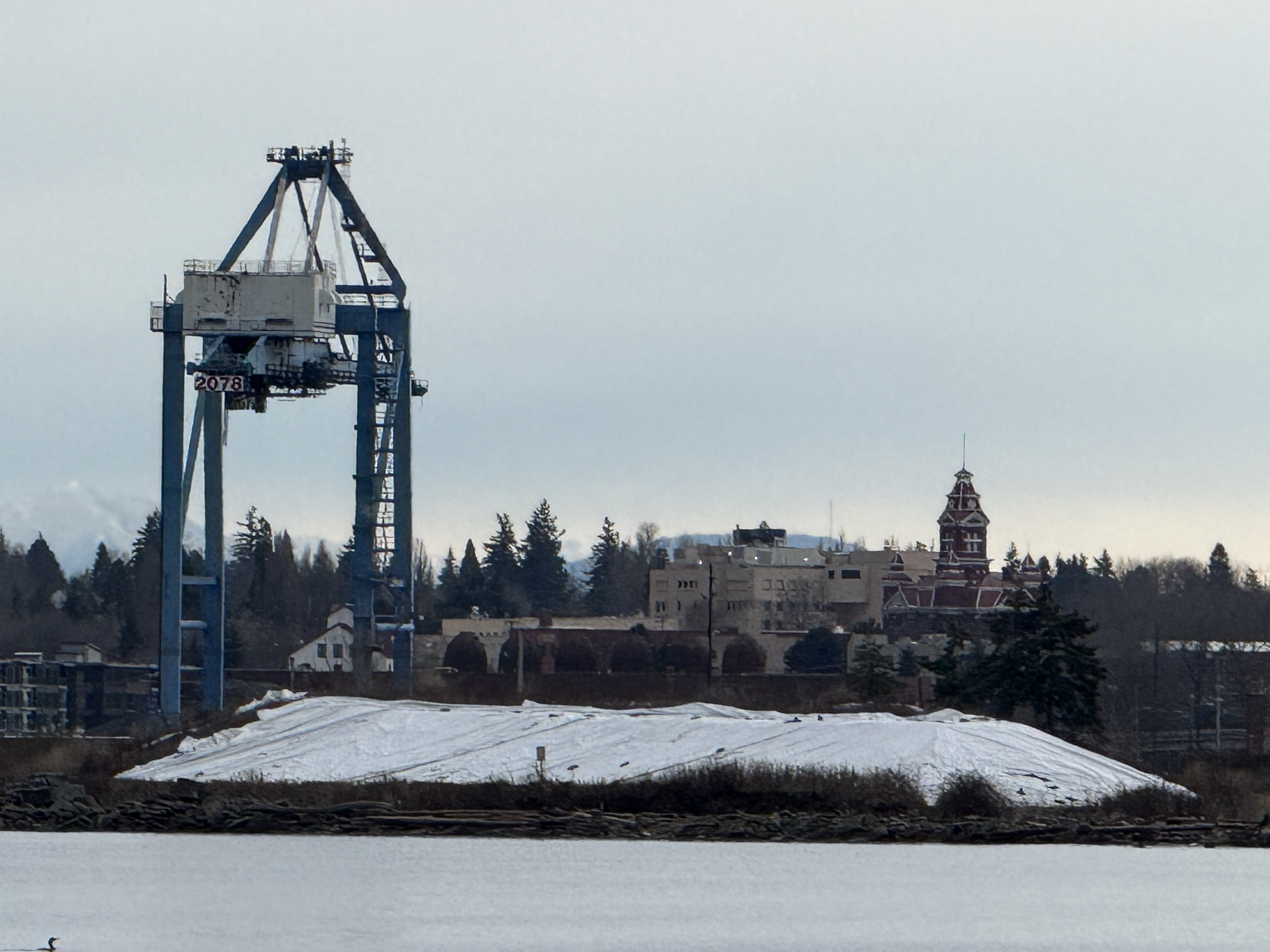
photo: Hope Rasa
White tarps cover the piles of contaminated material on the Cornwall Avenue Landfill site, with the Whatcom Museum and county jail in the background, as seen from Boulevard Park.
RG Haley Site
The RG Haley site was used for lumber, coal, railroad and wharf operations from the mid-1800s through the mid-1900s. (7) RG Haley International Corporation was the most recent of multiple companies to treat wood at the site (from 1955 to 1985). Chemicals released during the wood treatment process continue to contaminate the ground and water at the RG Haley site.
The RG Haley site is six acres of land, but the property includes 60 acres of water. Before the land at the RG Haley site was developed in the 1800s, it was open water and tidelands. Later, developers added fill material to the shoreline to create land.
Cornwall Avenue Landfill
Originally made up of subtidal areas and tidal flats, the Cornwall Avenue Landfill site was later developed and used for sawmill operations from 1888 to 1946. (13) During those times, wood disposal and log storage took place on the site. From 1953 to 1962, the City of Bellingham used the site for solid waste disposal. (1) In 1962, the city leased the property to American Fabricators, who continued to use it as a landfill.
After landfill operations ceased in 1965, the solid waste left on the property was covered with a layer of soil. Then, from 1971 to 2005, the Cornwall Avenue Landfill site was used for log storage and warehousing.
In 2013, the DOE conducted a remedial investigation and feasibility study (RI/FS). The RI/FS revealed the extent of the contamination left over from the site’s industrial past, including 295,000 cubic yards of municipal waste. (13) Contamination in the groundwater and sediment at the Cornwall Avenue Landfill site includes phthalates, polychlorinated biphenyls (PCBs), ammonia and more.
Waypoint Park’s Example
Despite their industrial history, the RG Haley and Cornwall Avenue Landfill sites can be transformed into something positive for the community in Bellingham. It’s been done before; Waypoint Park, located on Granary Avenue on the Bellingham waterfront, was successfully cleaned up in 2018. (14) Waypoint Park, home of the Acid Ball art installation, was once home to a pulp and tissue mill. Ossian Anderson opened the mill in 1926 and Georgia-Pacific (GP) purchased it in the early 1960s.
After a majority of the mill shut down in 2001, the Port of Bellingham acquired the land in 2005 from GP. The mill officially closed in 2007 and the city began designing and permitting what would become Waypoint Park in 2013. Construction of the park began in 2016. (15) It opened in 2018 with a playground, a salmon habitat and the Acid Ball as a memento of the site’s history. Waypoint Park is an example of the potential Bellingham’s old industrial sites hold for the local community.
_____________________________
Hope Rasa is a journalism – news/editorial student at Western Washington University with a passion for environmental awareness. Her previous reporting for The Front covered local social issues such as public health, incarceration and education. Hope’s interest in journalism began when she joined her high school newspaper. She wishes to continue reporting on pertinent and under-reported topics in Bellingham and the rest of Whatcom County.
References:
- “Cornwall Beach Park Master Plan Report.” City of Bellingham, Oct. 2014, https://cob.org/wp-content/uploads/cornwall-beach-master-final-plan.pdf?pdftype=e
- Mittendorf, Robert. “Cleanup and Construction are Underway for this Bellingham Waterfront Park.” The Bellingham Herald, 25 Jan. 2023, https://www.bellinghamherald.com/news/local/article271404887.html
- Watching Government, Bellingham City Council, Whatcom Watch, Oct./Nov. 2025, vote #182, https://whatcomwatch.org/index.php/article/bellingham-city-council-113/
- “Salish Landing.” City of Bellingham, https://cob.org/project/salish-landing
- Mittendorf, Robert. “Bellingham waterfront plan includes connecting new park to South Bay Trail.” The Bellingham Herald, 16 June 2025, https://www.bellinghamherald.com/news/politics-government/article308334160.html
- Loi, Luisa. “Bellingham Bay’s Dirty Dozen Sites.” Whatcom Watch, Jan. 2023, https://whatcomwatch.org/index.php/article/bellingham-bays-dirty-dozen-sites/
- “RG Haley International.” Washington State Department of Ecology, Sept. 2025, https://apps.ecology.wa.gov/cleanupsearch/site/3928
- “Whatcom Waterway.” Washington State Department of Ecology, Sept. 2025, https://apps.ecology.wa.gov/cleanupsearch/site/219
- “Bellingham Bay Cleanup.” Washington State Department of Ecology, 2025, https://ecology.wa.gov/spills-cleanup/contamination-cleanup/cleanup-sites/puget-sound/bellingham-bay
- “Cleanup Process.” Washington State Department of Ecology, https://ecology.wa.gov/spillscleanup/contamination-cleanup/cleanup-process
- Diehl, Anna. “Bellingham’s Waterfront Parks: Natural Developments Among Industrial History.” Whatcom Talk, https://www.whatcomtalk.com/2020/10/02/bellinghams-waterfront-parksnatural-developments-among-industrial-history/
- “Staff Memo to City Council.” City of Bellingham, 13 Jan. 2025, https://meetings.cob.org/Meetings/ViewMeeting?id=3408&doctype=1
- “Cornwall Avenue Landfill.” Washington State Department of Ecology, Sept. 2025, https://apps.ecology.wa.gov/cleanupsearch/site/220
- “Tour a Bellingham Waterfront Cleanup Site (and the Future Salish Landing Park Space).” RE Sources, 6 Feb. 2024, https://www.re-sources.org/2024/02/tour-a-bellingham-waterfrontcleanup-site-and-a-future-salish-landing-park-space/
- “Waypoint Park.” City of Bellingham, https://cob.org/services/recreation/parks-trails/parksguide/waypoint-park