Native Plant Neighbors
by Eric Worden
“April showers bring May flowers.” This saying originates from the UK, which has a climate similar to our area. The saying is certainly true for us, and many nature enthusiasts in our area love May, with its explosion of wildflowers, and they even schedule day trips and vacations to visit regional wildflower fields. It is now autumn, though, when people are thinking less about flowers and more about berries and seeds, and maybe one last visit to the beach.
Bumblebees, our most charismatic pollinators, also favor spring, and the current year’s generation of bumblebees has died by now except for the new queens, which are preparing for winter. Yet, in terms of work and vacations, nature’s work continues now with an autumn shift staffed by autumn-favoring pollinators and autumn flowers. In our area, one group of important autumn flowers are the asters.
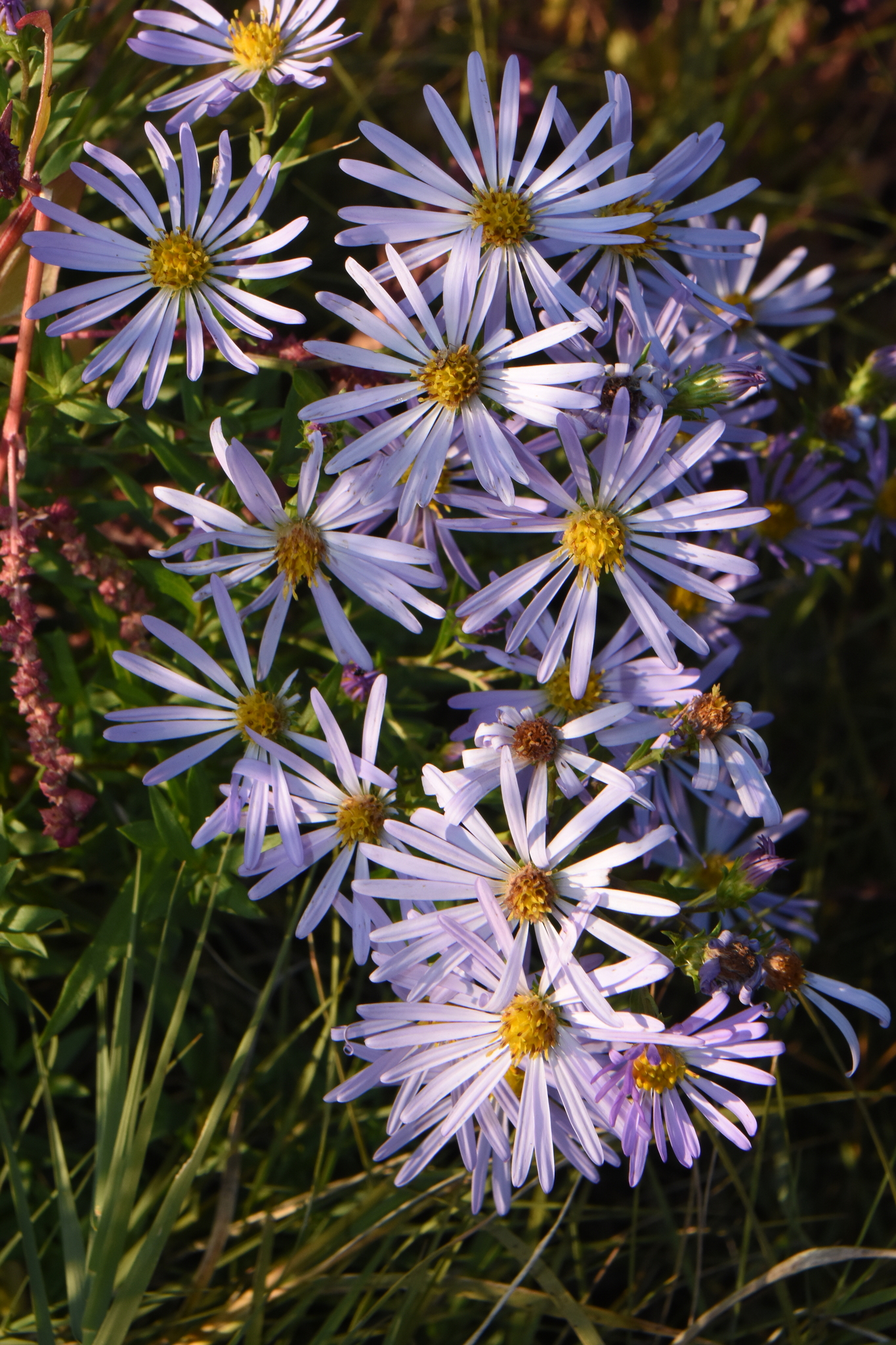
photo: Gabriel Campbell-Martinez via iNaturalist CC-BY
Douglas’s aster flowers
In open, sunny places in the lower elevation areas of western Whatcom county, including many gardens and roadsides, you can find Douglas’s aster, Symphyotrichum subspicatum. In moister upland areas, you will find a more leafy aster, Symphyotrichum foliaceus. The two species differ only subtly, mostly in their leaf shapes. Plucking an aster flower and looking at it, any eight-year-old child would call it a daisy, which is close enough for most people’s practical purposes.
There are dozens of closely related daisy-ish species in our region. The most closely related are the fleabanes, gumweeds, and goldenrods. They have various habits and colors, but the asters can be distinguished fairly reliably by their fall blooming season and their thin, light-purple-colored petals. Their very close cousins, the fleabanes, look almost identical, differing visibly only by minute characteristics, but, unless you are a botanist hunting in special places, around here you will almost always see asters. Asters are perennial plants, emerging each spring from rhizomes or from the base of last year’s stems.
Blooms Peak in Late August
In terms of autumn flowers and people’s attention, asters compete with roses, dahlias, and sunflowers. Though they bloom abundantly, asters are smaller, the blooms being only about an inch wide, and the plants being a couple of feet tall. In the city, I usually see them in the more ignored edges of gardens, streets, and alleys, where I think they have often planted themselves. While not eagerly planting them, people seem to find them attractive enough to not pull them out, or maybe the people are simply at the beach. I appreciate things that work and show beauty regardless of whether anyone is watching. The blooms slowly begin opening in June, accelerate and peak in late August, and continue until finally beaten down by October or November storms.
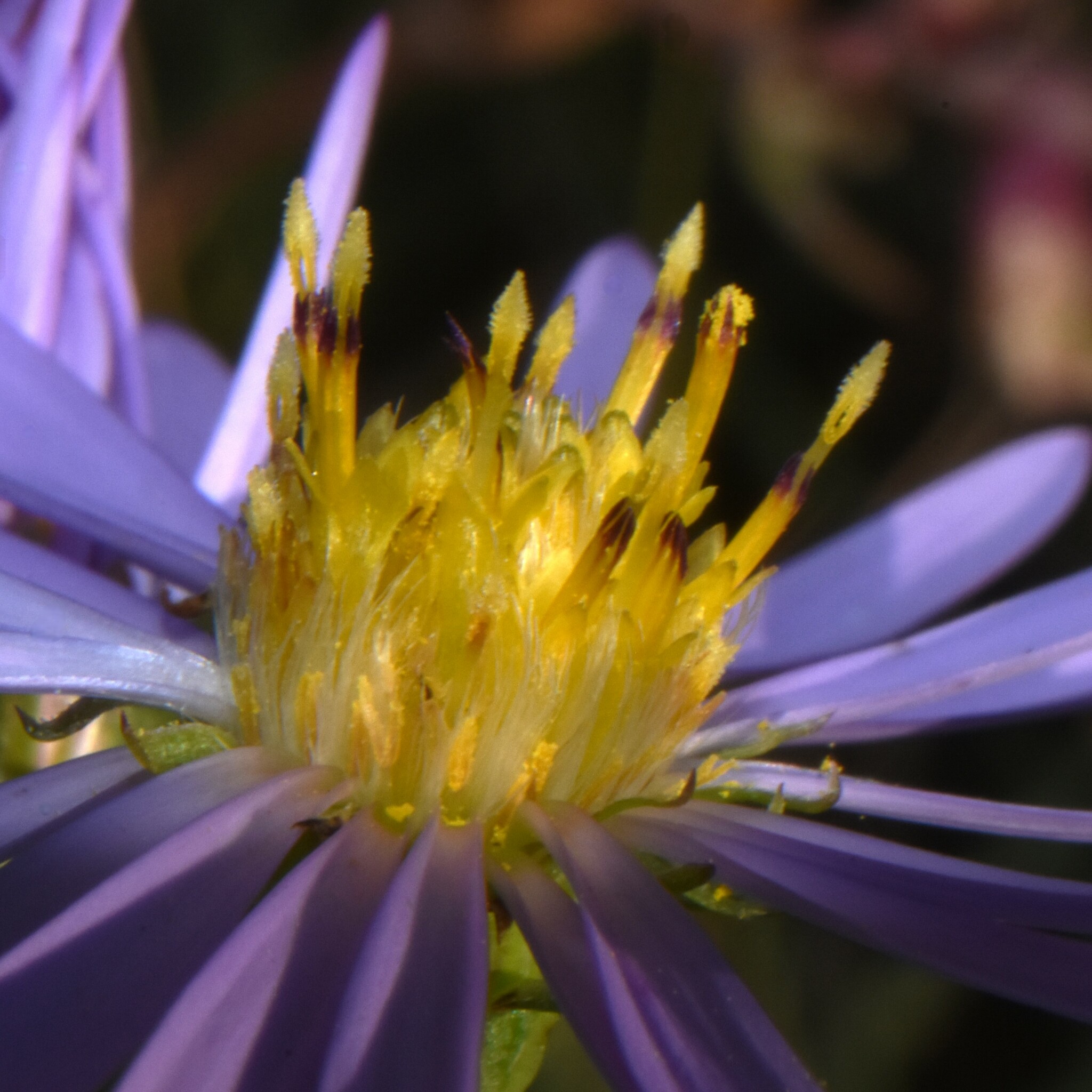
photo: Gabriel Campbell-Martinez via iNaturalist CC-BY
Douglas’s aster flower disc detail
A Composite of Tiny Flowers
The word “aster” means “star” in both Latin and in ancient Greek. The name alludes to the flower’s shape. In terms of botanical anatomy, they have an intricate construction: what we perceive as a single flower is actually a composite of dozens of tiny flowers. Each of the star’s 20 or so long purple rays projecting from the perimeter is a single petal of a tiny single-petaled flower. Actually, meticulous botanists have demonstrated that the single petal is three petals fused together. Additionally, the yellow disc center of the larger composite “flower” aggregates a dozen or so equally tiny flowers, each with five tiny yellow petals.
Curiously, the perimeter ray flowers are female only, while each disc flower is both male and female. The disc flowers prevent self-pollination by maturing the pollen-bearing male part first, and then the female part later after the pollen has been exhausted and hopefully carried off by insects. This reproductive strategy has succeeded wildly, as evident by the huge number and diversity of species in this family, and the high genetic diversity within populations of the species.
A Variety of Fall Pollinators
Likewise, the success of asters and other similar fall-blooming plants is linked to the success of a wide variety of late-summer and fall pollinators that includes flies, butterflies, beetles, wasps, and many small solitary bee species. Bumblebees also visit the flowers, but do not prefer them. Bumblebees prefer larger, more bumblebee-adapted flowers with deeper nectar wells and more pollen. Anyway, bumblebees rapidly decline in numbers in late summer and fall, so asters can’t rely on them. By presenting a simple shape that any flying insect can land on and walk over, the aster caters to a panoply of unspecialized autumn insect visitors.
In your garden, if you wish to support autumn insects with a supply of much-needed nectar energy, and support birds, frogs, and spiders with needed autumn insect food, let humble asters grow while you run to the beach one last time. These native aster species can be purchased as plants from local native plant nurseries, and seeds are also available in stores and online. Learn more about asters and other native plants at the Washington Native Plant Society, wnps.org.
______________________________
Eric Worden is a lifelong amateur naturalist and the chair of the Koma Kulshan chapter of the Washington Native Plant Society.
References:
- “Plants of the Pacific Northwest Coast,” BC Ministry of Forests and Lone Pine Publishing, Jim Pojar and Andy MacKinnon, editors
- “aster,” Wiktionary
- “Symphyotrichum,” Wikipedia