Community Service Spotlight
 Bellingham’s Streets Could Be Next
by Jamin Agosti
In the spring of 2024, Paris’ deputy mayor for transportation announced something nobody would have bet on just a decade earlier: bicycles had overtaken cars. Parisians had made a huge shift, choosing a bike for 11 percent of trips and their car for just 4 percent.
Paris didn’t get there by accident, and it didn’t get there because Parisians are uniquely bent on two-wheeled transportation. Paris made a deliberate choice about what its streets are for — and was willing to start by moving fast with paint and plastic before pouring concrete. Bellingham can make the same choice. A coalition of local residents, businesses and neighborhood groups led by Walk & Roll Bellingham are asking the city to do exactly that.
Cleaner Cars Aren’t Enough
Conversations about transportation emissions often jump straight to electric vehicles and cleaner engines. While those matter, the reality is that they’re far from enough. In 2019, London launched its Ultra Low Emission Zone — similar to the congestion pricing zone in New York City — which charges more-polluting vehicles a daily fee. This has been a major success for air quality in London: nitrogen oxide emissions have been reduced by about 24 percent and exhaust particulates by 29 percent. Carbon dioxide emissions, however? Only 2 percent.
That gap is a good lesson: swapping dirty cars for cleaner ones might clear the air, but it barely dents climate pollution. Carbon emissions drop when car trips drop. Planners call this mode shift: moving a meaningful share of everyday trips away from driving and towards walking, biking and transit.
While we’re half a world away from London and Paris, it still matters here in Bellingham. Transportation is our largest single category of greenhouse gas emissions — nearly half of all emissions — and is projected to grow as we make improvements to residential and commercial energy standards. Unfortunately, we can’t just electrify our way to our climate goals.
Start Fast, Then Make It Permanent
Paris’ transformation began in the early 2000s and was paying off even before the pandemic. The city implemented cleaner vehicle standards and a smattering of small local actions reclaimed space from cars, improved transit, and restricted traffic. By 2018, emissions from road transportation within the city had fallen 36 percent from 2004 levels.
Then, in 2020, Paris hit the accelerator. As France emerged from lockdown, officials worried that residents would abandon crowded trains for private cars. The city’s answer was the “coronapistes:” roughly 30 miles of popup protected bike lanes, installed in just a few weeks.
The materials were humble, much like we currently see in Bellingham: plastic posts and modular barriers that crews can glue down in hours rather than by slowly excavating and pouring concrete. People started riding in them immediately, and within just a few months Paris’ mayor announced they would become permanent. Rue de Rivoli, once one of Paris’ most congested streets, now serves mainly bikes, buses and taxis. Paris has also lowered its default speed limit on most streets to about 19 mph, much as Bellingham recently lowered its own default to 20 mph.
The air has improved, too: a 50 percent drop in nitrogen dioxide and 55 percent drop in fine particulate matter (PM 2.5) between 2005 and 2025.
Build a Network and People Come
London’s story is about steady network-building, not one dramatic shift. In 2016, the city had about 50 miles of designated bike routes. Less than a decade later it had increased this five-fold and ridership — as you’d expect — exploded.
The lesson isn’t that every street needs a bike lane, it’s that people ride when they have safe routes that create a connected network. A comfortable bike lane that drops you into a dangerous intersection doesn’t serve a parent riding with a child or a commuter who is new to biking. A connected network does. London has paired its bikeways with school streets and low-traffic neighborhoods, all of which calm streets so kids can walk and bike safely.
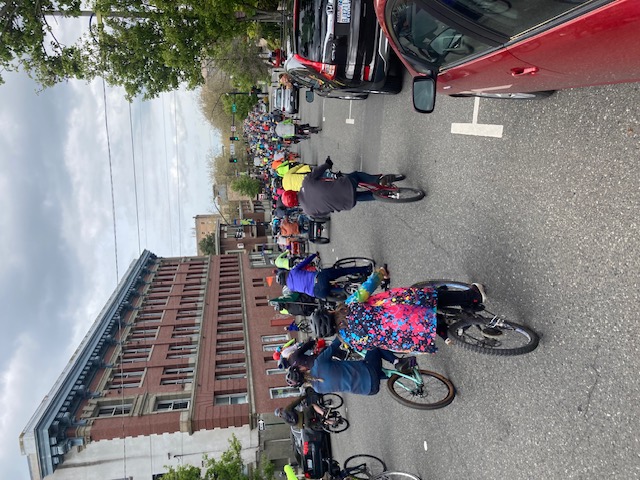
photo: unknown
Community members celebrate biking during the annual bike parade, a Bellingham tradition dating back to 1948.
“But Bellingham Isn’t Paris”
True. We’re far from being a dense capital with a metrorail system. We have hills and plenty of rain, as we’re all well aware. But, the core principle doesn’t depend on size or weather or topography. Sixty percent of people say they’re interested in biking but don’t because of safety concerns. When Bellingham tested a protected bike lane on Eldridge Avenue, bike use skyrocketed — despite the fact that the single segment doesn’t connect to any other bike facilities. Imagine what a real, comfortable connected network could do.
The need is also urgent on its own terms. In the last decade, over 600 crashes on Bellingham streets involved people walking or biking. One hundred forty of them resulted in a serious injury or death.
Safe Streets Bellingham
This is where Walk & Roll Bellingham comes in. We’re an all-volunteer advocacy group founded in 2012 and working for everyone who gets around on foot or on wheels, whether that’s a bike, stroller, wheelchair or scooter. Over the years, we’ve helped renew the voter-approved Bellingham Transportation Fund, pushed for stronger safety measures in the city’s 2024 Bicycle and Pedestrian Master Plans, and supported the new 20 mph default speed limit.
Bellingham has good plans, but, like other cities in the U.S., our problem is pace. A decade after approval, only about half the bikeway projects in the 2014 Bicycle Master Plan were built. Most of our local infrastructure projects take nearly a decade to build and cost millions of dollars.
In June, with the endorsement of a coalition of bike shops, restaurants, breweries, retailers, nonprofits and neighborhood associations, we launched Safe Streets Bellingham. The proposal borrows directly from Paris and has two parts.
- Quick-build corridors. Paint-and-post protected bike lanes and crossing improvements on 16 priority corridors, about 12 miles in all. Most are already priorities in the city’s adopted plans. The estimated all-in cost is $600-900,000 compared with $3-$8 million per mile for traditional reconstruction. Importantly, it fits within dollars already budgeted by the city for nonmotorized improvements. We can build it now, fast. And, because quick-build materials are flexible, the city can test, measure and adjust — just as Paris did.
- Neighborhood Slow Streets. Much like London’s low-traffic neighborhoods, this new program would empower neighborhoods to work with the city to designate residential streets as “low speed and local traffic” streets, using signage, pavement marking, and simple modular diverters, with emergency and local vehicle access preserved.
The city is making progress, including a recently approved $1.5 million contract for nonmotorized improvements at 10 locations. We’re asking Bellingham to match that progress to the scale of the need.
Join Us
Paris and London didn’t wait for perfect designs or perfect budgets. They started, learned and kept building. Bellingham can, too.
Read the full Safe Streets Bellingham proposal and add your name as a supporter at safestreetsbham.org. To get involved with Walk & Roll Bellingham, visit: walkandrollbellingham.org
____________________________________
Jamin Agosti is a board member of Walk & Roll Bellingham and Kulshan Community Land Trust and a member of the Bellingham Transportation Commission (views expressed are his own). He lives in Bellingham with his family.