In early January, the Salish Sea Alliance received its first remotely operated vehicle (ROV).
by Calvin Lowe
The Salish Sea Alliance, formerly known as the Northwest Straits Foundation, is a nonprofit organization dedicated to marine conservation and restoration of the Salish Sea. They work with communities, scientists and other partners on projects including removal of derelict fishing gear, restoring nearshore habitat, monitoring shorelines and promoting better shoreline stewardship.
Before acquiring the ROV, the Salish Sea Alliance relied primarily on commercial divers to retrieve derelict fishing gear. However, divers are limited to depths of 100 feet for safety reasons, preventing them from reaching some gear. The ROV has helped the organization’s marine programs manager, Jason Morgan, retrieve derelict crab pots from the waters of greater Skagit Bay.
The organization had experimented with ROVs in the past, but older technology was too slow and inefficient to make them practical. As ROV technology improved, smaller models became faster and more efficient, making them a viable alternative for retrieving gear beyond the reach of commercial divers.
The Salish Sea Alliance purchased an ROV from the California-based company Oceanbotics after a demonstration. “The purpose of the ROV is to increase our capacity,” Morgan said. “We wanna do more work.”
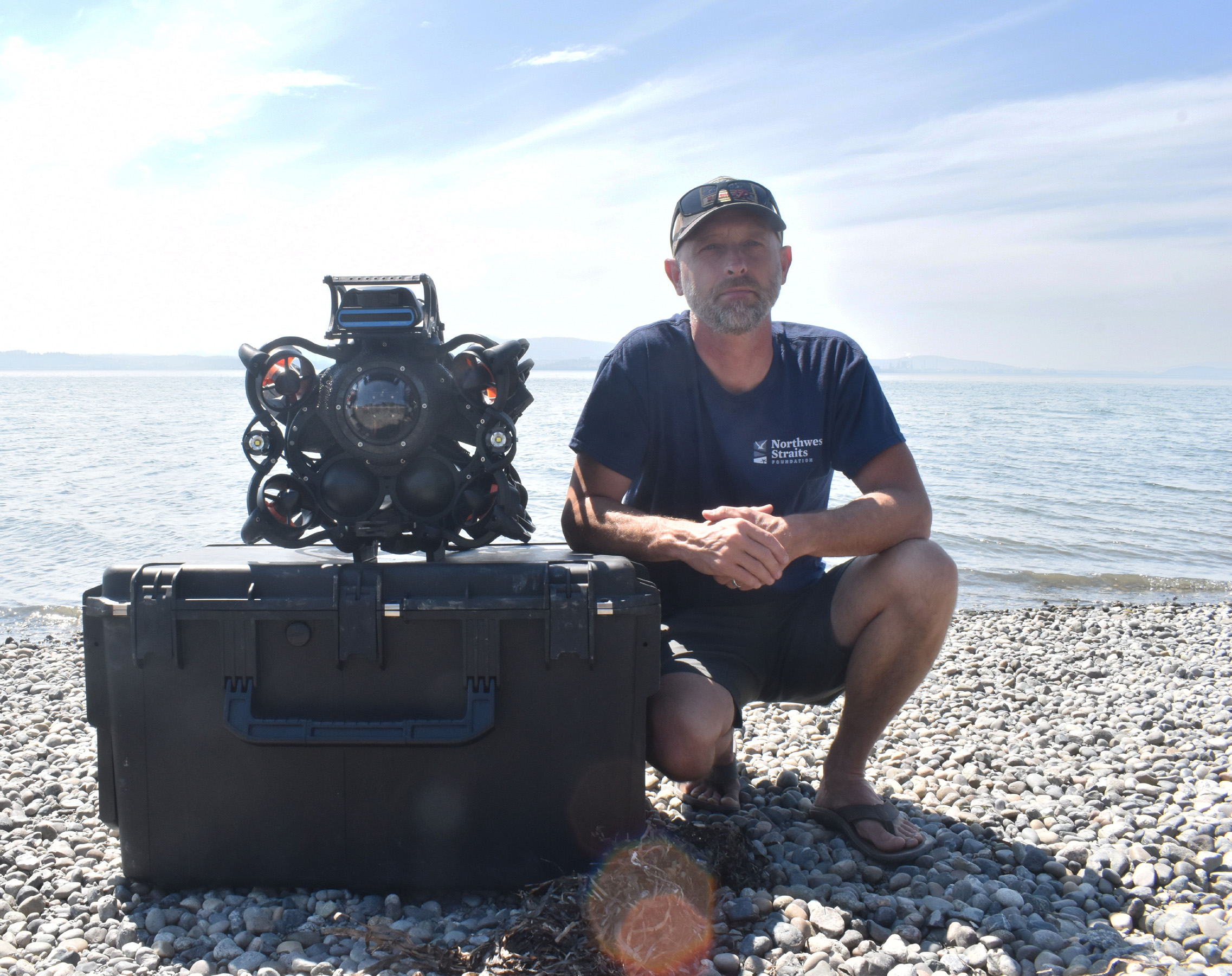
photo: Calvin Lowe
Jason Morgan poses with Salish Sea Alliance’s new remotely operated vehicle (ROV) at the Bay View State Park, a public recreation area located on Padilla Bay in Skagit County. The ROV helps retrieve derelict crab pots and other fishing gear from depths beyond the reach of commercial divers.
Derelict Gear Retrieval Process
Before a retrieval, a surveyor uses side-scan sonar to map the project area and identify potential derelict crab pots. After analyzing the data, the surveyor provides the crew with latitude and longitude coordinates for each target. Once the vessel reaches a target, the crew lowers the ROV into the water to locate the pot.
“The ROV has an arm that opens and closes,” Morgan said. “That arm holds a grappling hook that’s attached to a line. … It goes down, it finds that derelict crab pot, it hooks that grappling hook to it, lets go and backs away, and then we haul the crab pot up on board.”
While Morgan estimated that the base ROV costs about $47,000, additional equipment brought the cost of the complete system to more than $100,000. Among those additions is multibeam sonar, which helps operators locate crab pots when poor underwater visibility makes them difficult to see. The sonar sends acoustic signals ahead of the ROV, allowing operators to identify the outline of a pot on a screen and navigate toward it before using the ROV’s camera at closer range.
“It’s really murky down there. You can’t see that far,” Morgan said. “You have this sonar, they’re shooting acoustic sound waves in front of it, and you’re looking at that on a screen where you can see an outline of a crab pot.”
Morgan says that the most rewarding part of his job is pulling up derelict nets or crab pots because of the immediate impact it has on the environment. “That net or pot that’s sitting on the seafloor — while it’s there, it’s continually harming the environment. It’s capturing and killing marine animals. It’s degrading the habitat that it’s sitting on,” Morgan said.
After retrieving derelict gear, crews record any live or dead animals found trapped inside to document the gear’s impact on marine life. Crews then release any live animals back into the water.
User Error: Lost Crab Pots
More than 12,000 crab pots are lost in the Salish Sea each year, with about 80 percent coming from recreational crabbing. Many losses result from user error and a lack of awareness about practices that can prevent gear from being lost, Morgan said.
Morgan’s interest in marine conservation began long before he joined the organization. He studied marine biology and previously worked as a fisheries observer aboard commercial fishing vessels off the coasts of Washington and Oregon. “I worked on a lot of trawl boats and we would pull up a bunch of pots and stuff, so it got me thinking about that,” Morgan said.
More than 20 years ago, Morgan said he was already seeing the effects of derelict fishing gear, but did not know whether anyone was working to address the problem.
Today, Morgan’s work ranges from writing grant proposals to coordinating fieldwork around tides, currents and weather conditions. In the field, he may spend a day aboard a boat retrieving derelict fishing gear or conducting biological and physical surveys along the shoreline.
Nearshore Project: Clayton Beach
Morgan’s interest in protecting the environment dates back to his childhood, when he developed an affinity for water. “I’ve always been a person that cared about the natural environment,” Morgan said. Looking ahead, Morgan said he is particularly excited about an upcoming restoration project at Clayton Beach, part of Larrabee State Park off Chuckanut Drive.
“It will be the largest restoration project that we’ve ever done,” Morgan said. “There are a lot of really cool elements that are coming into play, and so I’m really excited to see that happen and for us to have a big impact there.”
Leading the Clayton Beach project is Lisa Kaufman, the organization’s director of programs, who has worked with the foundation for more than 13 years.
Kaufman manages the foundation’s nearshore restoration program, identifying opportunities to restore shorelines throughout the North Sound. She also manages its Shore Friendly program, which works with private property owners to reduce the effects of shoreline armoring and bulkheads.
Kaufman’s path into marine conservation was not a direct one. After studying biology and conservation in Colorado, she spent part of her early career working in public recreation before moving to Washington and eventually working on salmon recovery and nearshore restoration projects.
Most of her day involves grant and project management rather than being on beaches. She identifies funding opportunities, works with consultants, contractors, landowners and other stakeholders, handles permits and manages projects from identification through construction. The foundation has spent at least five years developing plans for the Clayton Beach restoration project, located at the southern end of Larrabee State Park, Kaufman said.
Project Seeks to Restore Shoreline
The project seeks to restore a shoreline that was heavily altered by infrastructure dating back to the early 1900s. An electric trolley line once ran south from Bellingham through the area, crossing Clayton Beach on a large wooden trestle. Remnants of that infrastructure remain at the site, including pilings and approximately 1,300 linear feet of rock armor along the shoreline.
While investigating the site, Kaufman and others noticed that the beach contained an unusually large amount of sand compared with the natural conditions they typically see along northern Puget Sound shorelines. Historical and aerial photographs helped them piece together why. “We started looking at some aerial photographs and we started collecting historical photographs as well,” Kaufman said. “We noticed that there was this huge hole in the ground off shore.”
The investigation determined that a roughly 13-acre, 20-foot-deep hole had been dredged offshore and that sediment from it had been pumped onto the beach during construction of the trestle and other infrastructure.
The ROV could eventually play a role in the Clayton Beach project as well. The organization hopes to use it to examine eelgrass beds and monitor the hole’s conditions, Kaufman said. The restoration project plans to fill the dredged area, remove rock and remaining pilings and bring in sediment more characteristic of the area’s natural shoreline.
“The area has really been modified to an extent that we can’t restore it to historical conditions,” Kaufman said. “But we’re gonna do the best we can to somewhat bring some of those natural features back.”
The project aims to restore eelgrass beds and improve spawning habitat for forage fish, particularly sand lance and potentially surf smelt. The project is also intended to improve public access to Clayton Beach, Kaufman said.
It also involves numerous landowners and partners, including Washington State Parks, state natural resource agencies, local Marine Resources Committees, tribes and other organizations.
For Kaufman, one of the most rewarding parts of her work is seeing a restoration project finally take shape aft er years of planning. “Even if it’s just like 100 feet of shoreline, that you’ve changed 100 feet of shoreline and that the habitat has a chance to heal,” Kaufman said.
Shore Friendly Program
The foundation’s restoration work also extends to privately owned shorelines. Conservation technician Phoebe Berghout works with landowners through the Shore Friendly program, providing information about erosion, vegetation, drainage and ways to improve nearshore habitat.
Berghout’s path to the foundation began at the University of Washington, where they double majored in aquatic and fishery sciences and environmental science. After conducting research on fish biology, habitat ecology and great blue heron populations, Phoebe worked on shoreline monitoring and salmon habitat restoration projects before joining the foundation.
For Berghout, working directly with landowners is one of the most rewarding parts of the job. “It’s an honor and a privilege to be welcomed to somebody’s property where they have lived for any amount of time,” Berghout said. “Some people have had these properties in their families for generations.”
Whether removing derelict crab pots from the seafloor, restoring shoreline habitat at Clayton Beach or working with private landowners through the Shore Friendly program, the organization’s goal remains the same: improving the health of the Salish Sea.
Kaufman said that work often requires years of planning and cooperation among agencies, tribes, nonprofits, landowners and community members. “Change takes time,” Kaufman said. “It is the multitude of organizations and people that are working towards these goals, all working together, that’s really gonna make it happen.”
_________________________________
Calvin Lowe is a recent graduate of Western Washington University, where he earned a bachelor’s degree in Journalism News/Editorial and Political Science. He is a multi-instrumentalist and a gamer. His favorite instrument is the guitar, and his favorite console is the Nintendo Switch.