Deer affected by hair-loss syndrome observed in Washington since mid-1990s
by Hope Rasa
In Bellingham, Wash., the deer are locals. Columbian black-tailed deer, a very common subspecies of mule deer in the Pacific Northwest, are more frequent sights around certain Bellingham neighborhoods than some of their human residents. These deer also wander the campus of Western Washington University, blending in with the herds of students walking to their classes. Some see the deer as nuisances, others see them as friends — either way, they’re a part of the community. Lately, however, these staples of the local fauna have been disturbing onlookers with their sickly, disheveled appearance.
For the past few months, most of Bellingham’s deer have been walking around with severely depleted fur coats. It’s unclear exactly how many deer are impacted.However, most deer out and about in Bellingham neighborhoods like Happy Valley and Fairhaven are missing some or most of their fur, sometimes with pink, irritate skin visible.
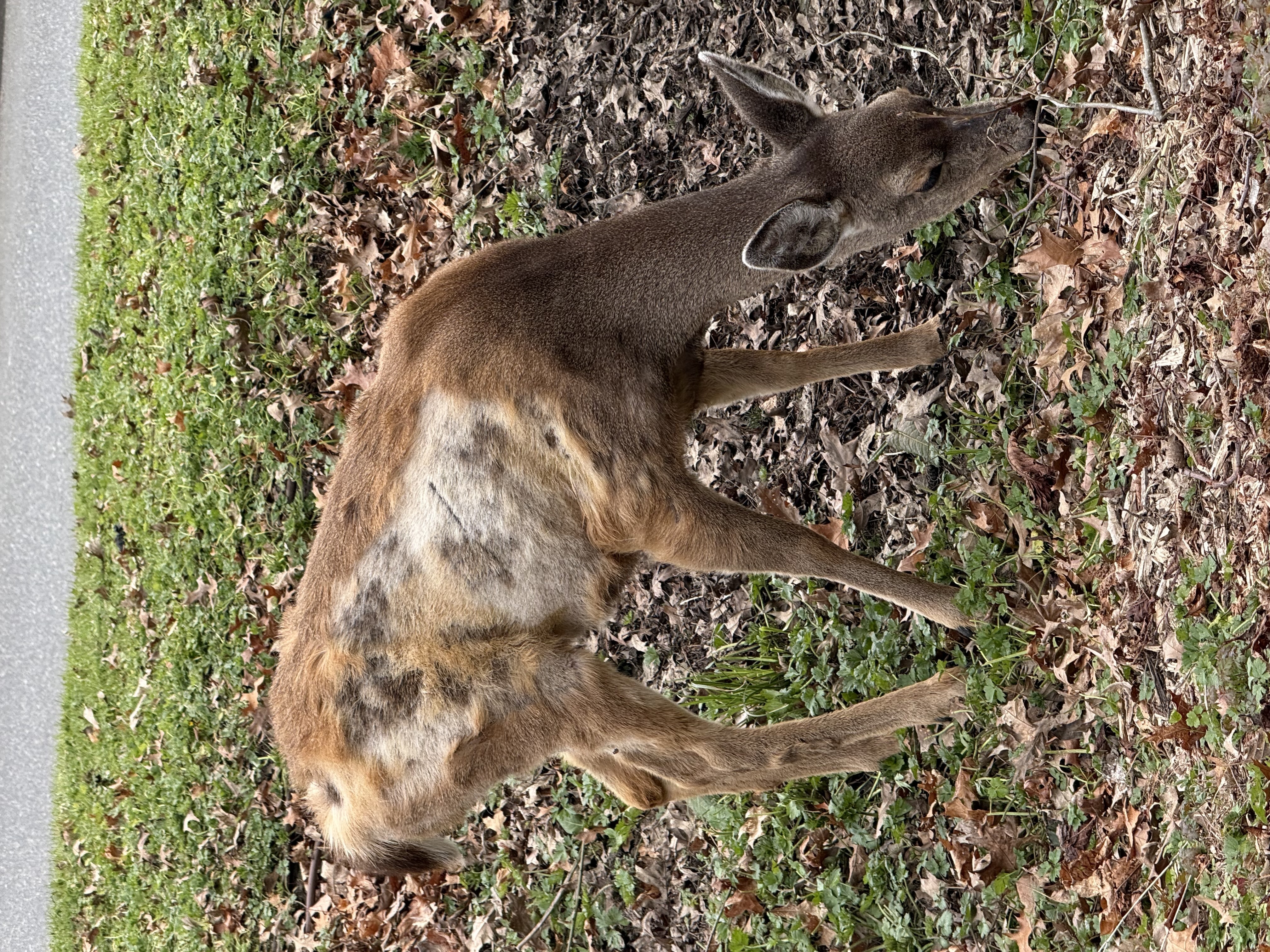
photo: Hope Rasa
A doe grazing near a parking lot on the Western Washington University campus on April 20, 2026, in Bellingham. The doe’s fur is patchy and discolored, with multiple layers of her coat visible as various areas are in different stages of erosion.
Diagnosis: Hair-loss Syndrome (HLS)
HLS is caused by a heavy infestation of Eurasian lice. (1) When deer become infested with these non-native lice, they typically develop a severe allergic reaction. This causes their skin to become irritated, leading the deer to groom itself excessively.
At first, HLS may cause a deer’s fur coat to change in color. This is caused by the removal of guard hairs, the coarse, long top layer of fur that protects the deer’s undercoat. (2) Eventually, the deer’s hair loss becomes more apparent, resulting in the raggedy appearance seen in many of the deer around Bellingham.
These Lice Don’t Affect Humans or Pets
While it may cause deer to look alarming, HLS is relatively common and not a sign of mange or any other more severe conditions. Deer with HLS may begin to appear emaciated and lethargic. However, deer suffering from HLS can often remain alert and active. (4) Additionally, the Eurasian lice that cause HLS don’t affect humans or pets. (1)
While deer can’t spread HLS to people or domestic animals, they can spread it to each other. The most probable source of transmission for HLS is deer to deer contact, including sneezing or sharing water. Deer in poor health also tend to be more susceptible to HLS than others.
“Unfortunately, there is no practical way to treat wild deer populations for infestations of non native lice,” Gunnell said over email. “Survival varies, with fawns more vulnerable than adults, but many adult deer do recover by summer when they regrow their coats and regain body condition as forage improves.”
While fawns are less likely to survive HLS than adult deer, the syndrome isn’t their leading cause of death. Predation, starvation and other illnesses cause more deaths in fawns than HLS. (5)
In 2006, the Makah Tribe, based in Neah Bay, Wash., began a study of black tailed deer on their timberlands and adjacent, private timberlands. Researchers fitted 100 fawns with radio collars and closely tracked them for over two years. The study found that the leading cause of death for these fawns was predation, mainly from mountain lions and bobcats. During the winter of 2006, more than half of the studied fawns had HLS, but none died as a direct result. However, fawns with HLS had a lower (50 percent) winter survival rate than fawns without HLS (64 percent). While no fawns died as a direct result of HLS, the syndrome may have caused them to be more vulnerable to predators, decreasing their likelihood of surviving the winter.
What’s To Be Done?
When Eurasian lice infestations peak during late winter and early spring, many deer — especially fawns, which are between 6 12 months old — grow weaker and die during this period of time. (2) Bucks (adult male deer) are observed with HLS far less frequently than does or fawns.
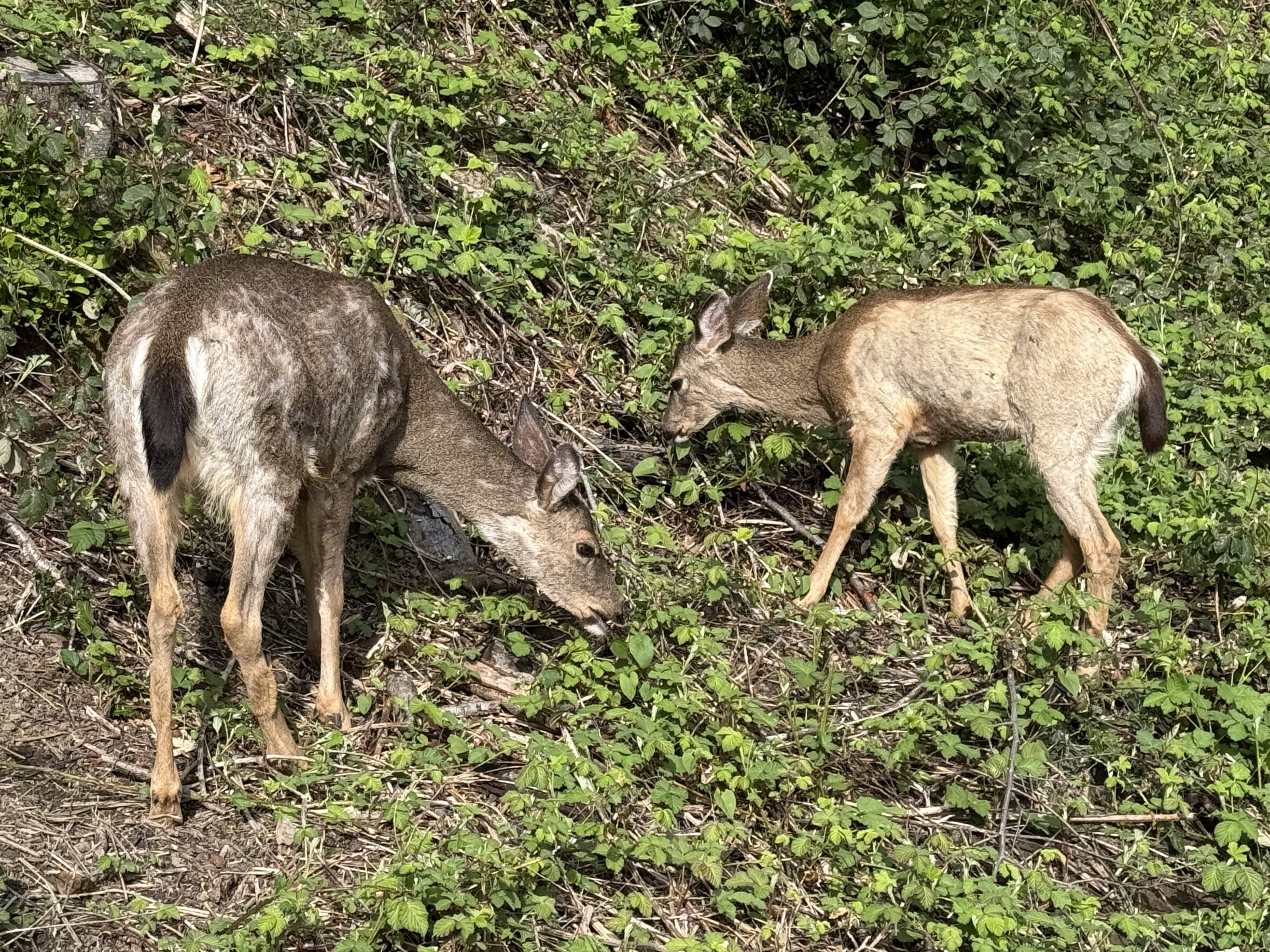
photo: Hope Rasa
Two deer, likely mother and fawn, with deteriorating fur coats graze at the side on Bill McDonald Parkway on April 15, 2026. While the doe is missing some patches of her fur, her fawn’s hair loss is far more severe. Nearly all of its fur coat is fading, except for its head, neck and a small strip along its spine.
It’s possible to rid deer of lice infestations with the use of medication; deer in captive settings have been successfully treated this way. However, it’s not possible to treat Bellingham’s large, free roaming deer population with medication. There are simply too many deer scattered and hidden across this urban environment. Much like there is no realistic way to treat HLS in urban deer populations like Bellingham’s, it’s also not possible to stop HLS from spreading.
The city’s deer population is undoubtedly significant, although there’s no official estimate. (6) It’s difficult to survey the Bellingham deer population because of the crowded vegetation and urban environment they live in. They may be overpopulated here, due to lack of hunting from humans and very few natural predators.
Columbian black tailed deer are native to western Washington, and typically prefer to live in forests. As human settlements have continued to encroach on their habitat, these deer have adapted to urban living. They’ve grown clever about crossing the street and are surprisingly comfortable with human presence, often letting people get close to them or even feed them.
The dense population of these urban deer makes them notoriously difficult to manage. (6) Unfortunately, that means they must largely fend for themselves against Eurasian lice infestations.
On the bright side, these Eurasian lice infestations don’t pose a significant threat to Bellingham’s Columbian black tailed deer population, since it’s so robust.
What can indeed harm the deer is feeding them. Disease can spread through deer through feeding. Humans leaving food out for deer, causing multiple deer to feed in the same place, can cause disease to spread.
Additionally, most of the things humans feed deer are not a part of their natural diet. Feeding deer may also cause them to be less afraid of humans, which can increase the likelihood of an attack. (6)
History
Washington first observed HLS in Columbian black tailed deer in 1995. (1) The focus of infection began in west central Washington, before spreading throughout western half of the state. By 1998, HLS was observed in black tailed deer populations in Oregon, west of the Cascade Mountains.
The Eurasian lice responsible for HLS typically infest European and Asian antelope and deer, who aren’t significantly impacted by them. Of course, when these lice infest black tailed deer, they cause a hypersensitivity reaction. Elk in Washington have also been impacted by Eurasian lice infestations, but they don’t experience severe hair loss like deer do.
Early timeline of HLS arrival and spread in the Pacific Northwest
- 1995: HLS was first recognized in Washington, caused by a species of non native lice in the genus Damalinia (subgenus Cervicola) species.
- 1998: HLS was first recognized in Oregon.
- 2003: WDFW began receiving reports of deer with symptoms similar to HLS in south central Washington, near Yakima. These were the first reports of apparent HLS in eastern Washington.
- 2004: WDFW received reports of more severely affected deer.
- 2005: Lice collected from four deer affected by HLS were identified as Bovicola tibialis, another non native louse that typically uses deer as hosts.
- 2006: Numerous dead deer, especially fawns, with hair loss in the Yakima area were reported to WDFW. These reports were from a greater geographical area compared to those in previous years. (2).
_____________________
Hope Rasa is a journalism – news/editorial student at Western Washington University with a passion for environmental awareness. Her previous reporting for The Front covered local social issues such as public health, incarceration and education. Hope’s interest in journalism began when she joined her high school newspaper. She wishes to continue reporting on pertinent and under-reported topics in Bellingham and the rest of Whatcom County.
Sources
- Hair loss syndrome in deer. (n.d.). Washington Department of Fish and Wildlife. https://wdfw.wa.gov/species habitats/diseases/hair loss
- “Hair loss syndrome” caused by exotic lice. (2009, May). Washington Department of Fish and Wildlife. https://idfg.idaho.gov/old web/docs/wildlife/diseaseExoticLiceFacts.pdf
- Wildlife and fish health: Deer hair loss syndrome. (n.d.). Oregon Department of Fish and Wildlife. https://www.dfw.state.or.us/wildlife/health_program/hairloss/index.asp
- Bildfell, R. J., Mertins, J. W., Mortenson, J. A., & Cottam, D. F. (2004). “Hair loss syndrome of black tailed deer of the pacific northwest.” Journal of Wildlife Diseases, 40(4), 670 681. https://doi.org/10.7589/0090 3558 40.4.670
- Preston, D. (2008, April 17). “Disease likely increases winter mortality of black tailed deer on North Olympic Peninsula.” Northwest Indian Fisheries Commission. https://nwifc.org/disease-likely-increases-winter-mortality-of-black-tail-deeron-north-olympic-peninsula/
- Long, B. (2024, August 18). “Love or hate them, Bellingham’s abundant urban deer are challenge to manage.” Cascadia Daily News. https://www.cascadiadaily.com/2024/aug/18/love-or-hate-them-bellinghams-abundant-urban-deer-are-challenge-to-manage/