Beaks and Bills
by Joe Meche
Yes, we’re back from the islands and happy to be home. I can’t remember the precise time we decided on this trip, but the motivation to visit our granddaughter, Logan, was at the top of the list of things to do. Having visited three of the major islands previously, it was only fitting that we would visit her on our fourth … the island of Hawaii. In typical fashion leading right up to our departure, I spent time with maps of where to go and books on the birds I hoped to see. From what I gleaned, there would be birds aplenty on the Big Island.
The most sought-after birds in Hawaii are, of course, the endemic birds that have been there before the time that humans first arrived. These birds are unique, highly specialized, found nowhere else, and critically endangered. As in so many cases, humans in general have had the largest impact on these native species. The human impact started as far back as the first Polynesian settlers in the form of Polynesian rats. Habitat loss, predatory mammals, and avian diseases have also contributed to the decline. The current focus is on strict conservation measures to ensure that the remaining endemics thrive and survive despite being on the endangered species list. Only time will tell.
Besides the endemics, there are plenty of other species that can be found on most of the islands. These birds fall under the headings of introduced, winter visitors, and vagrants. It’s easy enough to understand the presence of the introduced species, but I’m fascinated by the visitors and vagrants. Consider the broad expanse of open water these birds have to traverse to get to the islands. One winter visitor in particular caught my attention in my early reading … the Pacific golden plover, known to Hawaiians as kolea. These birds nest in Alaska and Siberia and migrate widely across the Pacific. One or two individuals even stop by Semiahmoo now and then, causing a bit of excitement for local birders who discover them. It takes true diligence to find and especially identify one mixed in with hundreds of our common black-bellied plovers that look quite similar.
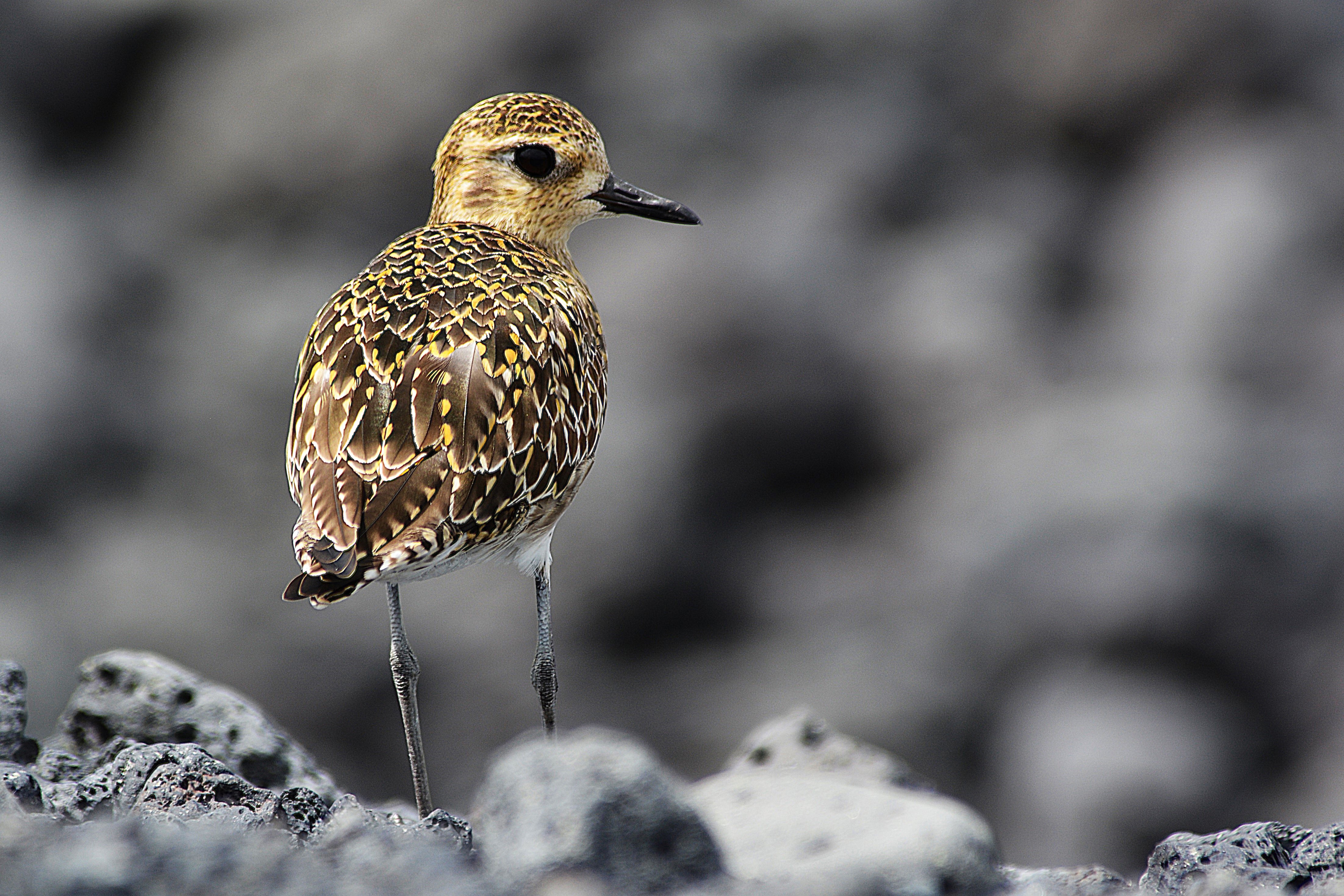
photo: Joe Meche
Pacific golden plover/kolea
For a bit of geographical and historical background, the Hawaiian Islands are an archipelago of eight major volcanic islands and numerous smaller islands in the North Pacific Ocean. Hawaii became the 50th state of the United States in 1959 and occupies almost the entirety of the archipelago. They were once known as the Sandwich Islands and the present name was derived from the largest island, Hawaii … commonly known as the Big Island for obvious reasons. The islands are actually the exposed part of a great undersea mountain range that’s almost 2,000 miles from the nearest continent and part of the Polynesian sub-region of Oceania. The archipelago’s highest point, Mauna Kea, rises to 13,796’ above sea level. When measured from its base on the ocean floor, it is comparable to a 30,160’ mountain, rivaled only by Mt. Everest.
The first Polynesian settlements of the islands date back to 300 CE. The first contact with Europeans occurred almost by accident when the islands were sighted by British naval Captain James Cook in 1778 during his third voyage of exploration. As it turned out, it was Captain Cook’s final voyage in search of a Northwest Passage since he was killed in a violent dispute with local inhabitants. The rest of Hawaiian history to the present follows a familiar pattern of newcomers with eyes on the prize of agriculture and strategic location in the middle of the Pacific Ocean.
Our first day was a travel day, of course, and getting there is half the fun … or so says the old adage. I’d like to speak to the person that coined that phrase. From this point on, I will sing the praises of the Bellair Airporter shuttle. It’s a very pleasant alternative to taking on the infamous I-5 corridor from Bellingham to either SeaTac or Paine Field. We chose Paine Field which is south of Everett and less than an hour from home. We flew the friendly skies on Alaska Airlinean birdss to Honolulu and Hawaiian Airlines to Hilo to pick up our rental car to end our day at the Hilo Reed’s Bay Hotel. I chose this hotel due to its proximity to the airport, coming and going. After a long first day, it was understandably refreshing to have a great shower, bed, and a pretty nice view of Reed’s Bay … well within a stone’s throw from our balcony.
After a good night’s rest, we left Hilo and followed Logan’s recommendation for a great breakfast at Pele’s Kitchen in the old part of Pahoa. To say the place was unique would be an understatement. It was clean and it was funky and the food was delicious. It’s the kind of establishment that is hard to describe and no number of photos will convey the feeling of the place. I don’t think we would have found the same laid-back vibe in the newer part of town. The staff was comprised of a cast of expatriates from the mainland who were happy to have found a home. One of the cooks had actually spent time fishing for salmon in the Bering Sea and had no desire to return. The ex-fisherman had a favorite saying that the entire staff repeated oft en: “Today is the best day ever!” It seemed to be infectious and spread throughout the café.
Logan’s place was northeast of Pahoa in a delightful residential neighborhood. It was typical of the islands in that everything was lush and filled with the kind of tropical vegetation you might expect. She has her own trees that bear avocados, bananas, mangos, and other assorted fruits … a little bit of heaven right there on a private corner lot. She also has saffron fiches, spotted doves, geckos, and another lizard which I still have to identify. Though she’d be the last to say it was anything close to fancy, it fits her like a glove. Solar panels, an outdoor kitchen, shower, and toilet … what else do you need?
After a great, welcoming visit, we headed for our own digs for the next five nights on the Puna Coast north of Kalapana. It turned out to be a quiet and cozy VRBO with coconut palms just outside the back door and … our very own outdoor shower! Our toilet was indoors, thankfully! As dusk settled in on our first night, I first heard a bird that I could not identify. As I researched into the evening, the sound heightened to a roaring chorus! It was only then that I remembered amphibians! This one turned out to be an introduced frog from Puerto Rico, the highly invasive coqui frog! They croaked all night only to be relieved just after dawn by the avian singers of the day. Locals tend to despise them, but they reminded me of the similar choruses I grew up with in south Louisiana.
On our third day, we packed food and drink and headed for the Hawai’i Volcanoes National Park. This was the day we realized how much driving would be needed to even scratch the surface of the island. It became clear that we needed more time on the next trip … should there be one, that is. We did the touristy thing on the rim overlook of the Kilauea Caldera. I had the same feeling I had when I first visited the Grand Canyon in 1976. Quite a bit of steam was constantly rising from inside the crater and the immensity of what we were seeing was a bit mind boggling. We continued up the main road to a bird park loop at 4,000’ hoping to see endemic forest species. I identified a few by their calls but left without a single photo. I took Cindy to Logan’s place for a girls’ night and returned to our place for an outdoor shower and dinner.
Following my typical routine. I was on the road just after sunrise on a solo expedition to the very end of Kalapana Road. To go anyplace on the east side of the island, you traverse numerous, historic lava flows. The year of the respective flows were noted on my map and it’s incomprehensible to imagine the natural forces at work, not to mention the effort to reconnect the roads by humans. There’s a definite time element involved since it always takes a while for the lava to settle and cool down.
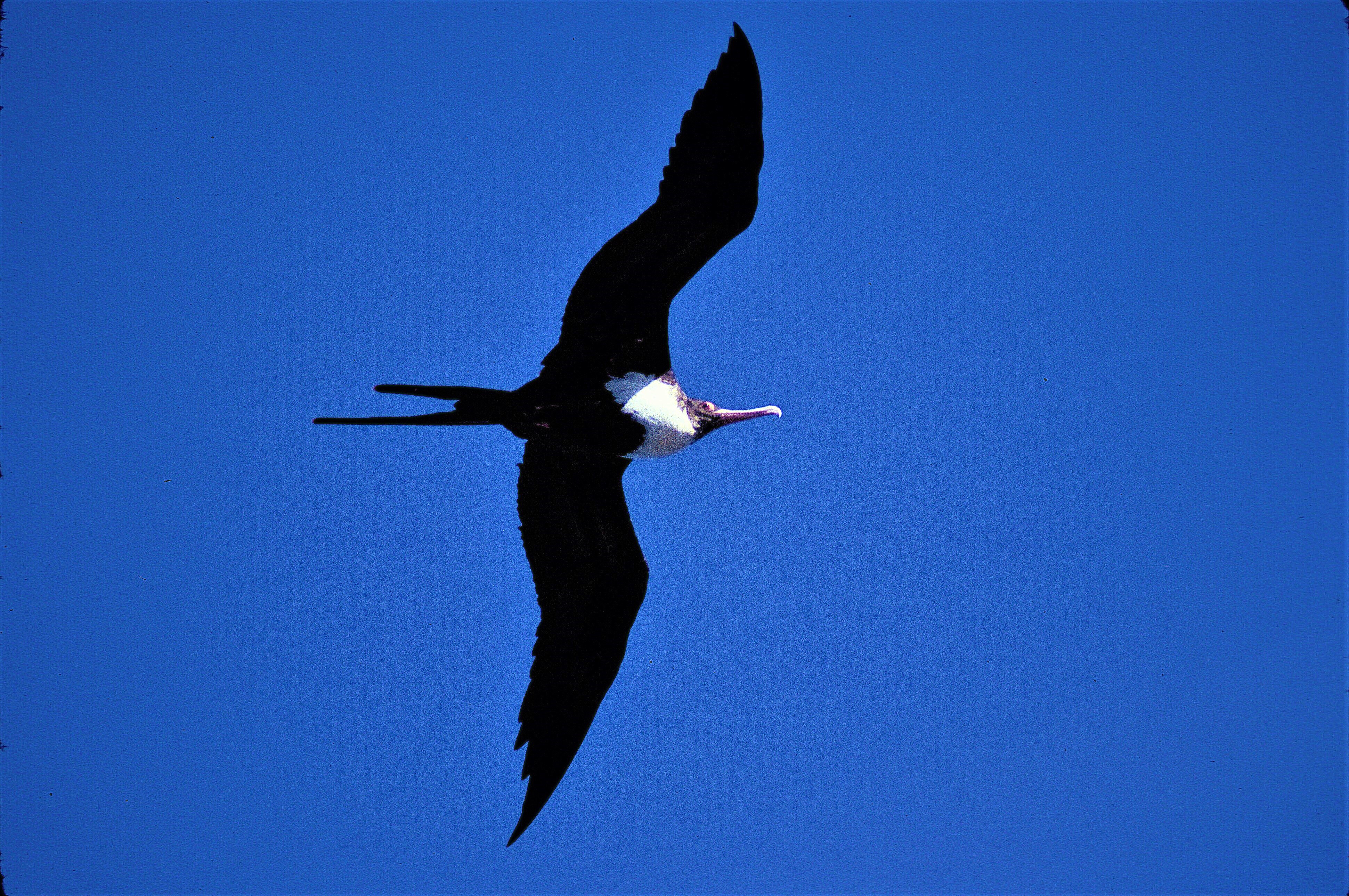
photo: Joe Meche
Great frigatebird
The drivable road ended at Isaac Hale Beach Park, one of several county parks along the east side of the island. The park was named after a Korean War veteran who was killed in action in 1951. The area was the site of a centuries-old fishing village and one of the few places to launch a boat on the southeastern part of the island. It had a good swimming beach with coral reefs that were ideal for snorkeling and large waves for surfers. That all changed with the 2018 lower Puna eruption of Kilauea. The lava flow covered the reefs and left the swimming beach covered with black sand. I saw only fleeting images of birds on the drive, but was delighted to find a relative mother lode of birds at the park. The highlight of my birding day, however, came with a visit by a northern cardinal, a favorite bird from my youth.
On the following day, I talked Cindy into packing a picnic lunch to show her this same unique park. The best parts were that she had places to walk and I had an opportunity to spend more time with the birds I had seen the previous day. Rain from the night before had left puddles here and there that birds utilized for bathing and drinking. All of the birds were colorful introduced species except for the golden plovers which, as it turns out, are quite approachable.
We had a two-day plan for packing and relocating to Hilo to begin our departure phase. Logan came by to take us to a different beach in the afternoon … one that she referred to as an off-road beach. I think she just wanted to show us how capable her Jeep was for any terrain. And once again, the beach was mostly black rock from an older eruption that had been smoothed perfectly by the endless surf. It was a pleasant place to spend time doing nothing.
We left our VRBO on our second-to-last day and returned to the same hotel we stayed in on our first day. Again, with an early flight out the next day, proximity to the airport was a major factor in my choice. The Lili’uokalani Park and Botanical Garden sits on the shoreline of Reed’s Bay in Hilo and it was here that I located one of my target birds … a wandering tattler. Another highlight was the family of nenes, Hawaii’s state bird.
After a visit in this lovely park, Logan took us to a favorite beach at the Kole Kole Gulch Park. As it turns out, this might have been my favorite stop on the trip. Two freshwater streams join and flow into the Pacific in an idyllic setting. Thai food in another favorite restaurant in Hilo topped off a wonderful visit with our host and guide, granddaughter Logan Laura.
Before the sun came up on our last day, we returned our rental car and started the process of getting home, in direct reverse of the way we started. The airport at Hilo is reminiscent of Paine Field in that it’s small and easy enough to navigate. Once we cleared TSA, we began a long day that ended when we pulled into our driveway at 12:30 a.m.! We started at 5 a.m., so it was a long day that included a five-hour layover in Honolulu and a six and a half hour flight to Paine Field. In retrospect, we had a great trip but it left me wondering if I’d ever need to return … all things considered.
_________________________________
Joe Meche is a past president of the North Cascades Audubon Society and was a member of the board of directors for 20 years. He has been watching birds for more than 70 years and photographing birds and landscapes for more than 50 years. He has written over 250 columns for Whatcom Watch.