by Hope Rasa
The Bellingham City Council voted during their regular meeting on Feb. 23, 2026, to extend the city’s interim Landmark Tree Ordinance through Sept. 2026. The ordinance protects “landmark trees” — trees that measure at least 36 inches in diameter at breast height (DBH). Under the ordinance, these trees cannot be cut down or damaged without approval from the city. The City Council originally passed the Emergency Landmark Tree Ordinance on May 20, 2024, and later converted it to an interim ordinance.
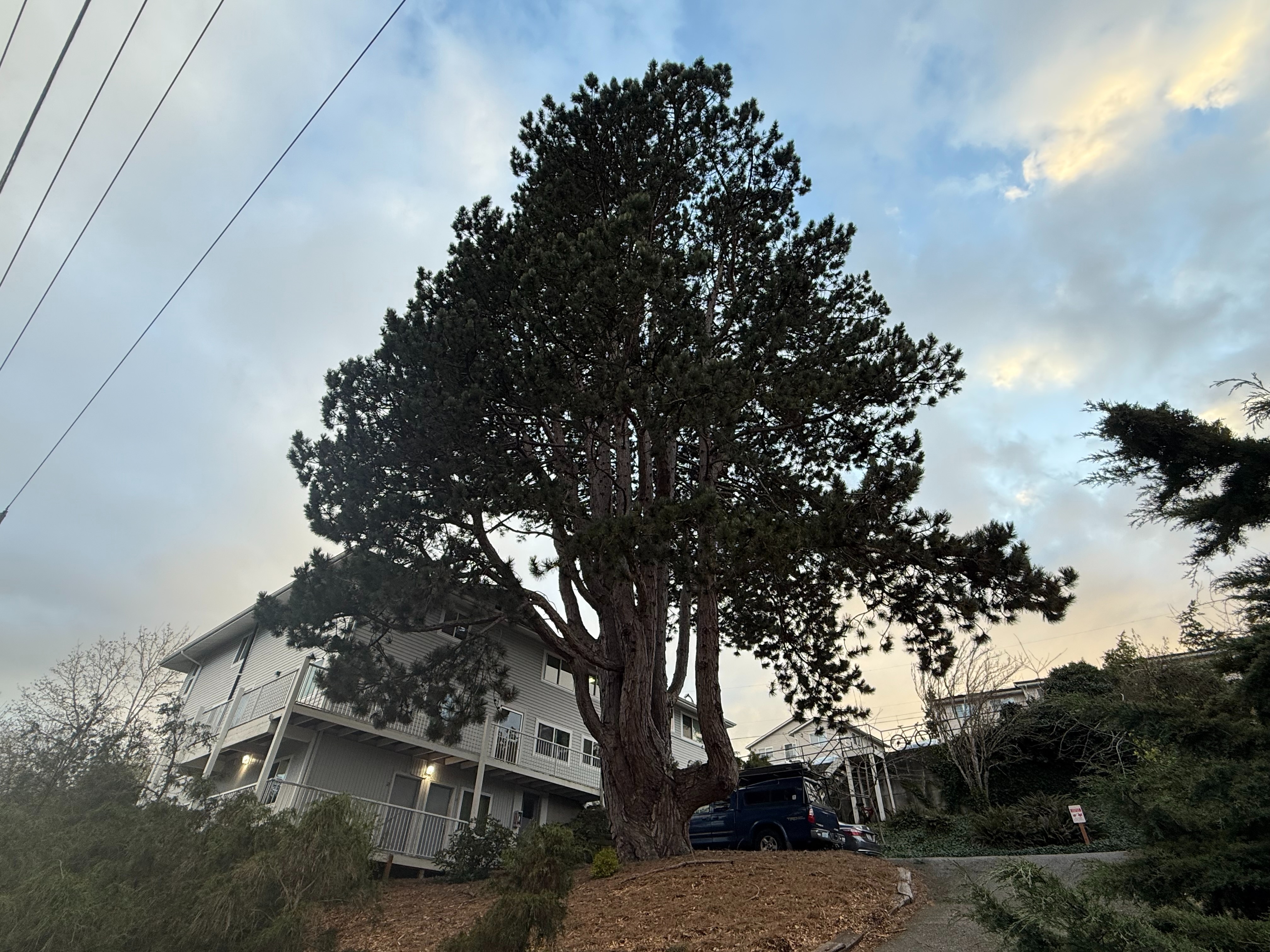
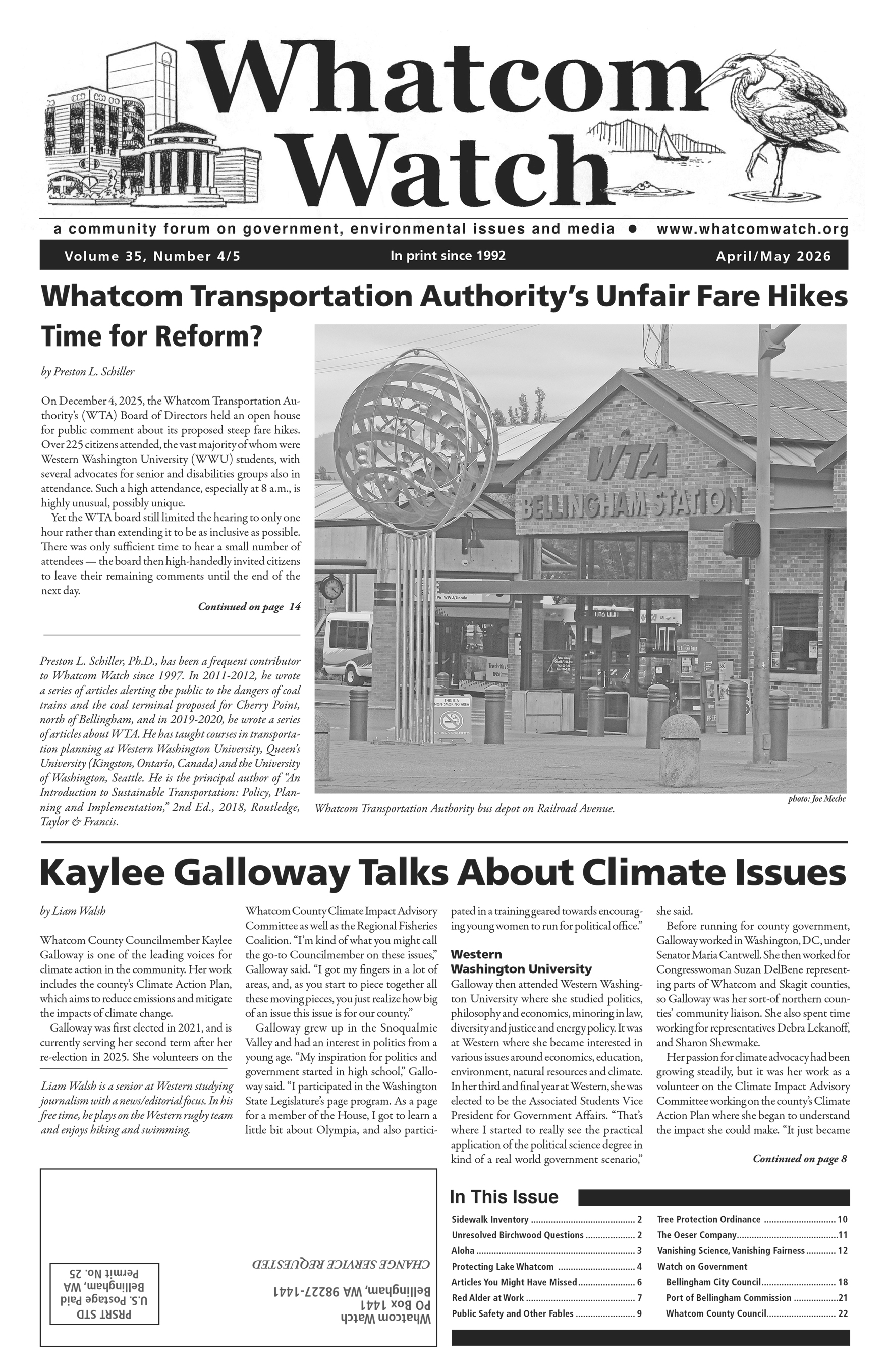
photo: Hope Rasa
A landmark tree in Bellingham, Wash., on 21st Street. The tree is an Austrian Pine with an 80-inch diameter at breast height.
This latest extension to the interim ordinance on Feb. 23, 2026, will give city staff more time to make it permanent. This happens through the Type VI legislative process, which is already underway. This process is what’s required to make the interim ordinance permanent. It involves several steps, including public hearings with the Planning Commission and City Council.
The Emergency Landmark Tree Ordinance became necessary during the development of the Urban Forest Plan, a separate project the city has been working on since 2020. (1) The goal of the Urban Forest Plan is to maintain healthy trees/vegetation within Bellingham.
“What we experienced while going through that process was that there were a number of people in our community that were preemptively taking down trees because they were concerned about the city developing regulations that would otherwise prohibit or prevent them from doing so,” Blake Lyon, the director of Planning and Community Development for the City of Bellingham, said.
Lyon said he couldn’t give a specific number for how many people were preemptively cutting down trees during this period, or how many trees had been cut down. However, Lyon said that he heard about trees being cut down from multiple different sources and locations around the city. So, it wasn’t a specific issue with a particular person or developer, Lyon said. Lyon explained that when landmark trees are cut down, it means losing a decades-old tree.
“We started seeing that [reports of trees being cut down] kind of pop up,” Lyon said. “Given the number of times that we heard it and the kind of broader distribution of that, we said, okay, this is why we needed to do the emergency ordinance.”
Natural Tree Cover Rapidly Decreasing
Infographic: Hope Rasa
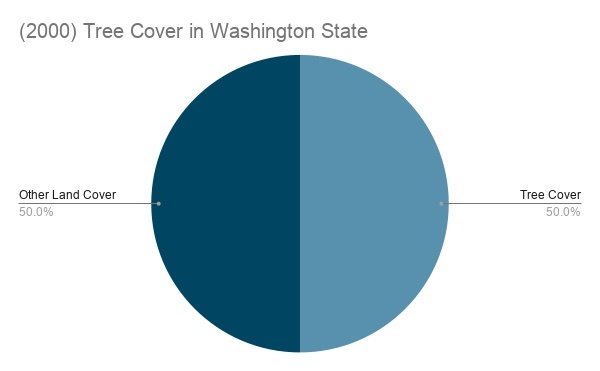
In 2000, 50 percent of land cover in Washington state was tree cover, according to Global Forest Watch. (2)
In Washington state and around the world, natural tree cover is rapidly decreasing. Between 2020 and 2024, Washington state lost 58 kha (equivalent to 143.26 acres) of natural forest. That’s equivalent to 31 Mt (metric tons) of CO₂ emissions. (2)
Infographic: Hope Rasa
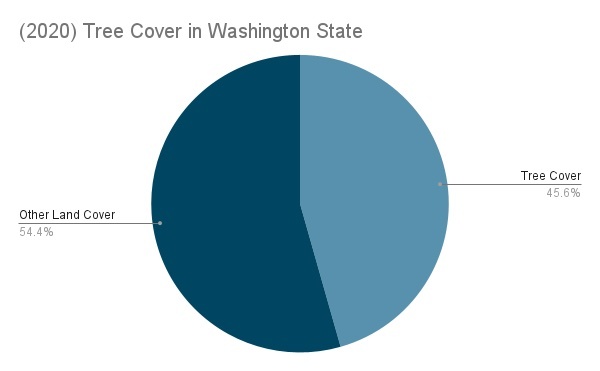
By 2020, only 45.6 percent of land cover in Washington state was tree cover, according to Global Forest Watch. (2)
Start of Type VI Legislative Process
On Feb. 19, 2026, Lyon and other city staff presented the interim ordinance to the Planning Commission to start the Type VI legislative process. The Planning Commission reviews land-use issues like this one and makes recommendations to the city council. At this stage, Lyon said that his team is determining what about the interim ordinance works well and where refinement is necessary. He also said they’ve been reaching out to different interest groups in order to balance competing priorities. The goal is to produce a more permanent replacement for the current interim ordinance that takes as many of these things into account as possible.
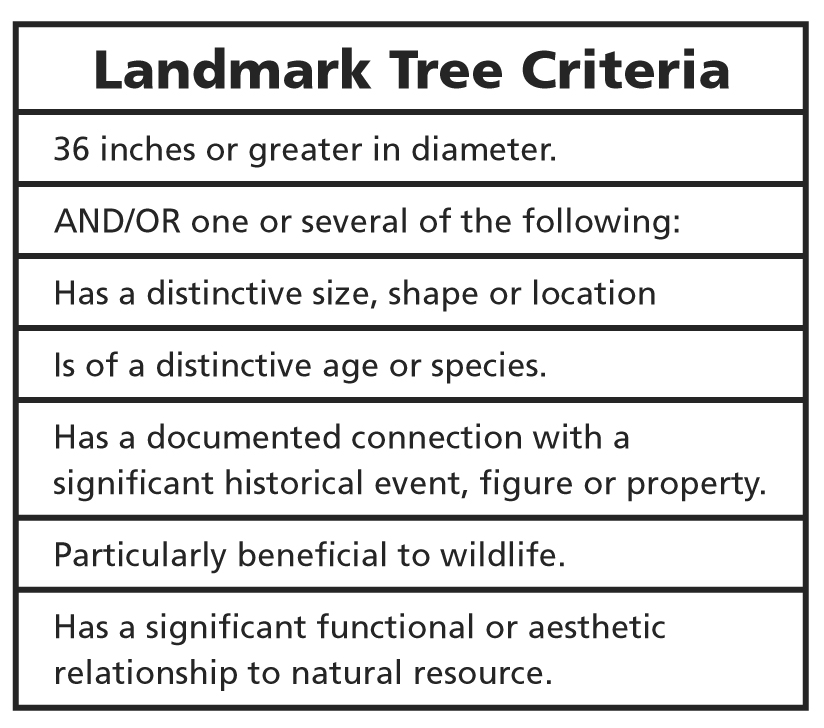
The interim ordinance established a landmark tree inventory, which maps Bellingham’s landmark trees. (3) The inventory is in its early stages and continues to grow. Anyone can nominate a landmark tree by filling out the landmark tree nomination form on the City of Bellingham’s website. (4) Trees that are at least 36 inches DBH are automatically considered landmark trees, even if they haven’t been nominated. However, they won’t appear in the landmark tree inventory unless nominated through the form.
Other trees, ones that aren’t at least 36 inches DBH, can still be nominated for landmark status. Among other things, distinctive size, shape, species, age, or historical significance can all help a tree qualify for landmark status. “Exceptional beauty” was once considered grounds for landmark tree status before a Bellingham City Council decision on July 15, 2024.
Landmark Tree Committee
A person doesn’t need to own the property on which a tree is located to nominate it for landmark status. However, if the tree is less than 36 inches DBH, they will need to complete an additional questionnaire and obtain the property owner’s signature. (5) In addition to the landmark tree inventory, the interim landmark tree ordinance also established a Landmark Tree Committee. The committee reviews landmark tree nominations and makes recommendations for approval to Lyon.
Violating the ordinance — cutting down or harming landmark trees without approval from the city — results in an $800-$5,000 fine per violation. Regular pruning and maintenance isn’t considered a violation of the ordinance.
It’s still possible to remove a landmark tree, if necessary. Under the ordinance, Lyon can approve the removal of a landmark tree if it’s necessary to enable construction, maintain utilities, or if the tree is hazardous.
Lyon said it’s certainly not ideal to operate under an interim ordinance for an extended period of time. He and his team, Lyon said, want to give their community better clarity on the best way to move forward. “There have been times where people are not sure how long the interim ordinance is going to last and how dramatically the rules are going to change,” Lyon said. “It’s a little bit of being in a state of uncertainty for, you know, what the rules are moving forward.”
While a long-term replacement for the interim ordinance is in the works, Lyon said another six month extension is certainly a possibility, although he doesn’t anticipate it at this point. The latest six-month extension to the interim ordinance was also meant to allow time to evaluate the implications of House Bill 2267. (6) HB 2267 didn’t pass out of the originating chamber, so it won’t be moving forward. HB 2267 would have required the Washington State Department of Commerce to provide guidance on urban forest management to local governments. This would have impacted the handling of landmark trees, as well as a broad range of other things.
Seeking Public Input
While working on setting up a long-term replacement for the interim ordinance, Lyon and his team are seeking public input. If these comments from the public are fairly concise, they may be able to finish the Type VI legislative process before the latest six-month extension runs out. If public input reveals that people generally want to go a different direction or make significant changes to the landmark tree policy, it might take longer than six months to get that set up.
“We don’t want to shortchange the community’s input process and the Planning Commission’s [input],” Lyon said.
Coordinating with the Planning Commission and other city staff could also delay the Type VI legislative process past the six-month extension. During the Type VI legislative process, Lyon and his team have to present their work-in-progress landmark tree policy to the Planning Commission, which then makes a recommendation to the City Council. Then, Lyon and his team present it to the City Council.
“And so, if they [the Planning Commission and/or the City Council] feel like, hey, they need more time to evaluate it, or they need additional considerations to be vetted out, we want to give it the time that it needs to get those done,” Lyon said.
Improved Communication
Right now, Lyon said that the interim ordinance is doing some things well. For one, developers are coming to the city early in their construction processes and asking questions about the preservation of landmark trees. Lyon said he also thinks there’s a lot more communication between various city departments about these issues.
At the Bellingham City Council’s regular meeting on Feb. 23, 2026, Bellingham resident Adam Bellinger spoke during the public hearing section about possible unintended consequences of the interim ordinance. Bellinger said that, due to the sheer number of wooded areas in this city, there are a very large number of landmark trees. Bellinger said his parents have lived in the Samish neighborhood for 50 years, and their property contains several trees that have just about reached the 36-inch diameter minimum to become landmark trees.
“Financially, this incentivizes them to basically clear-cut all those lots to maintain the viability of them to become buildable,” Bellinger said. “So that doesn’t seem to meet the intended desire of the city and the council and everybody to try and keep forested neighborhoods.”
Lyon said that he and other city staff have heard a range of comments like this before. Some people believe that the bar is too low for trees to qualify as landmark trees and that the minimum of 36 inches DBH should be placed higher. Lyon said that, in considering issues like these, from a staff perspective, they look at what other comparable jurisdictions are doing.
“We’re looking at what we feel like is in the best interest of our community and health and longevity of our natural resources here in the city, and so we kind of balance that out,” Lyon said.
Landmark trees can present roadblocks for construction. Not being able to remove a landmark tree can leave less space to build on a lot. However, the interim ordinance allows people to communicate and work with the city in order to determine if removing a landmark tree is reasonable for construction or some other reason. The city helps look for opportunities to work around landmark trees during construction; cutting it down is a last resort. Bellingham is one of many cities struggling with a need for housing. It’s a balancing act trying to prioritize new housing construction while preserving landmark trees.
When it comes to room for improvement, Lyon hopes to clear up some vague language in the interim ordinance and give people more clarity in terms of when it’s acceptable to remove a landmark tree. “I think there’s also some things that we’re learning and that we can improve on how we do our application process and how we do our kind of coordination of project reviews and permitting reviews,” Lyon said.
__________________________________
Hope Rasa is a journalism – news/editorial student at Western Washington University with a passion for environmental awareness. Her previous reporting for The Front covered local social issues such as public health, incarceration and education. Hope’s interest in journalism began when she joined her high school newspaper. She wishes to continue reporting on pertinent and under-reported topics in Bellingham and the rest of Whatcom County
References:
- “Urban Forest Plan.” City of Bellingham, https://cob.org/services/planning/environmental/ufmp.
- “Washington, United States Deforestation Rates and Statistics.” Global Forest Watch, https://www.globalforestwatch.org/dashboards/country/USA/48/.
- “Landmark Tree Protection.” City of Bellingham, 23 March 2026, https://cob.org/services/environment/trees/tree-protection.
- “Landmark Tree Nomination Form.” Survey123, https://survey123.arcgis.com/share/dc8e40eff7bb4440a5a0221c75e394b9.
- “Notification of Landmark Tree Nomination.” City of Bellingham, 16 May 2025, https://cob.org/wp-content/uploads/Property-Owner-Notification-Landmark-Tree.pdf.
- “HB 2267-2025-26.” Washington State Legislature, 2 April 2026, https://app.leg.wa.gov/BillSummary/?BillNumber=2267&Year=2026.