photo: Hope Rasa
detail of Squalicum Creek photo
(see full photo below)
by Hope Rasa
The City of Bellingham (COB) has delayed until 2028 and possibly later a construction project that will benefit salmon and trout. The Squalicum Creek at Baker Creek Fish Passage Improvement Project (EN059) will remove two pieces of infrastructure, one in Squalicum Creek and another in Baker Creek, to make it easier for fish to swim through both areas.
Additionally, the project will install native plants, floodplain benches and large woody material (branches and logs, which benefit the ecosystem) to enhance the stream habitat.
Stefanie Cilinceon, the communications and outreach coordinator for the COB’s Public Works Department, said in an email that construction is delayed due to a funding shortfall caused by increased design and construction costs.
“Cost increases for fish passage projects have become a common experience for partners throughout the region due to a variety of factors, including supply chain, complexities identified during design, and the need for extended construction periods to meet both access and in-stream fish protection windows,” Cilinceon said over email.
The project at Squalicum Creek and Baker Creek was previously anticipated for 2027, with construction bidding expected to happen in late 2026. (1)
Cilinceon also said in an email that construction is now tentatively scheduled for 2028-2029. She said that the COB is actively applying for additional grant funds. If awarded, Cilinceon said that funding will allow construction bidding to take place in late 2027 or later.
Design for the project at Squalicum Creek and Baker Creek is 90 percent complete. (1) Part of the design is being revised to lessen long-term maintenance and operation costs.
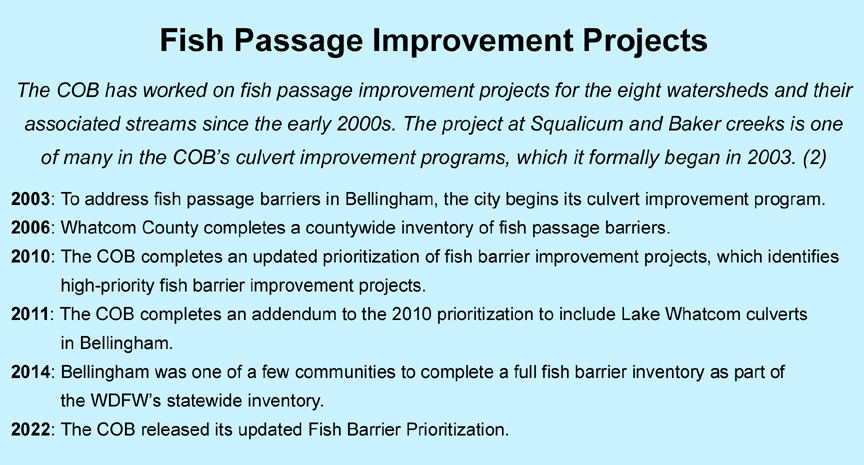
This voluntary fish passage project honors a Memorandum of Agreement that the COB entered into in 2022 as part of a shared commitment to fish passage improvement. (2) This Memorandum of Agreement is with the Nooksack Tribe, the Lummi Nation and the Washington Department of Fish and Wildlife (WDFW).
Project Funding
Inflation is making it harder for fish passage improvement projects like the one on Squalicum Creek and Baker Creek to receive adequate funding. Joel Ingram, a fish passage biologist with WDFW, said that this has been more of a problem over the past two to three years.
“And professional services have also gone up pretty substantially,” Ingram said. “So that’s the engineering cost, that’s the consulting cost, that’s a variety of auxiliary costs that go into the planning, the design and eventually, the implementation of these large infrastructure projects.”
Ingram works in the WDFW’s fish passage section and reviews projects like this one for state funding through the Brian Abbott Fish Barrier Removal Board (FBRB). (3) The project at Squalicum Creek and Baker Creek receives its funding through a grant that the Brian Abbott FBRB awarded in 2023. The FBRB reviews applications for fish barrier removal projects, such as the one at Squalicum Creek and Baker Creek, which come with an outlined budget.
“Over the last several years, we’ve had pretty high inflation — increase in costs associated with those projects — and they’ve exceeded those original budgets,” Ingram said. Some of the sponsors for these projects have had to come back and request additional funding on top of what they already received to close the funding gap, Ingram said.
“In many instances, we’ve been able to accommodate those requests,” Ingram said. “However, in the Squalicum project specifically, the request was pretty substantial, and we were not able to fully make that project whole as far as the cost goes.”
Ingram said that during the Brian Abbott FBRB 2023-2025 Grant Round, when the project at Squalicum Creek and Baker Creek received its funding, the FBRB funded 99 other projects in Washington state. Some of those projects have experienced budget increases, too.
Removing the Weir on Squalicum Creek
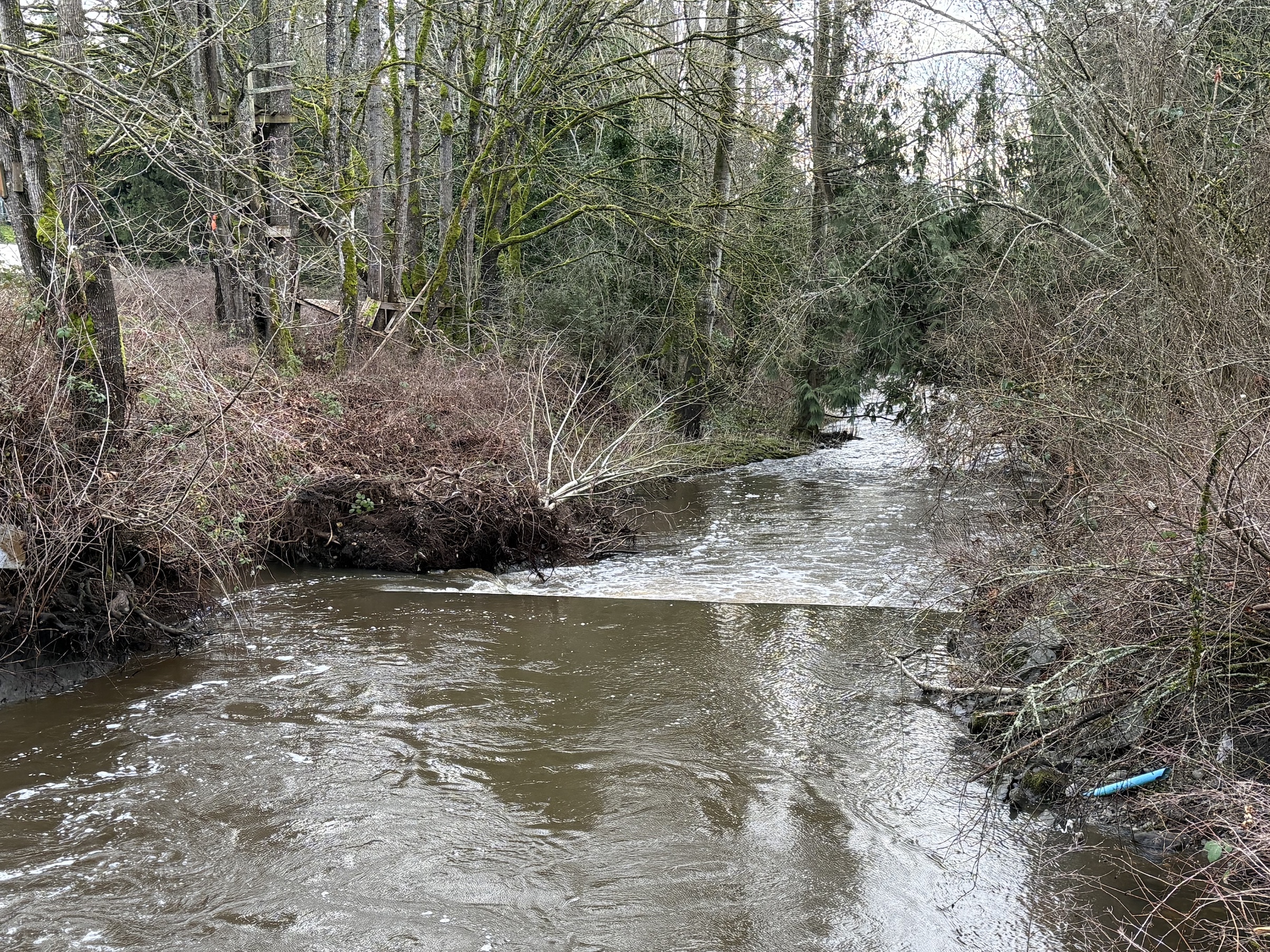
photo: Hope Rasa
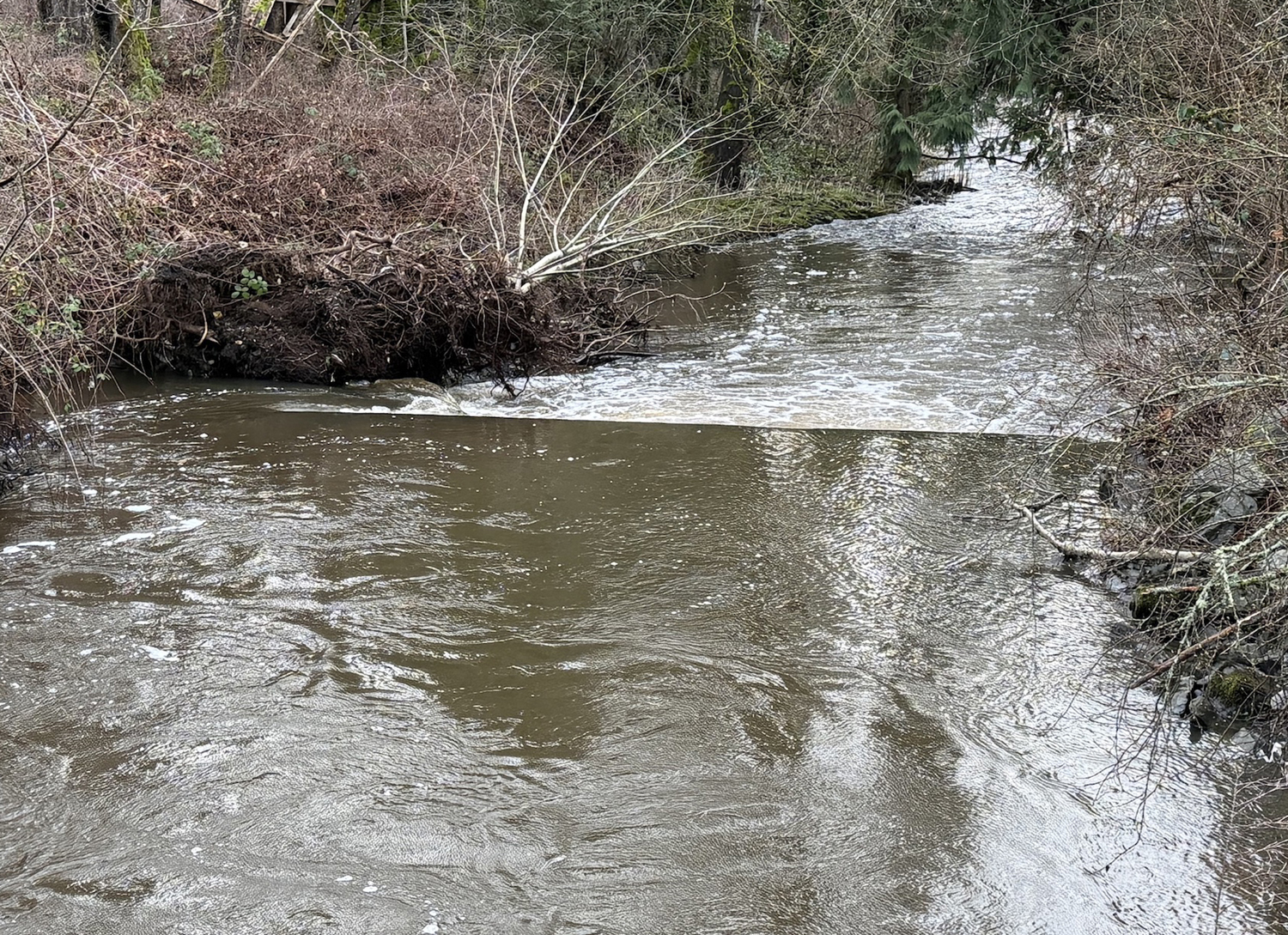
Photographed from upstream, water in Squalicum Creek flows over the weir.
This project will remove a weir from Squalicum Creek and regrade the stream. The WDFW considers the weir on Squalicum Creek a partial fish passage barrier. The weir in Squalicum Creek is near and upstream from a culvert crossing in Baker Creek, where that stream passes under Squalicum Way.
“That weir, we believe, was put in place to backwater the crossing underneath Squalicum and make it better for fish passage,” Ingram said. A weir is a low dam built to raise the upstream water level. The one on Squalicum Creek is 29 feet long and 2 feet tall, causing a significant surface water drop. This limits fish passability to only 33 percent. (4)
“The problem with a weir or a fully crossing stream channel structure like that is that it creates an artificial water surface drop,” Ingram said. “And sometimes that water surface drop becomes large enough that fish can’t get past it.”
Ingram said this is especially true for smaller fish. He said that larger fish, like coho salmon, are often able to get past obstructions in the stream channel, like the weir in Squalicum Creek. However, Ingram said that they’re considering all fish at all life stages.
The weir on Squalicum Creek restricts these fish
from spawning and rearing habitats:
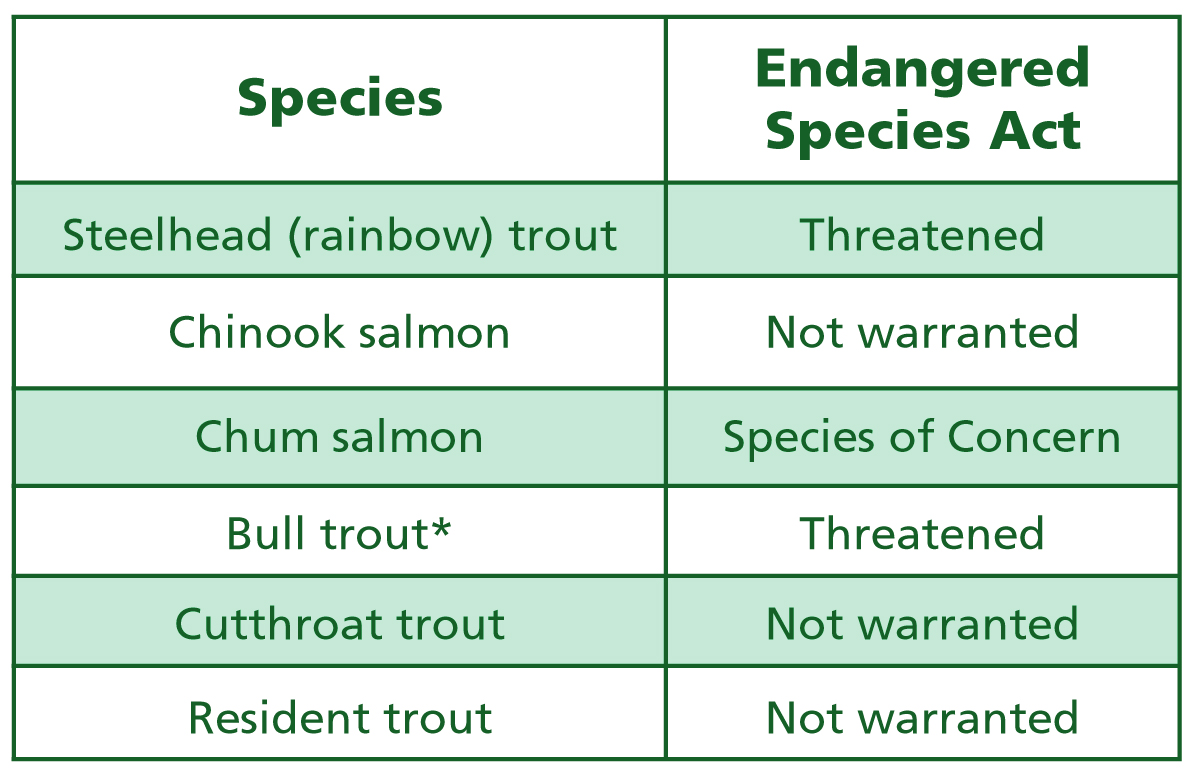
*The presence of bull trout in the project area is presumed. Bull trout are very rare or absent in the project area. The most recent documented occurrence was in 1970. (5)
Replacing the Culvert on Baker Creek
In addition to removing the weir on Squalicum Creek, this project will also remove a culvert on Baker Creek. A culvert is a tunnel that carries a stream underneath a road. Baker Creek, which is a tributary of Squalicum Creek, has a culvert on it where the stream passes under Squalicum Way — a major road in Bellingham. The culvert is just upstream of the weir on Squalicum Way. Except for the Chinook salmon, the site of the culvert on Baker Creek has all the same species of fish as the weir on Squalicum Creek. (5)
The culvert on Baker Creek is a 5-foot by 5-foot box culvert. It’s shaped like a double-barreled square tunnel. Box culverts are a type of culvert commonly used for railway and road crossings and are beneficial for preventing flooding and erosion.
Right now, the WDFW doesn’t identify the culvert on Baker Creek as a fish barrier. (6) This wasn’t always the case, but the WDFW retrofitted the culvert with a fishway in 2005. (6)
While the culvert isn’t a fish passage barrier on its own, the weir on Squalicum Creek makes it problematic. The weir on Squalicum Creek artificially elevates the water surface level, making it higher than the culvert. After the weir is removed, the elevation will drop, causing the culvert to become a fish passage barrier. (1)
Once it’s removed, the culvert will be replaced with a fish-passable bridge (fishway). (5) Fishways are structures that allow fish to travel through culverts or other obstructions. (7) Ingram said that the fishway will have some habitat-related features, like large woody material.
Upstream from the culvert, there’s an old bridge originally used for the BNSF Railway Company that runs adjacent to Squalicum Parkway. Ingram said the project will involve removing this bridge. “So, that’s getting creosote [material used in the bridge] and other poor water quality generating materials out of the water system,” Ingram said.
Squalicum and Baker Creeks
The health of Squalicum Creek’s ecosystem is impaired (8), but it has the potential to provide fish habitat and better water quality in Bellingham. Some of the problems facing the health of Squalicum Creek’s ecosystem include fish passage barriers, salmon stock declines and issues with water quality. Parts of Squalicum Creek exceed Washington state standards for water temperature, fecal coliform bacteria and dissolved oxygen. (8)
Squalicum Creek is one of eight watersheds in Bellingham. (9) Watersheds are where all the water from rainfall, springs and snowmelt channel into a lake, river, or another body of water. (10) Bellingham’s watersheds drain water from the land, lakes and streams into the Bellingham and Chuckanut bays. Baker Creek and several other tributaries flow into the 13.2 square mile Squalicum Creek watershed, which flows into Bellingham Bay. (8)
Near the project work area, the COB and the Washington State Department of Transportation have carried out a number of other projects over the years. The project at Squalicum Creek and Baker Creek will help fish access habitat that the city restored with past improvement projects, such as Squalicum Creek Re-Route Phases 1-4. (11) Among other things, the Squalicum Creek Re-Route project reduced stream temperatures by restoring a manmade lake into a wetland. The final two phases of the Squalicum Creek Re-Route were constructed in 2020, and Phases 1-2 were constructed in 2015.
Fish Barrier Prioritization
Removing the weir from Squalicum Creek is a high priority for the COB based on their Fish Barrier Prioritization. (4)(2) This prioritization highlights fish barriers in Bellingham that are a high priority for improvement projects. The 2022 update of this prioritization includes the latest WDFW barrier assessments from its Fish Passage and Diversion Screening Inventory (FPDSI) database. (12)
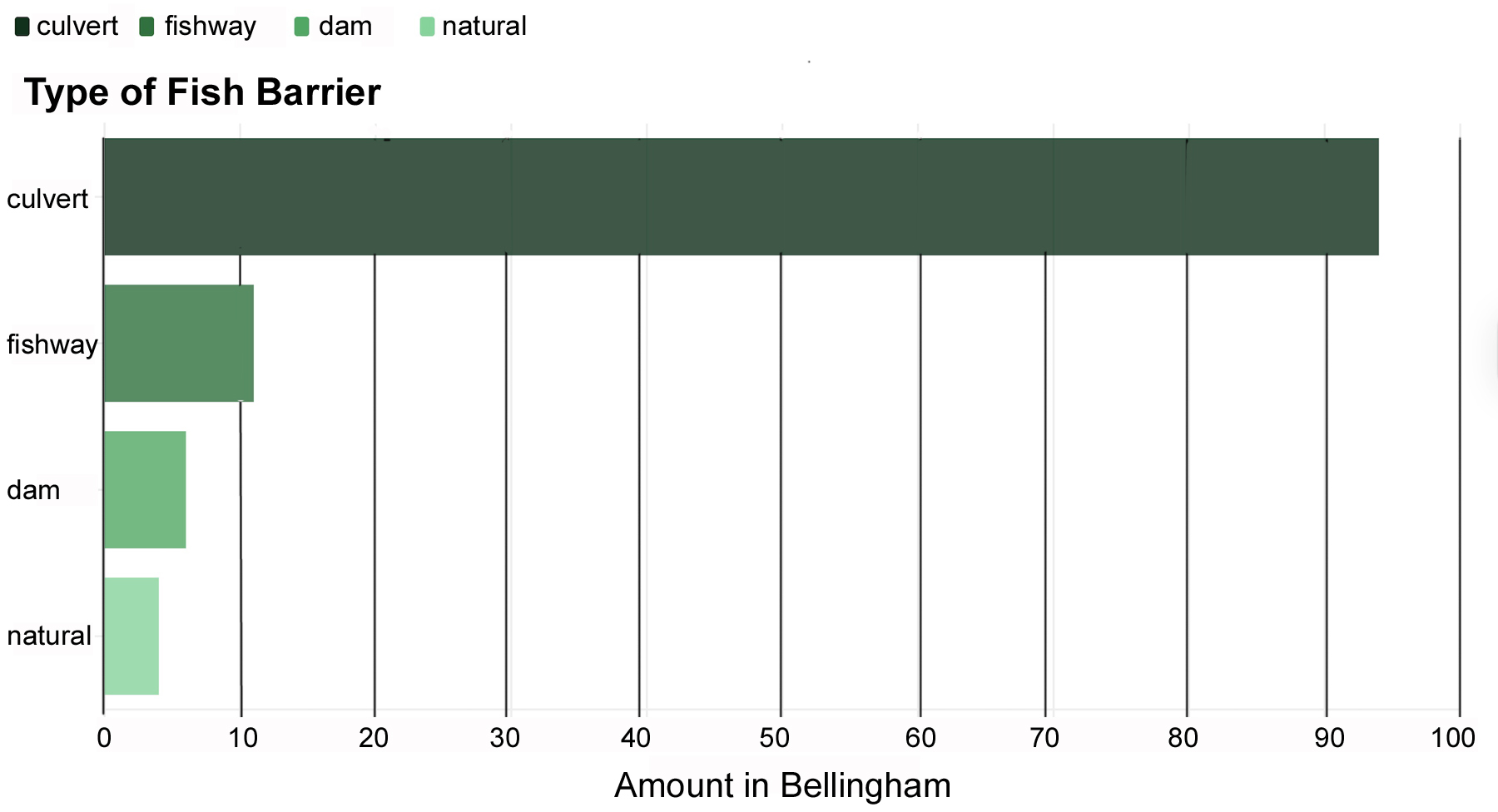
In 2014, the WDFW conducted a statewide inventory of fish passage barriers. This data, along with subsequent inventory updates, is available on the WDFW’s FPDSI database. (6) As of February 2025, the FPDSI database lists 104 structures in Bellingham as fish passage barriers.
__________________________________________
Hope Rasa is a journalism – news/editorial student at Western Washington University with a passion for environmental awareness. Her previous reporting for The Front covered local social issues such as public health, incarceration and education. Hope’s interest in journalism began when she joined her high school newspaper. She wishes to continue reporting on pertinent and under-reported topics in Bellingham and the rest of Whatcom County.
Endnotes
- “Squalicum Creek at Baker Creek Fish Passage Improvement Project.” City of Bellingham. https://cob.org/project/squalicum-baker . Accessed 1 Feb. 2026.
- “Fish Passage Improvements.” City of Bellingham. https://cob.org/services/environment/restoration/culverts . Accessed 3 Feb. 2026.
- “Brian Abbott Fish Barrier Removal Board.” Washington Department of Fish and Wildlife. https://wdfw.wa.gov/about/advisory/fbrb . Accessed 3 Feb. 2026.
- “2022 City Of Bellingham Fish Barrier Prioritization.” Public Works Department: City of Bellingham, Dec. 2022. https://cob.org/wp-content/uploads/Fish-Barrier-Prioritization.pdf?pdftype=e
- Spann, Grace, et al. “Preliminary Design Report: Squalicum Creek Weir and Baker Creek Crossing Fish Passage Project, Bellingham, Washington.” City of Bellingham, 28 April 2022. https://cob.org/wp-content/uploads/EN059_Preliminary-Design-Report-Squalicum_COB.pdf?pdftype=e
- “Washington State Fish Passage.” Washington Department of Fish and Wildlife. https://geodataservices.wdfw.wa.gov/hp/fishpassage/index.html . Accessed 1 Feb. 2026.
- “Fish passage rule making.” Washington Department of Fish and Wildlife. https://wdfw.wa.gov/species-habitats/habitatrecovery/fish-passage/rule-making . Accessed 1 Feb. 2026.
- “Squalicum Creek.” City of Bellingham. https://cob.org/services/environment/restoration/squalicum-creek . Accessed 31 Jan. 2026.
- “City Watersheds.” City of Bellingham. https://cob.org/services/environment/restoration/city-watersheds . Accessed 31 Jan. 2026.
- “What is a watershed and why does it matter?” Washington State Department of Ecology. https://ecology.wa.gov/ecologys-work-near-you/river-basins-groundwater/what-isa-watershed-and-why-does-it-matter . Accessed 31 Jan. 2026.
- “Squalicum Creek Re-route Phases 1-4.” City of Bellingham. https://cob.org/services/environment/restoration/squalicumcreek-reroute . Accessed 1 Feb. 2026.
- “Fish passage inventory, assessment, and prioritization.” Washington Department of Fish and Wildlife. https://wdfw.wa.gov/species-habitats/habitat-recovery/fish-passage/assessment . Accessed 1 Feb. 2026.