Native Plant Neighbors
by Eric Worden
All the world over, even among the most dissimilar cultures, I wonder: is there any fruit more universally loved than the strawberry? Unlike most other wild berries, I think that most people, even the city-born ones, will be rightly tempted to pluck and eat a ripe wild strawberry that they find in nature. Also universal, in my experience of walking trails with other people, is the sudden interruption of conversation with a leap, a pointed finger, and an exclamation: “Strawberries!”
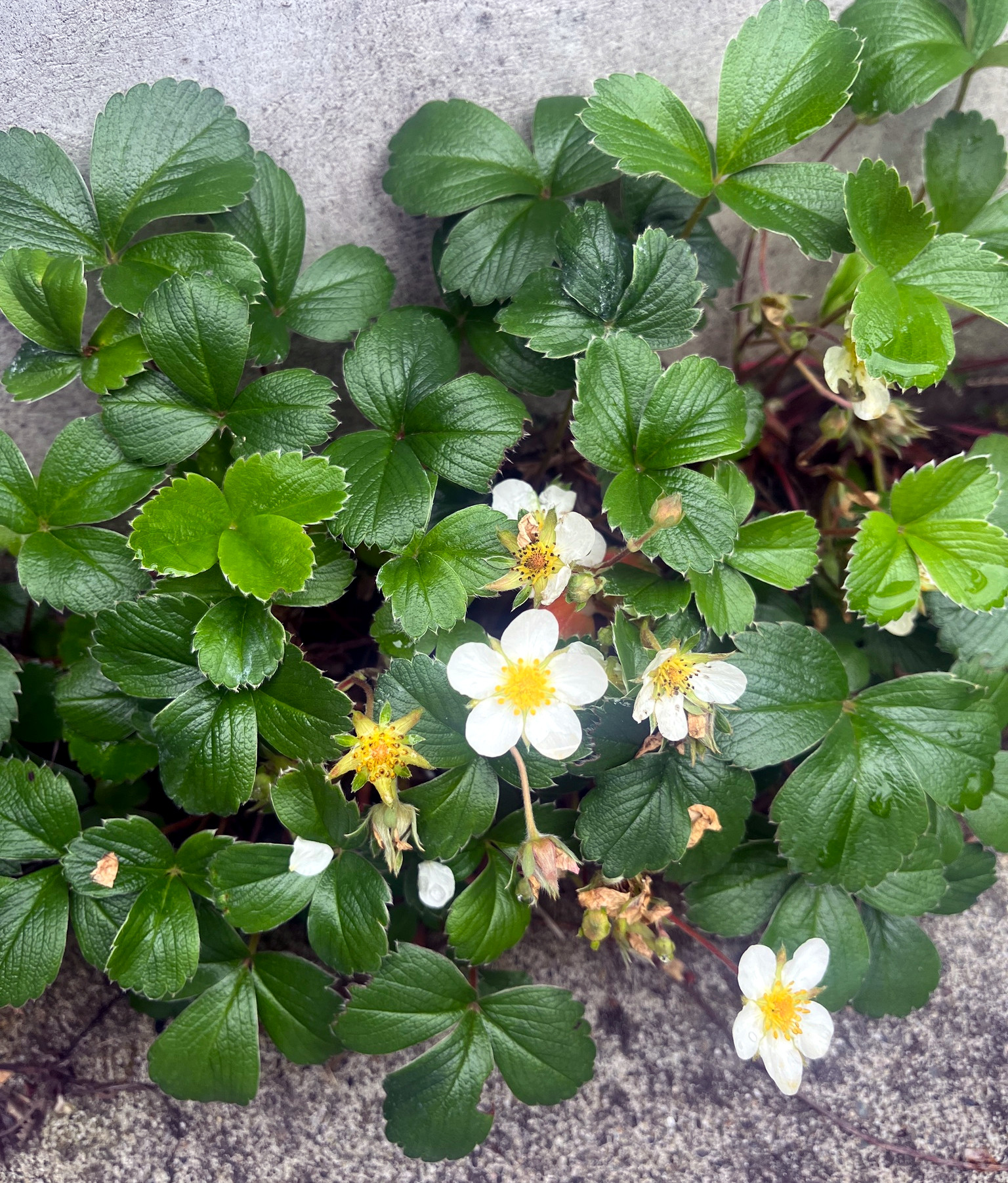
photo: Logan Stecker, CC0 via iNaturalist
Beach strawberries (Fragaria chiloensis).
In Whatcom County, there are four species of wild strawberry: three of them are commonly found and one found only rarely. Around the world, there are about 20 species. Unless you’re a botanist, you may find it tedious learning to distinguish one species from another. They all are found in sunny places, some preferring low elevation areas and some preferring middle elevation mountain areas. One species prefers the beach. The visible differences are in characteristics like the placement of leaf hairs or the shape of a particular leaf notch.
The berries of all of them — at least locally — are similarly delicious and similar in appearance. The berries of one of the common species, Fragaria vesca, can be readily distinguished from the other Fragaria species by the tiny seeds that project from the berry surface, giving it a pimply appearance. Locally, you can find an exemplary field of beach strawberry at the new beach installed in Bellingham’s Boulevard Park, near the cafe.
History Explained by Genetics
The cultivated strawberry found in markets worldwide is a hybrid of two North American species found locally: the beach strawberry (F. chiloensis) and the Virginia strawberry (F. virginiana). Though strawberries of many species have been eaten and cultivated worldwide for millennia, this particular hybrid — called F. x ananassa — was found superior for cultivation.
The story of strawberry speciation through geologic time, and the story of strawberry hybridization by humans, have a common thread in stories of genetics. Many strawberry species that share territory, such as our F. virginiana and F. vesca, are incapable of hybridizing due to their incompatible genetics — specifically, their respective number of copies of chromosomes, or ploidy. Humans, for example, each have two copies of chromosomes (2-ploid or diploid), as do most animals. Plants are more variable in this respect. F. virginiana and F. chiloensis both have eight copies of their chromosomes: they were readily hybridized into garden strawberries. F. vesca has two copies, and the rare local species F. cascadensis has 10 copies!
These last two species can’t hybridize with any others. Our superior 8-ploid (or octaploid) species, when brought to Europe and Asia in the 1700s, were incapable of hybridizing with their local species because of similar incompatibilities. So, our local species conquered the world. Don’t indulge in too much local pride though: the beach strawberry F. chiloensis is found on western coasts down into Chile, and F. virginiana is found widely in North America.
What Is a Strawberry?
Strawberries are members of the rose family of plants. The rose family includes many crop and horticultural species such as roses, apples, plums, cherries, and also two local native species previously profiled in this column: osoberry and large-leaved avens. Except for the osoberry, all these plants have very similar-looking flowers: five roundish simple petals, white or pink, surrounding a disc with innumerable stamens and carpels (male and female reproductive parts). Ask a child to draw a flower and they are likely to draw a rose family flower, or perhaps an aster family flower like the asters featured last month. Bees love rose family flowers, including strawberry flowers, because of the abundant pollen provided.
Strawberry fruits differ anatomically from other familiar rose family fruits. How delightful for nature to dispense with the large hard seeds that interrupt our enjoyment of other fruits! The tiny seeds on the outside of the fruit create a pleasing, barely noticeable crunch. However, for the botanists and pub trivia athletes among us, I need to explain that in terms of botanical anatomy: the red fleshy part of a strawberry actually is a swollen part of the flower called the receptacle, while what we commonly call the seeds are actually tiny dry fruits called achenes, which each enclose a seed.
A Keystone Species Supports Wildlife
Finally, strawberry plants are exceptional in a way that may be unexpected to you. Their leaves and roots are utilized as food by an amazing diversity of insects, especially moth larvae, much more so than many other species. Such species are called “keystone” species, metaphorically referring to the keystone of a stone arch that holds up the entire arch in the center.
Through his research at the University of Delaware, Dr. Doug Tallamy and his team found that only 14 percent of plant species — the keystones — support about 90 percent of moth and butterfly species. Of the Native Plant Neighbors profiled so far, the hard-working alder is the greatest keystone species, supporting over 200 species of moths, and huge masses of them. The small strawberry also carries more than its share, hosting about 70 species, some of them dependent on strawberries alone.
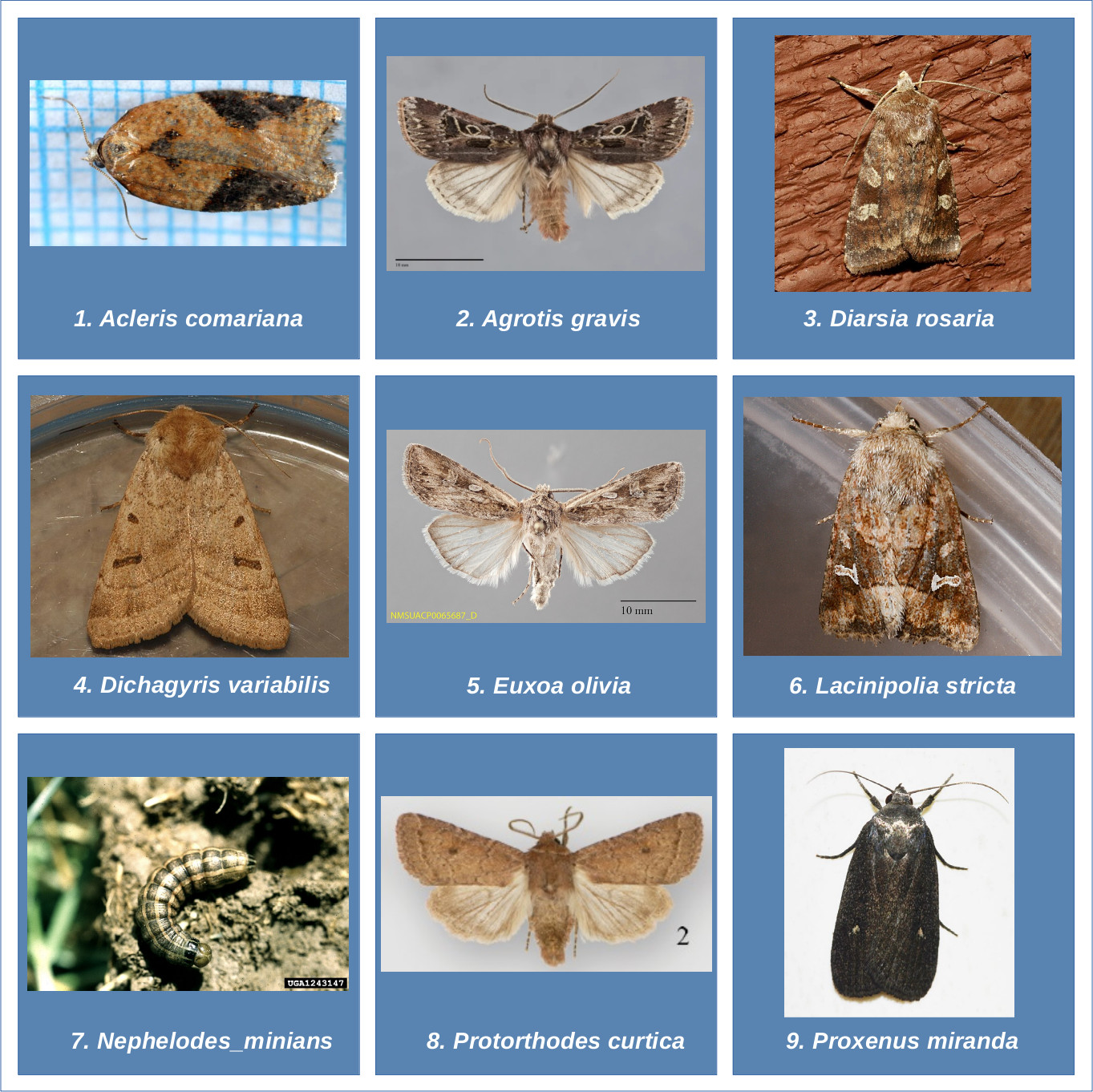 A small selection of the roughly 70 moth species that depend on strawberry plants.
1. Magne Flåten, Magnefl, CC BY-SA 4.0, via Wikimedia Commons
2. Merrill Peterson, CC BY-NC, via PNW Insects.
3,4,6. CBG Photography Group, Centre for Biodiversity Genomics, CC0, via Wikimedia Commons.
5. NMSU, CC0, via Wikimedia Commons.
7. Whitney Cranshaw, Colorado State University, Bugwood.org, CC BY 3.0 US, via Wikimedia Commons.
8. Lafontaine JD, Walsh JB, Ferris CD, CC BY 3.0, via Wikimedia Commons.
9. Andy Reago & Chrissy McClarren, CC BY 2.0, via Wikimedia Commons.
In the photo above, I’ve pictured a selection of the strawberry-utilizing species found by Dr. Tallamy’s team. Moths are small and drab, and attract little attention from people, but their larvae (caterpillars) are extremely important food for small animals, including small, drab, unseen animals like mice and shrews, but also the charismatic and beloved birds. Let this knowledge expand your appreciation of wild strawberries as you enjoy snacking on them in nature.
All three species of our native strawberries can be found at local native plant nurseries. To learn more about wild strawberries, visit the Washington Native Plant Society at wnps.org.
___________________________
Eric Worden is a lifelong amateur naturalist and the chair of the Koma Kulshan chapter of the Washington Native Plant Society.
References:
- “Keystone Plants by Ecoregion,” National Wildlife Federation, www.nwf.org/keystoneplants
- “Fragaria,” Wikipedia