Native Plant Neighbors
by Eric Worden
If you think of your native plant neighbors as I do, you can imagine them as human characters. Can you think of a local forest plant that is extraordinarily tough, yet comely, elegant, and modest? One that is guarded yet giving? If I were better read in literature, I might recall a classic chivalrous hero; instead I’m thinking of Viggo Mortensen’s portrayal of Aragorn in the movie Lord of the Rings.
I’m thinking of the heroic shrub named low Oregon grape, also known as “dull” or “Cascade” Oregon grape. Its leaflets are stiff and prickly, yet arrayed in orderly pairs along a graceful fern-like arch. At this time of year, you can find it abundantly in most forests west of the Cascades, especially the drier ones. In January, while most shrubs are bare and shivering, having dropped their leaves, low Oregon grape’s foliage persists pristinely, even through our hardest freezes. I call it “modest” because it usually grows only one or two feet tall, and “giving” because of the juicy berries it offers to wildlife: and a lot of them for the size of the plant.
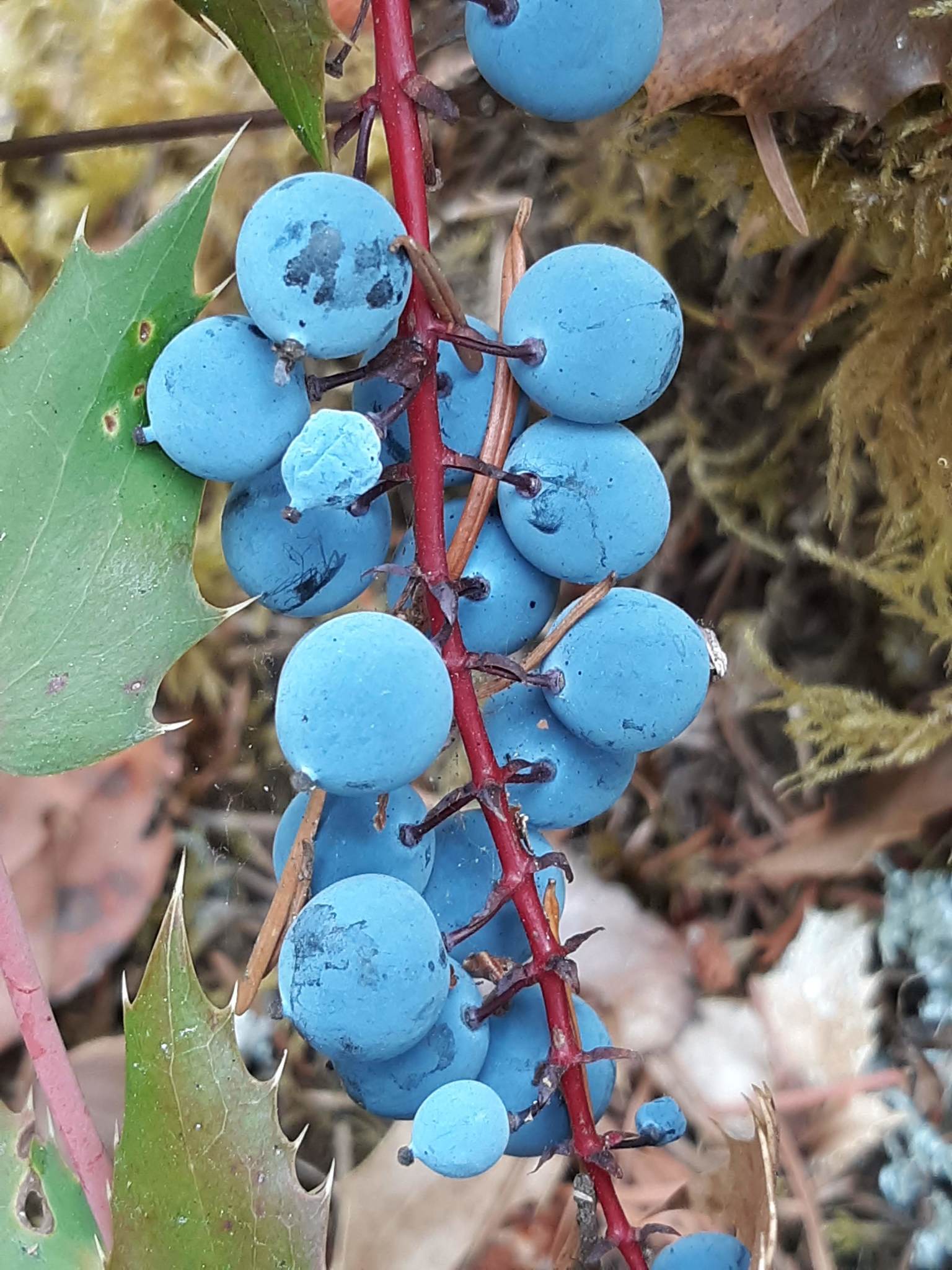
photo: Joshua Morris
Low Oregon grape berries
Prefers Dry Shade
In the garden, this plant is most heroic in that terrible dead zone we all know: dry shade. Low Oregon grape will remain healthy under full shade in the most miserably dry, thin, rocky, or shallow soil. It prefers shade and appreciates some water, but it will grow — and remain attractive — almost anywhere except saturated soils.
Once established, it will slowly spread by underground rhizomes; that’s welcome because, like ferns, its wave-like fronds look attractive in groups. For the gardener, the greatest difficulty may be finding plants for purchase. Reportedly, nurseries have difficulty raising the seedlings in pots. I’m a big fan of this heroic plant and my garden has a lot of dry shade, so this fall I collected seeds, and with luck I’ll have a dozen small seedlings growing in the spring.
Tall Oregon Grape
Low Oregon grape has a big brother, tall Oregon grape, which is a distinct species, and probably more noticed by most people due its much greater height and its common use in landscaping. In addition to its height, the tall Oregon grape is distinguished by being not at all fern-like, with a disorderly appearance of the leaves and leaflets, and the leaflet veins branching in an ordinary forked pattern. In contrast, the leaflet veins of low Oregon grape grow in an intriguing net-like or nerve-like pattern, leading to its scientific species name, “nervosa.”
The tall Oregon grape is less shade tolerant than its shorter brother; otherwise the two brothers are similar in their habits and ecological contributions.
The stiff, spiky leaves of low Oregon grape may remind you of another forest plant, holly. Holly, however, is not a brother and not a hero. It is a recent introduction from Europe, and unwelcome in our forests because it often grows densely and interferes with our native plant community.
Animals, Birds Eat Berries
As for ecological contributions: walking in the woods during January, you will find no Oregon grape berries because animals have eaten them all. Around here, probably raccoons eat most of them but also deer and some birds, especially spotted towhee. The berries grow on erect spikes in the center of the plant, and you can find them in late summer before the raccoons do.
Earlier in the year, in late April, the same spikes display a bold profusion of bright yellow flowers that attract bumble bees and sometimes Anna’s hummingbirds. Being evergreen, the plant provides winter cover for small animals. Low Oregon grape also helps forests regenerate after fires by regrowing from its roots and underground rhizomes.
For humans, this plant has even more to give. Under the bark of the stems and roots you’ll see a bright yellow substance called berberine, which has always been valued for dyeing. Historically, native people living east of the Cascades, outside of Oregon grape’s range, traded with local people for this yellow dye.
Oregon Grape Jelly
Finally, what about these “grapes?” The plant is not closely related to ordinary table grapes or other wild grapes. However, like other wild grapes, the berries are quite sour, and they have a powerful and distinctive herbal flavor. Historically, some regional native groups ate the grapes fresh and sometimes preserved them, while others considered the grapes only raven food. Personally, I enjoy eating a few while walking in the woods, kind of like sour candy.
Unlike in the distant past, people now have access to sugar, and, like many other sour fruits, Oregon grapes with added sugar make terrific jelly! I describe the flavor of Oregon grape jelly as like a mix of Concord grape and blackberry. Though we are in the darkness of winter now, find your own patch of Oregon grape now, and dream of jelly next fall!
To learn more about low Oregon grape and other native plants, visit the Washington Native Plant Society at wnps.org.
_______________________________
Eric Worden is a lifelong amateur naturalist, and the chair of the Koma Kulshan chapter of the Washington Native Plant Society.