Beaks and Bills
Part II
Cannon Beach and the Oregon Coast
by Joe Meche
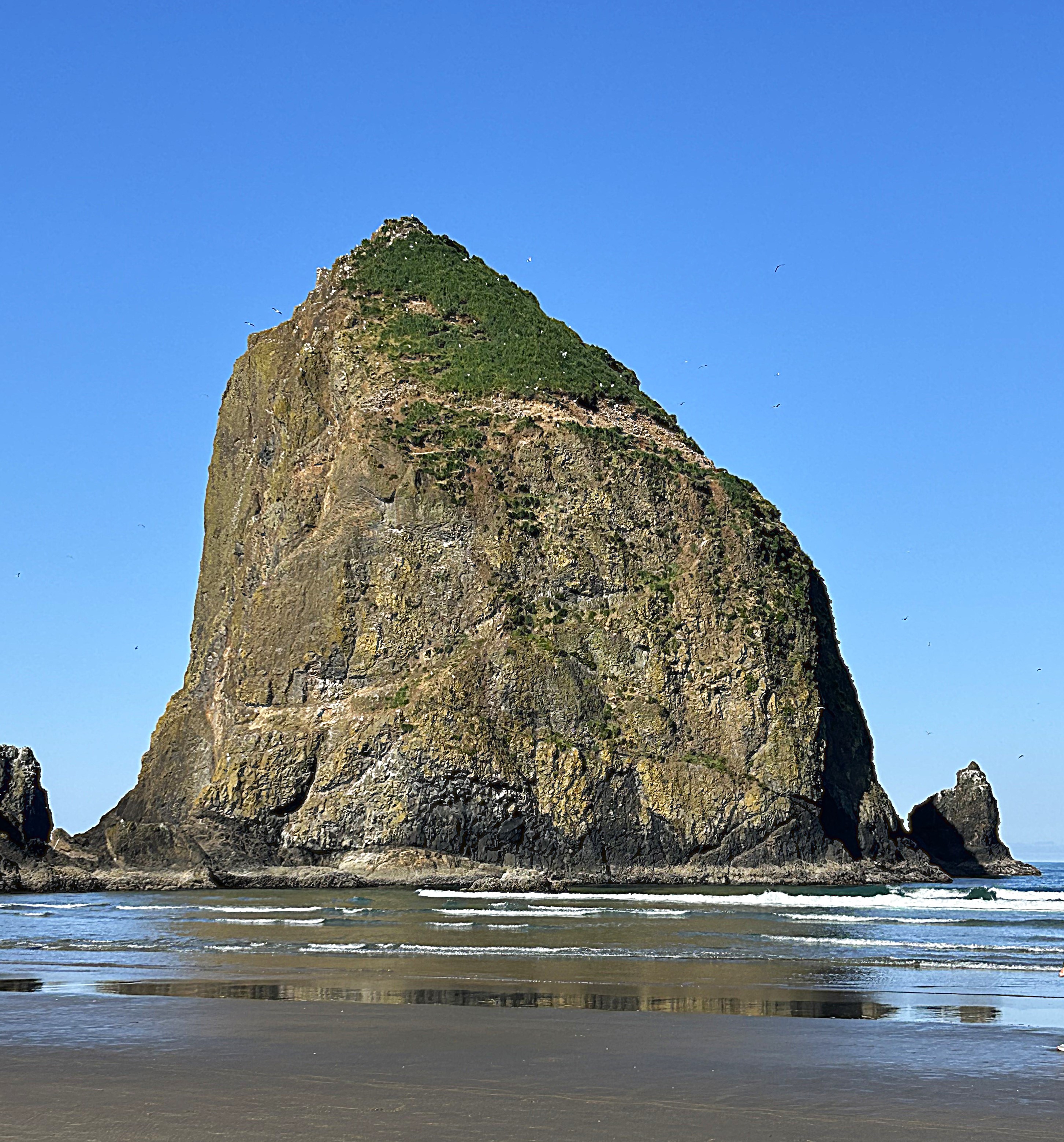
photo: Joe Meche
Haystack Rock
On the morning of Day Six, we left the Malheur National Wildlife Refuge, albeit reluctantly, and headed west by northwest to find saltwater. Our original plan was scratched when we discovered that our intended route would take us over more than 100 miles of a questionable dirt road. There were numerous sections of the road that were closed and there had also been damage from wildfires in the Hart Mountain National Antelope Refuge. With this bit of information, Plan B turned out to be a more pleasant alternative. This change also gave us time to stop in Burns to refuel and restock the larder for next two days on the road. We left the comparative luxury of the tiny house at the Malheur Field Station behind and prepared to camp out for a couple of nights.
The highway between Burns and our turn in Valley Falls crossed some of the most desolate parts of Oregon. Another loggerhead shrike put on an accommodating display at what has to be the loneliest rest area in the West. I will say, however, in typical Oregon fashion, it was very clean and well maintained. This stretch of road offered some of the largest alkaline lakes I’ve seen and it seemed like they would never end on a particularly warm day. The turn onto Highway 31 improved the day as we gained elevation on our way to La Pine and our campground for the night.
La Pine State Park is north of the town of La Pine and is far enough off the main highway to offer only the natural sounds you want in a good campground. We found this one to be especially attractive and immediately added it to our list of suitable-for-a-return-visit. From our campsite, it was just a short hike to a nice oxbow bend of the Deschutes River. A bit of rain during the night did nothing to disturb a good night’s sleep after the long and dusty road.
After morning coffee and a light breakfast, we motored through Bend and Sisters on the way to the Cascade Crest and Santiam Pass at 4,817 feet above sea level. The pass has a subarctic climate with cold winters and significant snowfall. The Hoodoo Ski Area, which is just below the pass, often has some of the heaviest snowfall totals in the western United States. Our passage over Santiam was greeted by low, fog-drenched clouds that obscured most of the volcanic cones that are prominent in the area. We had to admit that the moist air felt good after the dryness of the high desert.
We continued our quest for the Oregon Coast, driving through Sweet Home and then crossing Interstate 5 east of Corvalis. It was at a rest stop that we smiled in unison, knowing we were that much closer to Newport and the smell of salt air. After the high desert of southeastern Oregon and the Cascade Crest, the allure of salt air had a wonderful effect on us. Thanks to our early start, we rolled into Newport just after lunchtime and set our sights and appetites for Depoe Bay … a must stop on any traverse of Highway 101, whether you’re going north or south.
Downtown Depoe Bay is touristy, to say the least, but still charming and quite scenic. The walkway along the main street that sits on steep cliffs is known as a great place to see gray whales in migration. Heavy surf at high tide produces waves that crash into those cliffs and occasionally drench unsuspecting tourists. The bay of the same name is actually the 6-acre harbor that is widely promoted as the world’s smallest navigable harbor. If you’ve seen the movie, “One Flew Over the Cuckoo’s Nest,” you’ll remember the scene that took place in that unique harbor.
Spanning the entire length of the Oregon Coast are wilderness islands and headlands that make up the Oregon Islands National Wildlife Refuge. As well as the spectacular scenic views, these rocky shorelines and steep cliffs provide ideal nesting habitat for a variety of seabirds and mammals. One of the most appealing aspects of the Oregon Coast is the accessibility to the water with ample opportunities to view the off shore islands and the nesting birds. Of all the islands, none is more iconic than Haystack Rock at Cannon Beach and that was our destination for the next three days.
The history of Cannon Beach follows an all too familiar story that begins with the Tillamook people. The Tillamooks were part of the Salish linguistic group who were already settled in the area prior to a visit by William Clark of the Lewis and Clark Expedition in 1805. The expedition was wintering to the north near the Columbia River when two members returned to the camp with blubber from a whale that had been beached near Ecola Creek. The name Ecola is from the Chinook word for whale, ehkoli. And again, in typical fashion, the creek was renamed Elk Creek by early settlers, as was the community near the site.
In 1846, a small cannon from the US Navy ship, Shark, washed ashore a few miles south of the community. The ship had sunk while attempting to cross the Columbia Bar, known to maritime historians as the “Graveyard of the Pacific.” The same cannon was rediscovered in 1898 and inspired a name change for the growing community. Elk Creek was renamed Cannon Beach in 1922, encompassing the eight mile stretch of beach from modern day Ecola Creek to Arch Cape. Two more cannons, believed to have been from the Shark were discovered near Arch Cape in 2008.
William Clark later explored the area and first viewed the expansive beach area from just below the headlands of what is now Ecola State Park. Clark described his first view as “The grandest and most pleasing prospects which my eyes ever surveyed, in front of a boundless ocean.” Clark and several companions, including Sacagawea, met with a party of Tillamook who were boiling blubber on the beach and successfully bartered for 300 pounds of blubber and oil before returning to Fort Clatsop. A whale sculpture in a small park on the north end of Cannon Beach commemorates the encounter.
We wanted to end our grand tour by sleeping in a real bed so we’d be well showered and well rested for the day-long homeward leg of the journey. In my quest to find lodging in Cannon Beach, I kept running into obstacles that didn’t fit our dates, were too pricey, etc. In the process of elimination, I stumbled onto the Ecola Creek Lodge. The history of this lovely lodge fits right in with the previous accounts of the entire area. As the name implies, it sits on Ecola Creek, on the quiet north end of Cannon Beach, away from the hustle and bustle of the main attractions.
On our long/full day at Cannon Beach, the estuary enlivened me and also reminded me that I had made this long journey to see birds! What caught my attention right away was the sight of more than 200 brown pelicans and numerous western gulls relaxing in the freshwater outflow of the creek. This was exciting enough, but my real focus was on Haystack and the nesting birds that I had come to see … primarily the tufted puffins and common murres that nest there every year.
The best time to view birds on Haystack is at low tide and we hit it just right. It was a simple matter of walking to the base of the monolith and setting up for about six hours with my cameras and my beach chair, as well as simple fare of food and drink. To sit there and watch the dynamics of thousands of nesting seabirds is difficult to explain. The lesser number of puffins are accompanied by thousands of common murres, western gulls, pelagic cormorants, and even a few black oystercatchers. The almost constant in-and-out normal activity become chaotic when one or more bald eagles or peregrine falcons enter the scene in search of easy prey.
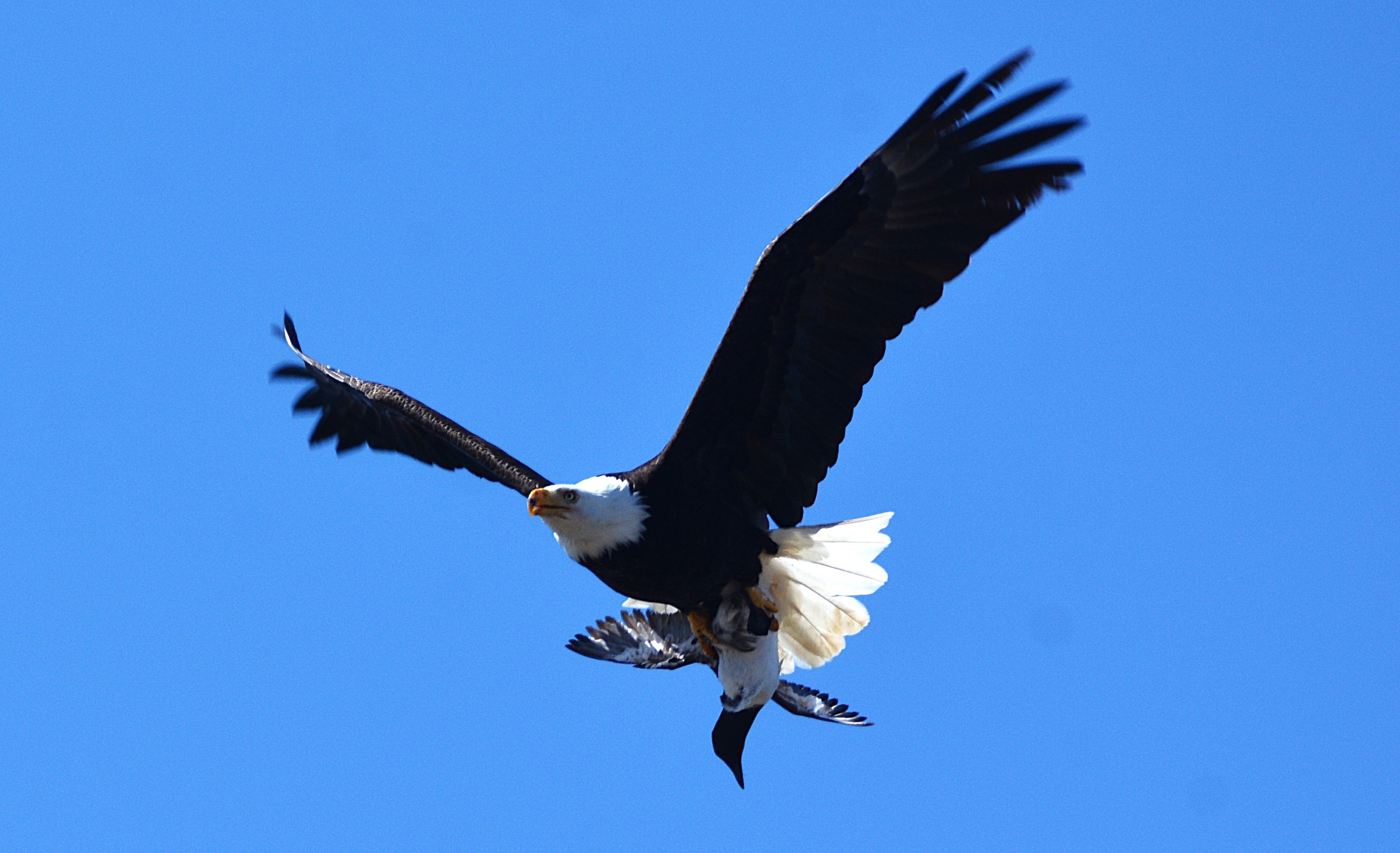
photo: Joe Meche
Bald eagle with common murre
The eagles, coincidentally, were nesting on the hillside above Cannon Beach, and, more than likely, have nestlings to feed. I knew that it was just a matter of time before they made a foray to the rock, so I waited … and they came. Four adult bald eagles soared right overhead and it seemed that every puffin and murre literally exploded from Haystack! I could hear the beating of wings and sensed the predator-prey event that was happening. It lasted for a while and before long I was able to photograph and witness the food chain in full display. The same bald eagles that flew overhead and into Haystack flew in the other direction with food for their nestlings firmly clutched in their talons.
After an extremely enjoyable and different visit to Cannon Beach and nine days on the road, we were ready to head home! As always, I tend to favor back roads and only use the major highways when necessary. On this particular return, we shunned both of the chaotic scenes around Portland and the Longview/Kelso area by crossing the Columbia at Astoria on the magnificent bridge that spans the river at the widest point before its mouth and the Pacific Ocean. Astoria itself is another major player in the history of the Pacific Northwest.
Having a lifelong fondness/fascination for bridges, the span that connects Oregon and Washington is one of my favorites of all time. Known formally as the Astoria-Megler Bridge, the span is 4 miles long and is the longest continuous truss bridge in North America. It was the final segment of U.S. Highway 101 to connect Olympia to Los Angeles. The long span replaced the ferry service than began in 1926 and did not run during inclement weather. The bridge opened to traffic in July of 1966 and now handles 7,100 vehicles a day. It was designed to withstand winds of 150 mph and water speeds of 9 mph.
We were excited to return to our home state and stayed on the back roads north past the expanse of the Willapa Bay area. This part of Washington is still in a relatively wild state and a very pleasant drive. True to form, we skirted Aberdeen and took on the last leg that would take us to Olympia and the rapid pace of the Interstate 5 corridor. We arrived home in the early evening, none the worse for wear and just happy to be here. No more driving for a while … but what’s next?
Cindy and I have been avid campers/ road trippers since our first trip together in 1992 and it goes without saying that we have lists. Our most frequently used and revised list is the one that not only chronicles every trip we’ve made, but also ranks them from best to worst, longest to shortest, and so on. We seem to share the ability to rejuvenate rapidly … almost as soon as we pull out of the driveway, in fact. There’s just something about severing the cord, albeit it temporarily, and heading into neutral territory with the hint of a new adventure ahead. I guess we’re just easy that way.
Our shortest trips have been overnighters, of course, but even three-week trips to Louisiana proved that we were meant to be together. The obstacles we faced and the challenges we overcame were just figurative bumps in the road. Our 16-day trip to Baja in 1996 heads the list and will always stand up to the new challengers. This most recent loop down into Oregon and up the coast back into Washington definitely gave us cause to reshuffle the list and insert it appropriately.
I guess the best coda I can offer to tie this all together at this tumultuous time in America is to encourage you to get out as much as you can and stay as positive as you can, knowing that this, too, shall pass. Carry on!
____________________________________
Joe Meche is a past president of the North Cascades Audubon Society and was a member of the board of directors for 20 years. He has been watching birds for more than 60 years and photographing birds and landscapes for more than 40 years. He has written over 200 columns for Whatcom Watch.