Editor’s Note: Whatcom Watch has entered a cooperative agreement with Salish Current. Salish Current, an online-only news organization, covers the North Sound area and Whatcom Watch mainly covers Whatcom County issues. Visit https://salishcurrent.org.
Researchers use miniature tags to study bee behavior
by Atlanta Moss
Trail walkers may have noticed new devices lining the Nooksack trails in Bellingham. The devices, which stand on poles and feature solar panels connected to gray power-boxes, are radio nodes that make up a grid system of receivers that obtain data from bumblebees tagged with newly innovated radio tracking technology.
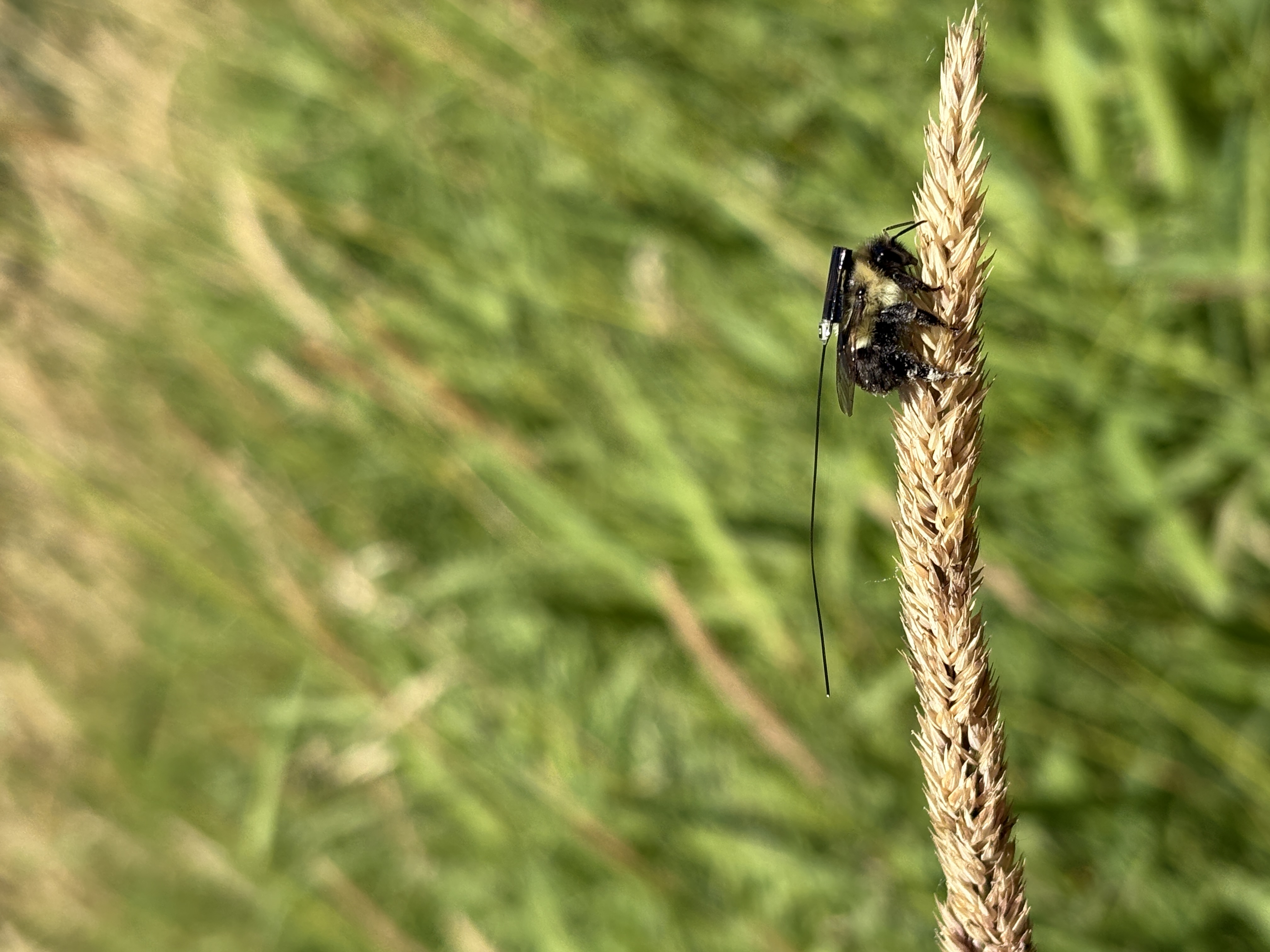
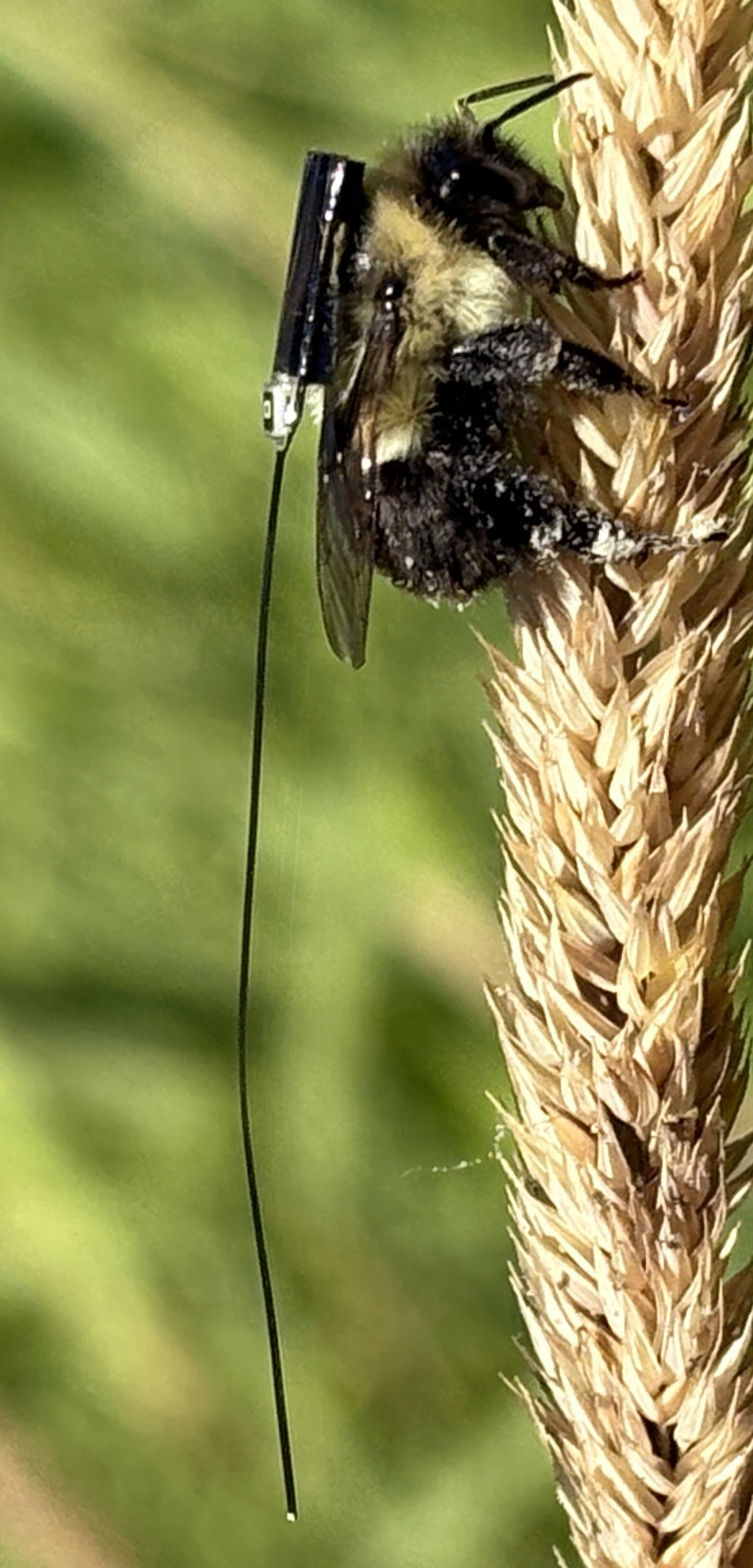
The Washington State Department of Agriculture (Agriculture) and Washington Department of Fish and Wildlife are collaborating to test minuscule solar-powered radio tags on bumblebees in the Nooksack area and around the Western Washington University campus. The tags, developed by Cellular Tracking Technologies, are the lightest transmitters on the market at 0.06 grams. They’re the first to allow researchers to track individual small insects, without affecting their normal behavior, over internet connection, using the same frequency as Bluetooth to receive movement data.
“The project is very exploratory,” Chris Looney, the project’s entomologist, said.
Agriculture started work on the grid in June and is planning to tag about 50 bees of different species with the BlūMorpho tags to observed them at least until next June. The project uses two different methods of receiving data from bumblebees.
courtesy: Julie Combs
A BlūMorpho-tagged bumblebee sits on a grass blade in Bellingham after being released by WSDA researchers.
Nooksack Area
In the Nooksack area, researchers set up a grid of nodes, small radio receivers that communicate with a solar-powered base station in the trees that sends detections back to the researchers over the internet. On the more urban site near the Western campus, they’re utilizing the Internet of Things to receive data, an expansive network of connected smart devices that can communicate without human intervention. Bees flying in the area will ping any device connected to Bluetooth in a 30- to 150-meter radius, creating a passive crowdsourcing of data points that are more accurate than any tracking system of the past, according to the vice president of global market development of Cellular Tracking Technologies, David La Puma.
The goal of the test is to examine the BlūMorpho tag’s capabilities to tell researchers anything new about bumblebees and their behaviors. They’re examining movement patterns, foraging ranges and individual behaviors to see if they can better understand how bees use their landscape and how the technology can fit into further research.
Bellingham local Elizabeth Vaughn is one person who noticed the numbered radio nodes on the Nooksack trail while walking her dog.
“I am curious to how they will use it in the future — what action that they can take to benefit our pollinators,” Vaughn said.
The species of bumblebee being targeted for tracking on the Western campus is Bombus occidentalis, or the western bumblebee. It’s a species native to western North America that experienced a significant population crash in the late 1990s. A well-established population appears to live on the campus and South Hill, and the state agriculture agency hopes the new tags can shine some light into what environmental factors help western bumblebees thrive.
“Maybe this (technology will) let you understand that a little bit better than just trying to walk around and catch them with a net all the time,” Looney said.
courtesy: Julie Combs
A BlūMorpho-tagged bumblebee – detail
Applying the Tags
To apply the tags, researchers catch the bees in vials and cool the bee down in ice to lower their metabolic rate until they become sluggish. The bees are then weighed, shaved on their backs, and receive a dab of UV-activated glue on their abdomen where the tag is applied and cured, Looney said.
Cellular Tracking Technologies released the BlūMorpho tag in 2023. Originally, only dedicated receivers like the nodes in the Nooksack area could detect the tags. In 2025, Cellular Tracking modified the BlūMorpho tags to transmit a second packet of data that could be received by almost any device with location-services and Bluetooth enabled. While the trackers aren’t Bluetooth devices themselves, being able to communicate over the same network as billions of widespread devices was a huge breakthrough, according to La Puma.
“The first big hurdle was just the ergonomics. So being able to get something light enough for them to carry. But the other part is being able to receive the information,” he said.
Wildlife telemetry, remotely tracking animals using radio frequencies, has been a standard practice since the 1960s. However, there have been limitations to the amount of data able to be collected.
Historically, researchers used very high frequency devices on the designated wildlife tracking frequency in the 162 to 173.999 MHz band, and tracked wildlife, by walking around with antennas. In about the last 20 years, tracking moved to autonomous networks called Motus, run by Birds Canada in Ontario. Tracker tags are registered to the Motus network and communicate to receiver stations.
“But it still requires people to put out receivers, and so, no matter how many people put out receivers, there’s still going to be big gaps in coverage,” La Puma said. “Now, all of a sudden, you’re getting thousands of data points as this bee flies around over trails, through parks, over roads, over houses … the level of spatial data that you get is astronomical compared to what it was historically, or even just a year ago.”
The BlūMorpho tags use both the passive Bluetooth network and Motus stations to transmit more than just location data. The solar-powered devices, coupled with the much higher frequency of 2.4 GHz, allowed Cellular Tracking to pack much more information into the transmissions over the shorter wavelengths, according to La Puma. The tags can send location, temperature and solar voltage information to researchers in near real-time. This information can help scientists discover much more about how insects use their habitats during the day, depending on how much sun is hitting their panel.
Other Insects
The capabilities of the tags have already been tested on other insects, most notably, monarch butterflies. Project Monarch is a collaboration of over 20 organizations across North America to track the health and migration patterns of monarch butterflies with more detail than ever. The fall and winter of 2025 saw the launch of over 400 tagged butterflies that have been tracked thousands of miles. Researchers hope to use the data gathered to better inform conservation efforts by understanding which areas in the migration route put the butterflies most at risk.
Looney also tagged the northern giant hornet species, known as the murder hornet, in South Korea after the invasive species was spotted in Washington in 2019 and declared eradicated in 2024. To better understand the species, he conducted experiments to test lures, traps and track behavior patterns.
The question Looney was asking with the hornets, and about invasive species in general, is “can we use (the radio tags) to find out things about their biology that will make us better able to control a species?”
The future of the tags, according to La Puma, will include sensors that can transmit altitude or atmospheric pressure information, which may help conservation efforts.
“Like, if you’re worried about certain birds and bats and insects getting hit by wind turbines or going through wind turbines, knowing exactly what altitude they’re flying at can be very informative,” he said.
There’s hope that, in the future, the tags will be able to communicate with low-orbit satellites as the technology advances. The development would eliminate the need for human infrastructure in the proximity of the animals and open the door for further wildlife observation.
“Up until now, we have not been able to track so many species,” La Puma said. “So I think this is kind of the golden age of telemetry, of wildlife tracking.”
Read the original article here: https://salish-current.org/2026/08/26/new-technology-tracks-bumblebees-across-the-nooksack-and-bellingham/.
________________________________
Atlanta Moss is a senior journalism student at WWU. Her passion for local news keeps her closely connected to the Whatcom community. She loves learning about environmental developments, city news and the arts scene. You can reach her at atlantamoss@yahoo.com.