Editor’s Note: Whatcom Watch has entered a cooperative agreement with Salish Current. Salish Current, an online-only news organization, covers the North Sound area and Whatcom Watch mainly covers Whatcom County issues. Visit https://salishcurrent.org.
Sudden Valley plans herbicide treatment for invasive waterlilies at Lake Louise
by Jenny Lam
They are back and spreading! The invasive fragrant waterlilies at Lake Louise in Sudden Valley cover much of the shoreline this time of the year. A bird sanctuary on the southeast end of the lake is so dense with lily pads that waterfowl commonly seen there in the cooler months are now absent. The few that are there struggle through the large leaves to reach the water. Access to the water from two beaver lodges at the north end of the lake is also covered by the waterlilies.
The board of directors at Sudden Valley Community Association agreed last September to spend up to $8,400 to treat the water with a herbicide. In an approval request memo to the board of directors, the association said, “The current overgrowth has now impacted water quality, recreational use and aesthetic values of Lake Louise. Fragrant water lilies are considered invasive, and unchecked expansion poses ecological and community use risks.”
AquaTechnex, contracted to do the treatment, wrote in an email that the herbicide they will use contains glyphosate. The company also admitted that “glyphosate has a drinking water restriction that states potable water intakes from the lake should be turned off for 48 hours if they are within a half mile of the treatment area. That would apply to this lake.”
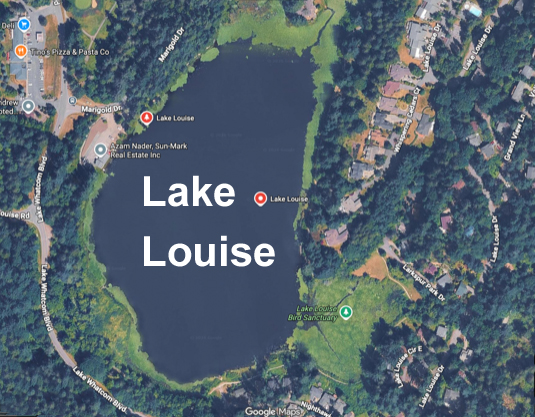
Lake Louise and Lake Whatcom
The closest points between Lake Louise and Lake Whatcom are fewer than 2,850 feet. Lake Whatcom is the drinking water source for Bellingham. Water from Lake Louise is also used to water the Sudden Valley golf course on the shore of Lake Whatcom during the summer months.
AquaTechnex added that “very little herbicide is actually getting into the water when applied to the lily pads. What does make it into the water is broken down over time by microbial activity and photodegradation from sunlight.” For Sudden Valley resident Bryan Burke, it has been one battle after another. Last year, he waded in chest-deep with a team of volunteers to tear out the rhizomes — thick, underground stems. The area they worked on near the Welcome Center is noticeably less dense this year.
“It would take about 40 volunteers at least once a week between May and September to make a meaningful impact,” he explained. He agrees that’s a big ask. Last year, he had nine helpers one week and only four of them continued for a few weeks after that.
Herbicide To Be Applied in October
AquaTechnex told Burke that they will apply the herbicide in October.
“This strikes me as nuts because the lilies begin to die off in mid-September and are mostly dead by late October,” Burke said. Glyphosate also breaks down slower in cool water, according to the U.S. Environmental Protection Agency.
One letter to the editor in the Sudden Valley Views in November last year questioned if management contacted the Lake Whatcom Quality Team at Western Washington University about the herbicide treatment since Lake Louise uses a weir which is periodically opened to Austin Creek, which dumps water into Lake Whatcom.
The response was that “manual eradication of the water lilies was attempted for two summers with limited success. AquaTechnex is a professional aquatic management company with extensive Pacific Northwest experience.”
A paper published in Aquatic Sciences by members of the Lake Whatcom Quality Team in April 2025 found that the waterlilies “would approximately double the amount of dissolved organic matter” in Lake Louise over the summer months.
Few Fish Can Survive
When the waterlilies die back in the fall, the detritus forms a thick layer in the bottom of the lake. Data from Western Washington University’s Institute for Watershed Studies shows that the dissolved oxygen level at Lake Louise fell from 8.6 milligrams per liter to 6.4 mg/l or about 26 percent between 2023 and 2024. The institute pointed out that few fish species can survive below 6.5 mg/l.
Thomas Riley fishes at Lake Louise several times every week, sometimes twice a day. He usually goes for largemouth bass, but he gets the occasional yellow perch or bluegill, too.
“This lake is weird,” Riley said. “There are days when I get a 4- to 5-pound bass, but the other day I got one that was only about six inches.”
Thomas uses a floating frog bait. “The waterlilies make it hard to see what’s going on. I have seen the bait jump up and the fish leaping into the air and then it’s gone. But the waterlilies are affecting activities over by the bird sanctuary,” he said.
The largemouth bass is a predator species. According the Friends of Cottage Lake, in King County, the lily pads may provide convenient cover for predators like the bass. But without the prey the bass eats, the food chain breaks down.
They would know because conservationists at Cottage Lake have been battling with the invasive waterlilies for years. The water there was treated several times between 2006 and 2017. But the waterlilies are back.
“We discussed in a recent meeting what to do about the waterlilies. They definitely cause more stagnant water and so increase the number of mosquitoes,” said Jonathen Morrison, Friends of Cottage Lake president. The lilies were apparently introduced to Cottage Lake in the 1930s and had spread all around the lake. After treating it with herbicide, the lake now has some small patches plus a larger one in the shallow south end.
“It seems like we will need to treat it about once every 10 years,” Morrison said.
No Easy Solution
Burke agreed that there is no easy solution to the waterlilies.
The Sudden Valley Community Association has been trying to get rid of the waterlilies since 2022 when the Welcome Center was built. They purchased three giant strimmers — plant cutters — with 6-foot-long blades that can cut through the rhizomes. Those were sitting in a warehouse until Burke volunteered to remove the waterlilies.
“But I will not be wading in there any time soon if there is herbicide in the water,” he said.
Read the original Salish Current article here: https://salish-current.org/2026/09/03/the-battle-of-sudden-valleys-invasive-waterlilies/.
__________________________________________
Jenny Lam volunteers for KMRE news and teaches part time at Western Washington University. Originally from Hong Kong, she taught journalism there for more than 12 years and was a broadcast journalist for more than 23 years both in Hong Kong and the U.K.