Native Plant Neighbors
by Eric Worden
I have a friend who knows little about native plants. Nevertheless, she has a system for distinguishing native plants from “normal” ones. Her system is this: If it looks neat and showy, then she assumes it is a “normal” plant, and, if a plant looks rangy and drab, then she assumes it is a native plant! Her system is not very reliable. For example, in the garden, she calls the deer- and winter-abused viburnum shrubs native plants. The species — Viburnum davidii — actually is native to western China, not here.
Conversely, recently in Bellingham’s Elizabeth Park, a passerby asked me about a shrub that I was admiring; it was the most elegant, showy, and fragrant plant in the garden that day, covered in white flowers. She stepped back in astonishment when I told her that it was a native plant called mock orange!
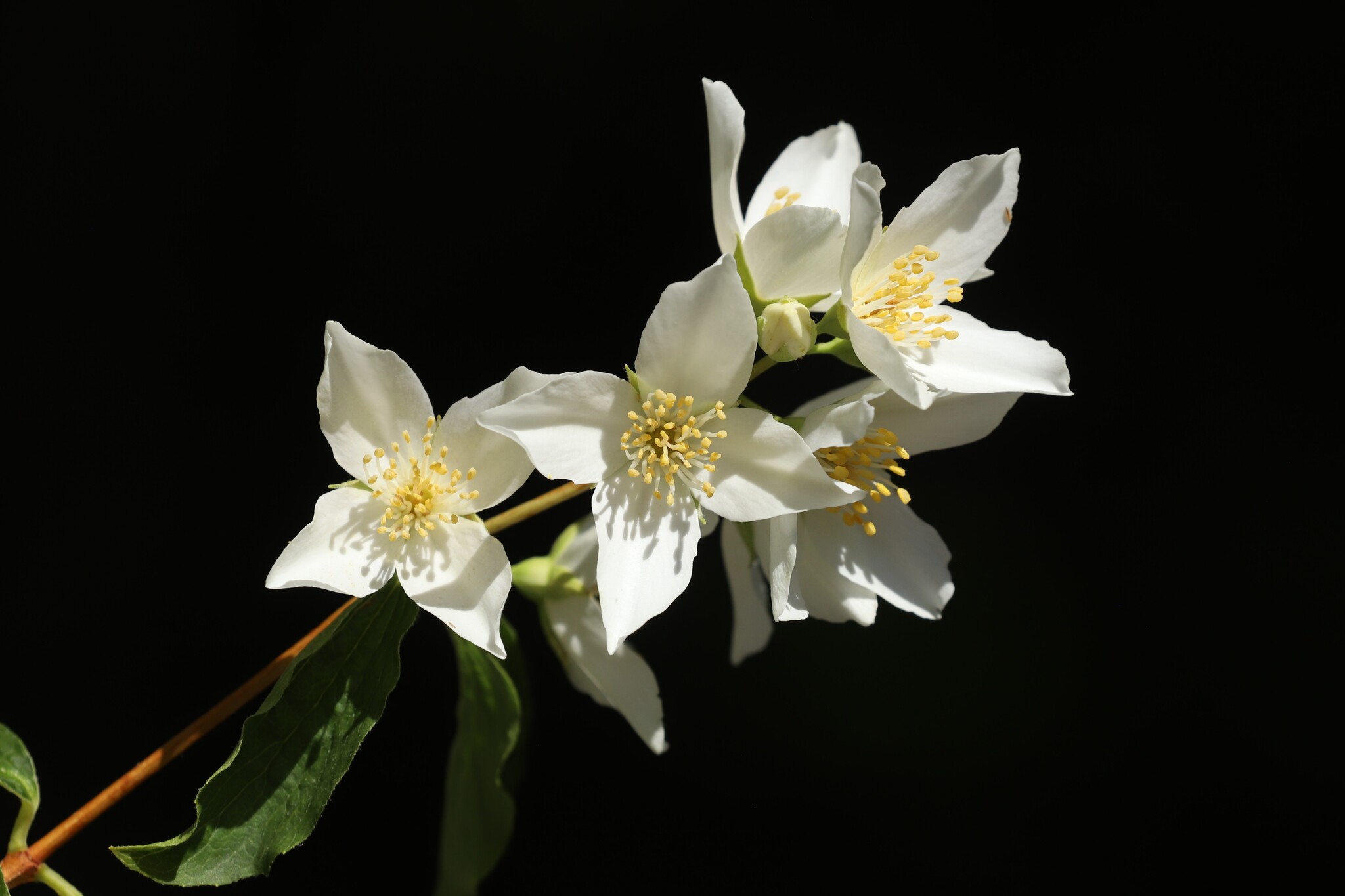
photo: T. Abe Lloyd via iNaturalist. CC-BY-NC
Mock orange flowers.
What she and others sometimes fail to understand is that their impressions of a plant are influenced mainly by the hand of a gardener, not by a plant’s intrinsic characteristics. Even an award-winning rose will look as miserable as Charlie Brown’s Christmas tree if neglected by the gardener. Similarly, a wild forest shrub, cared for in a civilized garden, can take the breath away from passersby.
Resemblance to Orange Tree Blossoms
The mock orange — scientific name Philadelphus lewisii — is a local native shrub that rewards civilized care with an early-summer fountain of long arched stems bursting with fragrant white petals. Similar related species are known from eastern and southern U.S. states, and they were named “mock orange” for their resemblance in color, shape, and fragrance to the blossoms of orange trees.
Our western species is widespread in Washington, Oregon, Idaho, and northern California, but never greatly abundant. In our Whatcom forests, it is somewhat uncommon, and may be found more frequently in gardens. Anecdotes from native plant enthusiast friends indicate that the flowers are attractive to bees, and unusually attractive to butterflies. Butterflies are known to have a sensitive sense of smell and perhaps are drawn from far away by the exceptional fragrance.
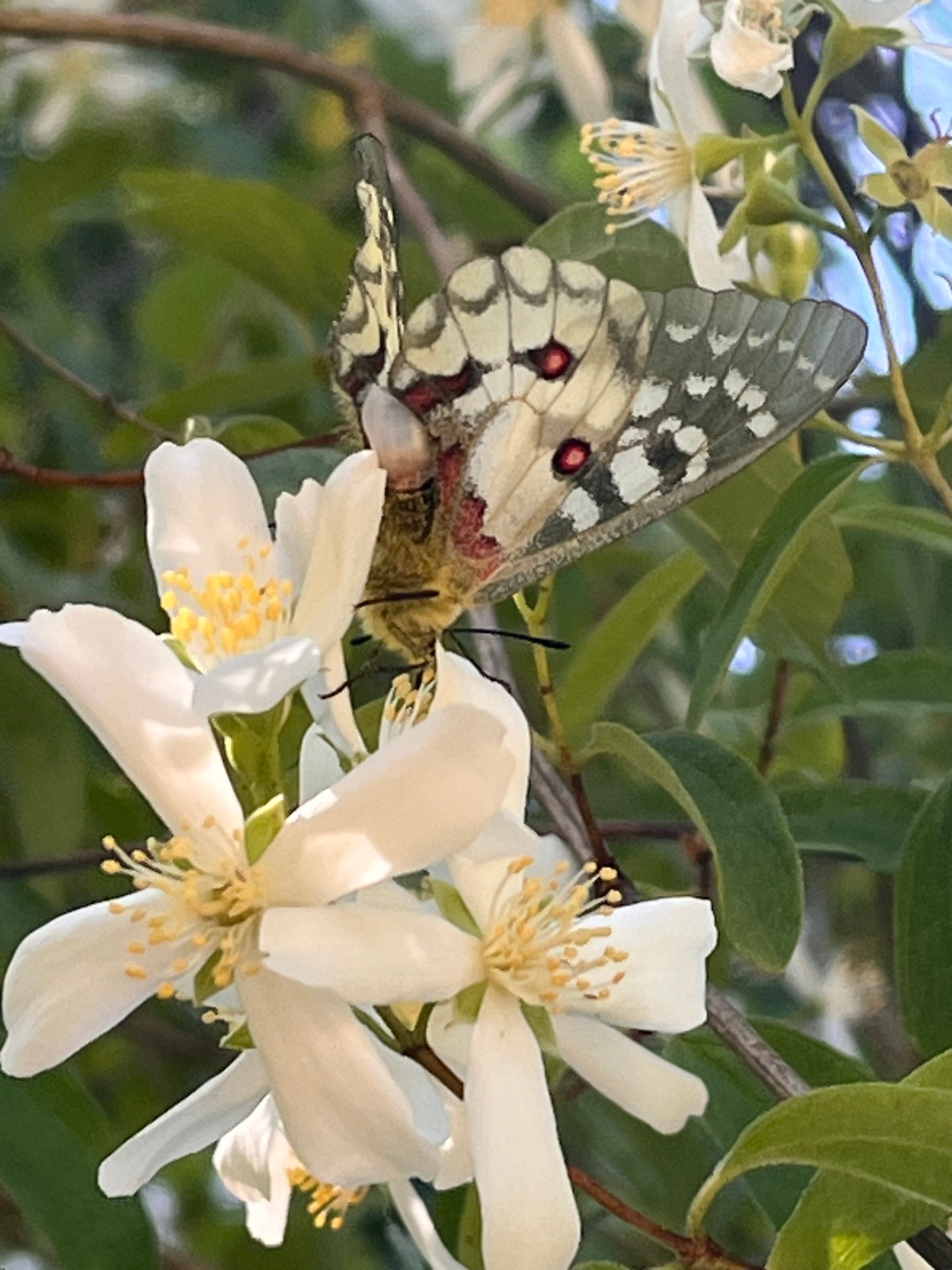
photo: Rhea Rainwater
Mock orange flowers attract bees and butterflies, including this snow Apollo butterfly (Parnassius clodius).
As for the resemblance to its namesake, blossoms of an orange tree always have five petals while blossoms of mock orange always have four petals — but who’s counting? In both plants, the petals are colored a luxurious, brilliant white, with a sprinkling of yellow, pollen-covered anthers in the center, and they emit a sweet perfume that can drift far from the plant and turn your head. Mock orange has little actual relation to a citrus orange, though. In reality, it is fairly closely related to the familiar garden hydrangea, another showy flower. Among other local native plants, its only close relative is the common whipplea, a small herb that is common in western Oregon, but in Washington is found only in a couple of small localities.
Vigorous Upright Growth
Mock orange has a strong upright growth habit, with branches reaching 10 or 15 feet high. When branches are cut down low, or even burned to the ground by fire, the plant resprouts with tremendous vigor. The more severely the branches are cut or burned, the more vigorous, numerous, and chaotic will be the explosion of new sprouts. In nature, this characteristic makes it resilient after fire, where it generally exceeds half of its pre-fire height after only a single season. Ordinarily, the leaves of mock orange are not preferred by browsing animals, but deer and elk consume the explosion of tender regrowth with gusto after a fire.
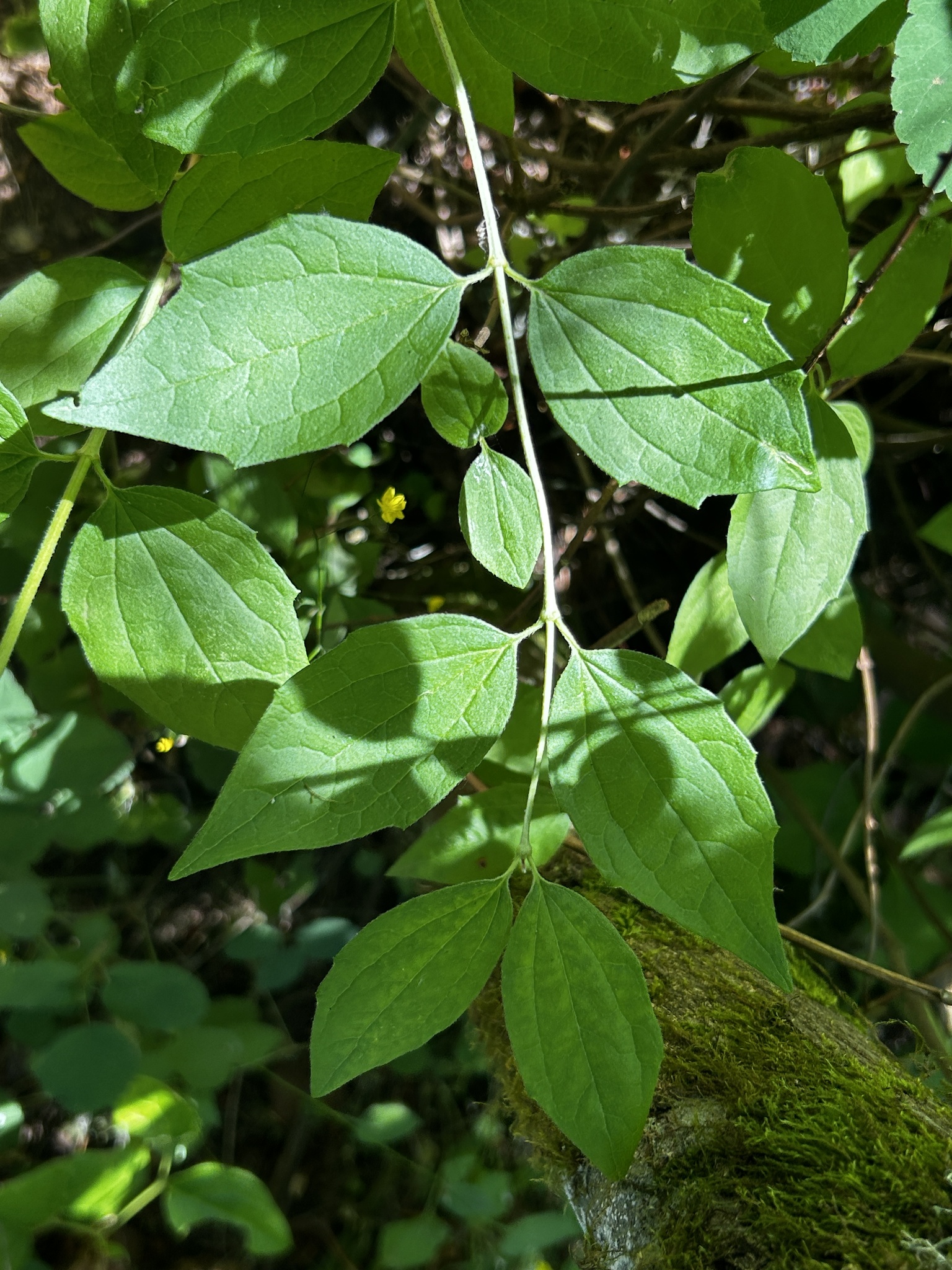
photo: AlmndButtrToast via iNaturalist, CC-BY-NC
Mock orange leaves have distinctive, coarsely serrated edges.
Gardeners wishing to cultivate mock orange’s natural beauty will understand and curate its vigorous upright growth by judiciously pruning its stems at their bases, rather than shearing, shaping, or shortening it. A sheared or shortened specimen will first look harsh and bristly, with the ensuing regrowth being crowded and chaotic. A well-pruned specimen in shade will show a number of elegantly flowing semi-erect arches, while in bright sun the result will be a triumphant, fully-erect fountain of stems. In the garden and in nature, the plant thrives in locations receiving a little extra summer soil moisture.
Indigenous Plant Names
“Mock” orange is like many of our local native plants that were long ago named “mock” or “false” in relation to other plants more familiar in the Old World, or plants from eastern North American regions that were colonized before the Pacific northwest. Another local plant suffering this kind of name is “mock azalea,” also known as “false huckleberry.” It’s a perfectly nice mountain shrub that is closely related to the “real” azaleas. Of course, all of these plants had names before English was ever used in this area. The Nooksack call mock orange stsélhp, and, according to Erna Gunther, the Lummi call mock orange tsitsinalitc. (1)
The wood of mock orange is particularly useful to indigenous people because it is “strong and ‘hard as a bone,’ never cracking or warping when properly prepared.” (2) This quality, combined with its long, narrow, and straight branches, with pithy, essentially hollow centers, lends it to many unique applications. Throughout the region, it was used by many groups to make various implements, spear shafts, bows and arrows, digging sticks, “sliding” snowshoes, cradle hoops, and combs. Of course, children utilize its hollow center to make toy blow guns!
Next year in late June, if you’re in the forest and see an improbably showy shrub, covered in white flowers, don’t assume that it’s a “normal” plant; it’s probably mock orange! You can purchase your own mock orange shrub at local native plant nurseries.
_____________________________________
Eric Worden is a lifelong amateur naturalist and the chair of the Koma Kulshan chapter of the Washington Native Plant Society.
References
- “Ethnobotany of Western Washington: The Knowledge and Use of Indigenous Plants by Native Americans,” by Erna Gunther, University of Washington Press, 1973: https://uwapress. uw.edu/book/9780295952581/ethnobotany-of-westernwashington/
- “Plant Technology of First Peoples in British Columbia,” 2nd ed. Nancy Turner
- Fire Effects Information System, USDA Forest Service, https://research.fs.usda.gov/feis/species-reviews/philew