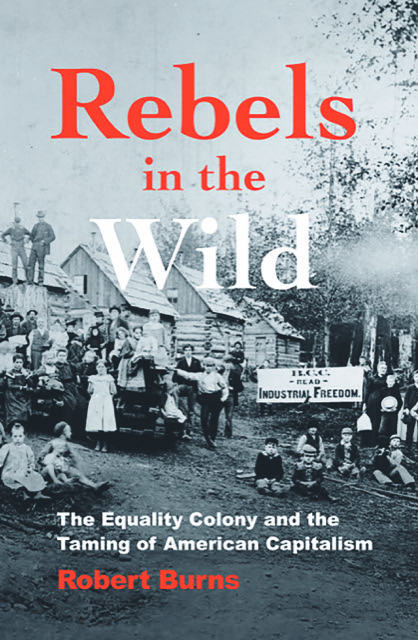
Rebels in the Wild
The Equality Colony and the
Taming of American Capitalism
by Robert Burns (Author)
and Libby Burns (Illustrator)
RWBurns Publications, 2025
366 pages, paperback, $18.99
ISBN-13: 979-8994055809
Interview by Dean Kahn
Author Robert Burns details the lives of those who built Equality Colony near turn-of-the-century Edison.
For nearly a decade, from its founding in November 1897 to its dissolution in June 1907, members of the Equality Colony — who reached a peak population of about 340 — tried to turn Washington into a socialist stronghold by becoming a living example of collective cooperation on 600 acres about two miles northeast of Edison.
Dean Kahn: You now live in Virginia, so what’s your connection to Washington?
Robert Burns: I grew up in Stanwood, the third of four children in a family that enjoyed the outdoors. I graduated from Stanwood High in 1973 and attended the University of Washington for four years.
Kahn: For people unfamiliar with Equality Colony, what’s your one minute synopsis of the colony and its relevance today?
Burns: Equality Colony was an experiment in socialist living that in some ways was ahead of its time. It gave voice to ideas, like the social safety net, that were too radical for the time, but became widely accepted a generation later. Thus, my conclusion that this episode in history foretold the taming of American capitalism.
Kahn: Why did you write the book?
Burns: I got interested in the Equality Colony about 10 years ago when I discovered that a relative on my mother’s side, Frederick E. Smith, who grew up in Blanchard, had researched the colony’s history in the 1960s and that many of his materials had been preserved at the Center for Pacific Northwest Studies in Bellingham.
I discovered this while researching my first book, “A Long Way Home: From Sweden to Cedarhome,” published in 2019. When I finished that book, I took a longer look at Frederick Smith’s materials and decided the subject was fascinating enough to merit more investigation.
Kahn: What struck you about the colony and its organizers?
Burns: The 1890s was an era in which social reform was popular and communal experiments were tried in many places across the country. Th ere had been several in the Puget Sound area before Equality.
What set Equality apart was its ambition to create more than a communal lifestyle. It aimed to trigger a revolution that would turn the entire state of Washington — and eventually the entire nation — into a socialist commonwealth.
Kahn: What lessons should progressive-minded people today take from Equality Colony and similar early endeavors?
Burns: I don’t feel qualified to offer political advice, but I would say that the Equality Colony experience showed the resilience of capitalism, as well as the capacity of our society to adapt and evolve its thinking in ways that changed the character of American capitalism in the 20th century.
Kahn: As far as you know, is your book the first full-length account of Equality Colony?
Burns: I call it the most complete or comprehensive account of Equality Colony. Th e only other book I’m aware of on this topic is Charles LeWarne’s “Utopias on Puget Sound: 1885-1915,” published by University of Washington Press in 1975 and chronicling the histories of several Puget Sound-area utopian communities, including Equality.
I was able to compile a more complete history of Equality because of the surfacing of some important documents in recent decades, including (colony organizer) Norman Lermond’s unfinished autobiography, and because the internet age has given researchers the ability to find long-forgotten scraps of written history in newspapers and other periodicals that were largely inaccessible in the 1970s.
Kahn: Your book includes detailed information about the organizers and residents of the colony. Why was that detail important for the book?
Burns: I set out to discover what motivated the people involved with the Equality Colony and those in the socialist movement more broadly. This required more than just knowing what they did during the colony’s brief life. It required understanding why they did it. It also demanded learning who and what influenced their early lives, as well as discovering the direction their lives took after Equality.
Finding what these individuals had said and written about their beliefs and their lives was the central challenge of this book project, given that none are alive to be interviewed. It was time-consuming, given the passage of time and the relative obscurity of these people.
I spent years finding examples of their writings in newspapers, books and other periodicals, as well as personal papers, in university archives in multiple states, including Pennsylvania, New York, Washington and California. In some cases, descendants kindly provided memoirs, photos and other helpful material.
Kahn: The colony was relatively short-lived, initiated at a time when progressives were turning away from the idea of socialist colonies and received tepid support from many anti-capitalist leaders. Given that, why is Equality Colony worth close study?
Burns: The Equality story helps us, if perhaps only in a small way, to understand how we as a society got here from there — how our economic system, our social priorities, and our governing philosophy evolved. I like to think the book gives us what all good history should offer: a look at not just who we were, but who we are.
Burns plans to discuss his book during two public appearances in August in Skagit County and Bellingham:
— August 12: Central Skagit Library, Sedro-Woolley, 6 p.m.
— August 14: Village Books, Bellingham, 6 p.m.
___________________________
This article was first published in the Salish Current. https://salishcurrent.org/2026/03/05/newbook-recalls-skagit-experiment-insocialist-living/