Editor’s Note: For 22 years, starting in 2004, scientist and toxicologist April Markiewicz provided the community with clear, data-driven analysis of these meetings through her Whatcom Watch articles. Her work set the standard for public understanding of the lake’s long-term trends, regulatory requirements, and scientific realities. Whatcom Watch thanks April for her many years of committed reporting.
This review continues that tradition of public accountability.
What the Data Revealed and What It Didn’t
by Kerri Burnside and Susan Kane-Ronning
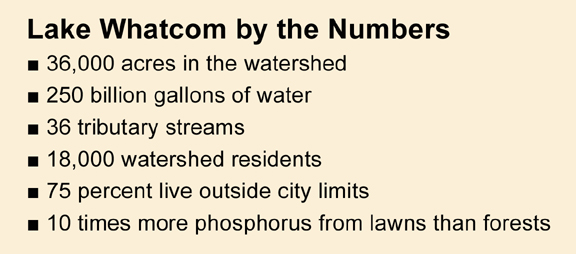
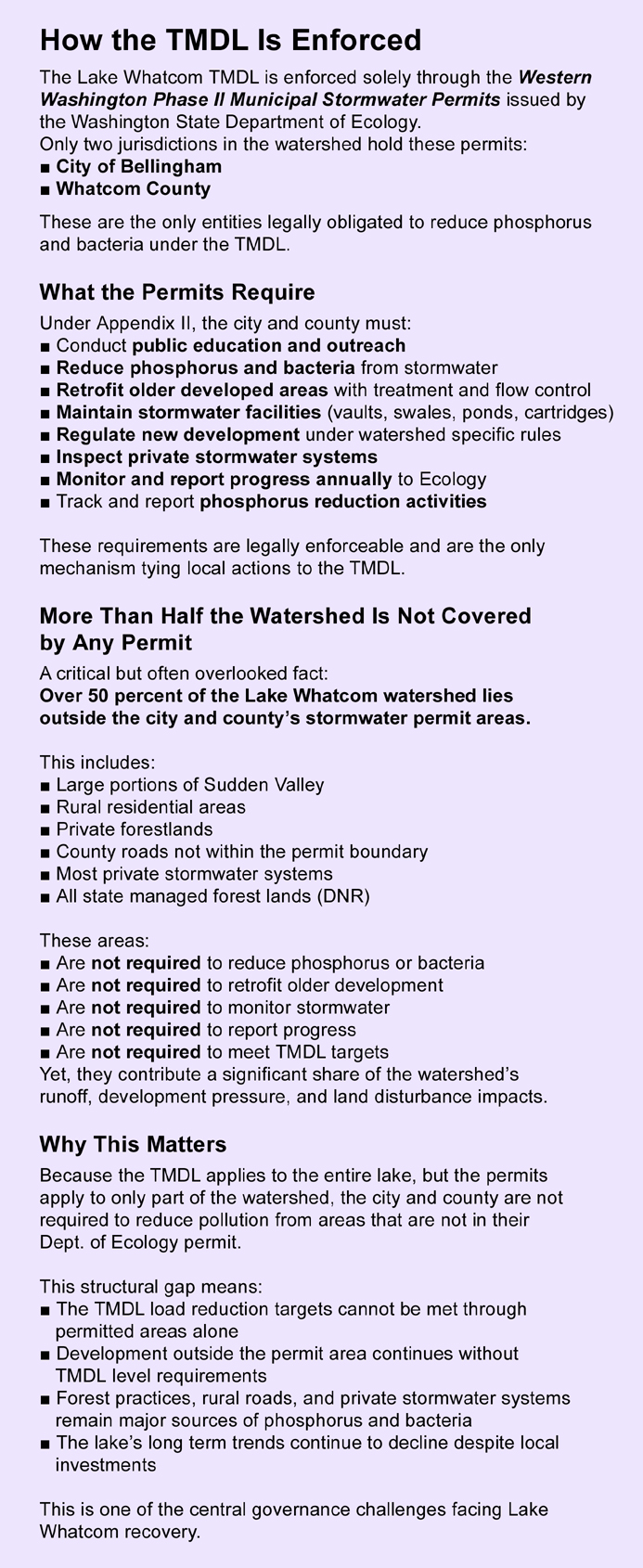
Lake Whatcom is the largest natural lake in Whatcom County and the drinking water source for more than 120,000 people. It has been listed as an impaired water body since 1998 due to low dissolved oxygen, elevated phosphorus, and fecal bacteria. Under the Clean Water Act, the City of Bellingham and Whatcom County must meet the requirements of a Total Maximum Daily Load (TMDL) to restore the lake to state water quality standards.
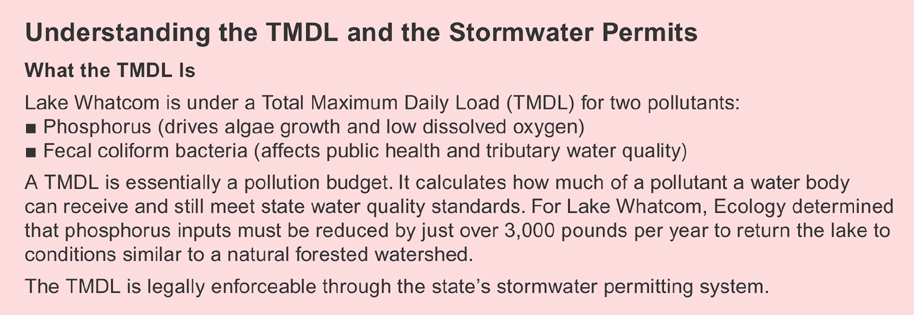
Ten years have passed since the state Department of Ecology (Ecology) finalized the TMDL, which requires reducing phosphorus inputs by just over 3,000 pounds annually by 2066. Now a decade into that 50 year timeline, the annual joint meeting of the city, county, and Lake Whatcom Water and Sewer District offered an opportunity to assess progress. The meeting took place in early April, with elected officials, staff, and community members gathered to review monitoring results, hear program updates, and discuss policy needs.
Stormwater remains the chief source of phosphorus and bacteria. Impervious surfaces accelerate runoff, while natural forested areas filter water before it reaches the lake. Ecology notes the lake would meet dissolved oxygen standards if there were 86 percent less development than existed in 2003. Instead, development has increased, and long-term maintenance of private stormwater systems remains inconsistent.
The annual meeting is the only time all three governing bodies convene to discuss Lake Whatcom. What follows is a summary of what the monitoring data showed, what the progress report emphasized, and where the gaps between them remain.
What the Monitoring Report Showed
Dr. Angela Strecker of the Institute for Watershed Studies presented an abbreviated summary of the 2025 Lake Whatcom Monitoring Report. She emphasized that no single indicator captures the lake’s condition; instead, four core indicators (dissolved oxygen, phosphorus, algae, and dissolved inorganic nitrogen) must be evaluated together.
Dissolved Oxygen
Dissolved Oxygen (DO) is the amount of oxygen that is present in water and available for aquatic organisms to breathe. High levels of phosphorus means low levels of dissolved oxygen. It is measured in milligrams per liter (mg/L). Fish, insects, and beneficial microorganisms all depend on adequate DO levels to survive.
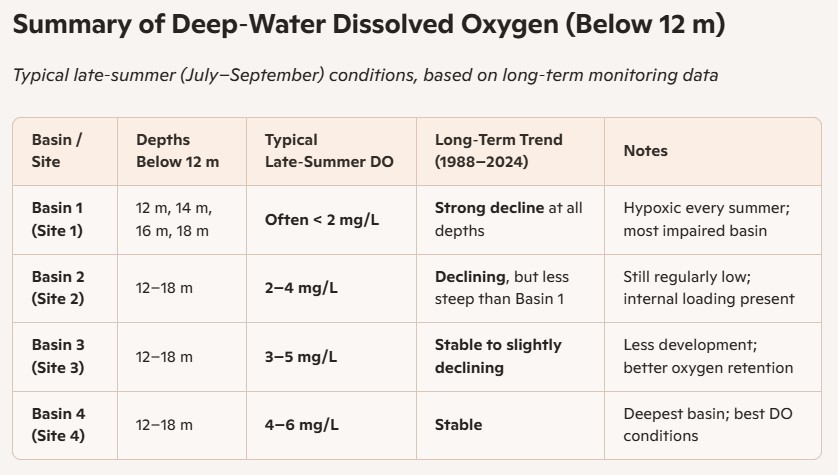
Long term decline continues, especially in Basin 1. Data from 1988–2025 show a clear downward trend in summer dissolved oxygen at all depths below 12 meters. Levels below 2 mg/L are inhospitable to most aquatic life; even 2–6 mg/L stresses sensitive species. Basin 2 shows decline as well, though less severe.
Why 12 Meters Matters
The lake stratifies into layers in summer:
- Epilimnion (surface)
- Metalimnion (middle)
- Hypolimnion (deep water)
Below 12 meters, water is part of the hypolimnion, where:
- Oxygen is not replenished during summer
- Decomposition consumes oxygen
- Low DO triggers internal phosphorus loading from sediments
This is why DO below 12 meters is a key TMDL indicator.
4. Thresholds
- >6mg/L — healthy
- 2–6 mg/L — stressful for fish
- <2 mg/L — hypoxic; most aquatic life cannot survive
Basin 1 deep water is routinely in the hypoxic range by late summer.
Source: Lake Whatcom Monitoring Project, Institute for Watershed Studies, Western Washington University. Dissolved oxygen data (1988–2024) summarized from long term monitoring at Sites 1–4, depths 12–18 meters.
Phosphorus
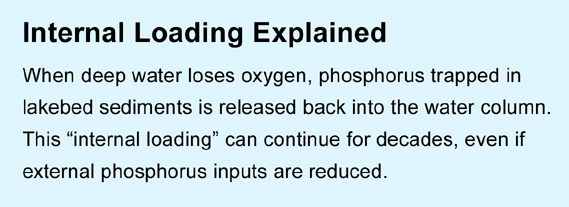
Surface phosphorus increased until around 2010, then declined, with no significant trend in recent years. Near the lakebed, phosphorus tells a different story: concentrations are two to three times higher than surface waters in Basins 1 and 2 due to internal loading, where phosphorus is released from sediments under low oxygen conditions. This phosphorus mixes throughout the lake during fall turnover, contributing to ongoing nutrient enrichment.
Algae (Chlorophyll)
Higher chlorophyll levels means less dissolved oxygen and more algae growth. Chlorophyll increased until about 2010. Site 1 has declined enough that the long term trend is no longer significant, but Sites 2–4 show plateaus rather than declines. Algal activity remains elevated, especially in the more developed basins.
Dissolved Inorganic Nitrogen (DIN)
High DIN concentrations lead to nutrient enrichment (eutrophication), resulting in reduced water quality, harmful algae blooms, and hypoxia (low oxygen). Dissolved Inorganic Nitrogen (DIN) is the portion of nitrogen in water that is immediately available for algae and aquatic plants to use. It includes three forms of nitrogen:
- Ammonium (NH₄+)
- Nitrite (NO₂-)
- Nitrate (NO₃-)
These forms dissolve easily in water and act as nutrients that fuel biological growth.
In lakes like Lake Whatcom, DIN plays a key role in determining which types of algae thrive. When DIN levels are high, many algae species can grow. When DIN levels become very low, conditions favor nitrogen fixing cyanobacteria — a group of algae that can pull nitrogen from the atmosphere. Some cyanobacteria species are capable of producing toxins that can affect drinking water and public health.
DIN is steadily declining at all sites. While this may seem positive, low nitrogen favors nitrogen fixing cyanobacteria, which are more likely to produce toxins. Strecker noted her team monitors cyanobacteria via microscopy to detect early signs of harmful species.
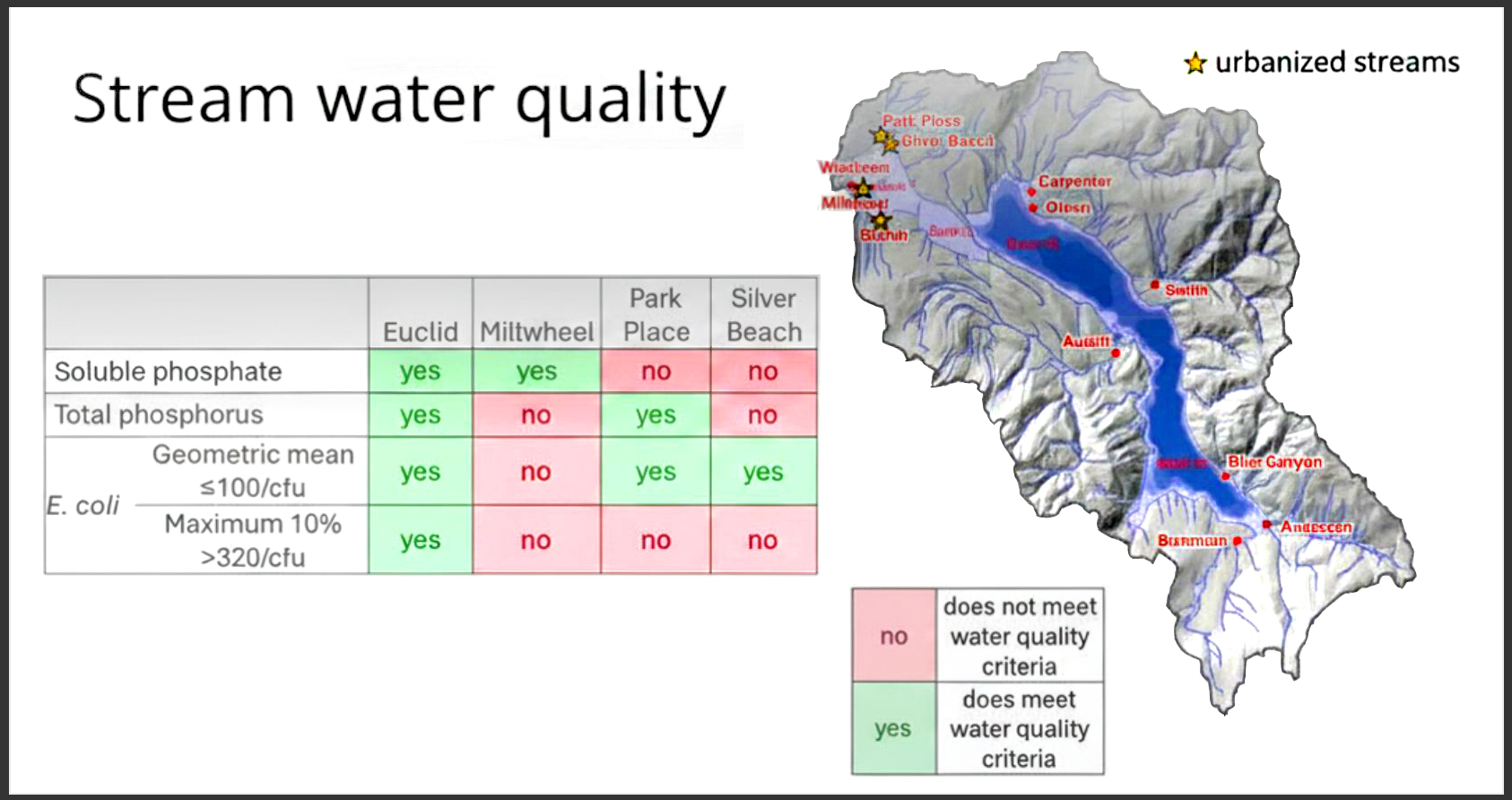
graphic from special Bellingham City Council meeting April 1st, 2026
Tributary Water Quality
Strecker highlighted four urbanized streams: Park Place, Silver Beach, Euclid, and Millwheel.
- Euclid meets criteria for both phosphorus and E. coli.
- Park Place, Silver Beach, and Millwheel fail at least two indicators.
Monitoring confirms that bacteria remains a major issue and that multiple tributaries are failing water quality criteria.
Overall, Strecker concluded that dissolved oxygen remains low, bottom (near the lakebed) phosphorus remains high, algae have stabilized but not declined meaningfully, and nitrogen continues to drop in ways that may favor harmful cyanobacteria. The lake remains impaired, and several indicators continue to move away from TMDL recovery targets.
What the Progress Report Emphasized
The Progress Report presentation delivered by City of Bellingham and Whatcom County staff focused heavily on projects, plans, and administrative processes rather than measurable water quality outcomes.
Stormwater Capital Projects
The city highlighted vault retrofits at five locations; the county described treatment systems at Eagle Ridge and Austin Court. Both noted rising construction costs. These projects are important, but staff did not connect them to phosphorus or bacteria reductions.
Development Regulations
Staff acknowledged the city’s development regulations are more robust than the county’s. The county is reviewing its regulations and has docketed updates, which will likely require code amendments. No timeline was provided for implementation.
Aquatic Invasive Species (AIS)
AIS received significant attention. Staff described:
A new rapid response plan
- Gates at Bloedel Donovan boat launch
- Phone based risk screening
- Monthly eDNA and plankton monitoring
- A planned code amendment to address 40-plus private boat launches
AIS is important, but it is not part of the TMDL and does not address phosphorus or bacteria.
There are approximately 40 uninspected private docks.
Climate Vulnerability Assessment
The city has contracted a consultant for an 18 month climate vulnerability assessment to evaluate climate impacts on the lake and watershed.
Forest Management Plan
The joint Bellingham-Whatcom County Lake Whatcom Forest Management Plan is undergoing SEPA review. No funding source has been identified for implementation, especially for the county.
Wildfire Response Study
The city is leading a study to assess wildfire response capacity across agencies.
Overall, the Progress Report emphasized activity rather than outcomes. Staff described what was done, not whether it is working.
The Gaps Between the Two
The monitoring report shows long term decline across multiple indicators.
The Progress Report emphasized accomplishments without connecting them to measurable improvements in water quality.
Key gaps include:
- No phosphorus load accounting
- No bacteria reduction reporting
- No numeric goals
- No connection between projects and water quality improvements
- No discussion of internal loading
- No evaluation of development impacts
- No assessment of recreation impacts
Stormwater retrofits and land purchases are actions, not results. Without showing how these actions affect dissolved oxygen, phosphorus, or bacteria, the public cannot assess whether the investments are working.
What Happened in the Meeting
The meeting itself reflected the same disconnect. The tone was upbeat, emphasizing accomplishments while avoiding discussion of long term trends.
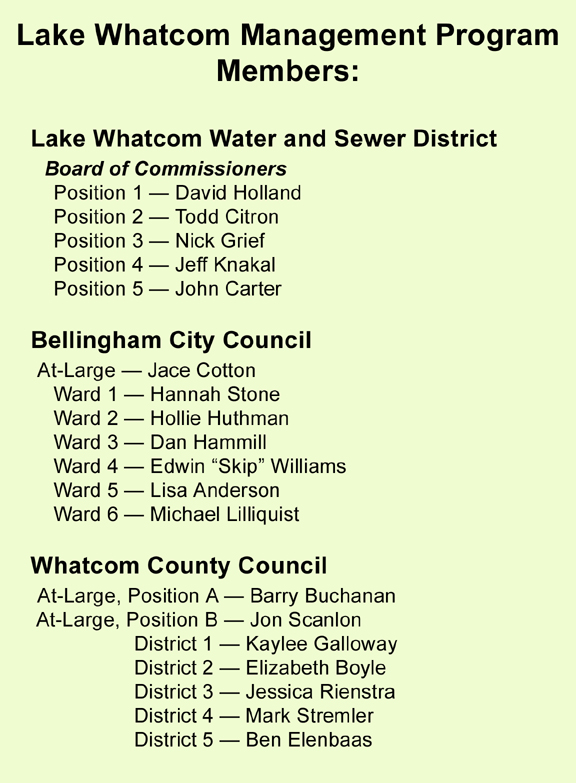
Questions From Commissioners and Councilmembers
Commissioner Citron noted that staff omitted the bacteria TMDL, despite it being half of the regulatory requirement. He also reminded the group that the 50 year timeline was a policy choice, not a scientific necessity.
City Councilmember Anderson asked about private stormwater inspections.
The city will begin inspections next year; the county lacks capacity and relies on complaints.
City Councilmember Hammill asked how AIS enforcement applies to private launches.
Staff described planned code amendments and outreach.
County Councilmember Scanlon asked the most significant question of the night: “What would it take to set goals?”
Staff responded that goal setting is “challenging” and avoided committing to numeric targets.
Scanlon also asked about wildfire response gaps; staff described an upcoming assessment.
County Councilmember Stremler asked how many boats require decontamination (6–10 per year) and whether phosphorus is natural or human caused. Dr. Strecker explained the watershed model attempts to quantify this.
County Councilmember Rienstra asked about recreation impacts. (Usage increased from 206,382 to 753,237 from 2024 to 2025.)
Parks staff confirmed no studies are being conducted on recreation’s effect on water quality.
County Councilmember Boyle asked whether the “200 pounds of phosphorus reduction” is cumulative or annual. Staff confirmed it is annual, not cumulative, and is an estimate, not a measured value.
Forestry Concerns
City Councilmember Anderson raised concerns about the outdated Lake Whatcom Landscape Plan, noting it is not based on current climate science and that DNR’s proposed logging areas could undermine water quality goals.
Public Comment
Public comment revealed a consistent pattern: community members see a widening gap between the monitoring data and the narrative presented by staff.
Speakers raised concerns about:
- DNR’s proposed 128 acre timber sale
- Lack of long term stormwater maintenance
- Missing bacteria reporting
- Outdated forestry practices
- Weak enforcement of fertilizer and herbicide restrictions
- Rising disinfection byproducts in drinking water
- Lack of contextual metrics
- Recreation impacts
- Governance misalignment
Several speakers emphasized that retrofitting cannot replace undeveloped land and that development impacts remain unaddressed.
What Needs to Change Before Next Year
If the Annual Joint Lake Whatcom Meeting is to serve its intended purpose, several changes are needed:
- Present unified reporting that integrates project updates with monitoring trends
- Measure progress against numeric targets tied to TMDL requirements
- Report bacteria reductions transparently
- Present monitoring data directly, without selective framing
- Align land use decisions with water quality goals
- Update the outdated Landscape Plan
- Evaluate recreation impacts
- Establish policy triggers tied to monitoring trends
Closing Discussion and Next Steps
As the meeting closed, Chair Kaylee Galloway highlighted upcoming Policy Group meetings and ongoing work on climate vulnerability, forest practices, AIS regulations, and the first ever field tour.
Then Councilmember Scanlon raised the most consequential policy question of the evening: “What would the impact be of having a moratorium on development in unincorporated Whatcom County?”
He noted that the county could reallocate growth elsewhere and that elected officials must be willing to make tough decisions.
Councilmember Anderson responded by describing the city’s previous two year moratorium in Silver Beach, which allowed the city to adopt more protective zoning and stormwater standards. She suggested the county could consider a similar approach while evaluating climate impacts, stormwater capacity, and appropriate zoning.
She emphasized:
- The community is spending tens of millions of dollars to fix lake problems
- Housing is needed, but not necessarily in the watershed
- Decisions must be made with a four generation lens
As the meeting adjourned after two hours, it was clear that the abbreviated format left little room for the depth and discussion that Lake Whatcom’s challenges require. The monitoring report, progress updates, policy questions, and public comment each deserved more time than the compressed agenda allowed.
Given the complexity of the TMDL, the scale of public investment, and the importance of the lake as our drinking water source, it may be time to consider dividing this annual session into two meetings; one focused on scientific monitoring and program performance, and a second dedicated to policy discussion and public input.
A two meeting structure would give elected officials, staff, and the community the time needed to fully engage with the issues that shape the future of Lake Whatcom.
Ultimately, Lake Whatcom’s future will be shaped not only by agencies and elected officials, but by the community that depends on it. Residents have repeatedly shown they care deeply about this lake, and that engagement is needed now more than ever. Understanding the science is the first step; insisting on accountability is the next. The choices we make today will determine whether future generations inherit a lake that is resilient or one that is permanently compromised. Protecting our drinking water is not a technical issue; it is a shared responsibility, and one we can no longer afford to postpone.
_____________________________________________________
Kerri Burnside is a lifelong Bellingham resident, member of People for Lake Whatcom, community organizer, and housing advocate. She serves in multiple local leadership roles and is engaged in advancing policies that support housing affordability, environmental protection, and community accountability.
Susan Kane-Ronning, Ph.D., is a member of the Sierra Club Mt. Baker Group, People for Lake Whatcom, and a longtime advocate for Lake Whatcom watershed protection. She is a licensed psychologist in Bellingham.