Native Plant Neighbors
by Eric Worden
In the shade of damp forests, sprouting improbably from the mossy sides of tall trees, you’ll find an enigmatic native plant neighbor, the licorice fern. While all the other leafy plants of the forest are anchored to the earth, the licorice fern, like the birds, defies gravity and lives wherever it pleases: on the ground, high in the trees, or clinging to damp rock cliffs or concrete bridges.
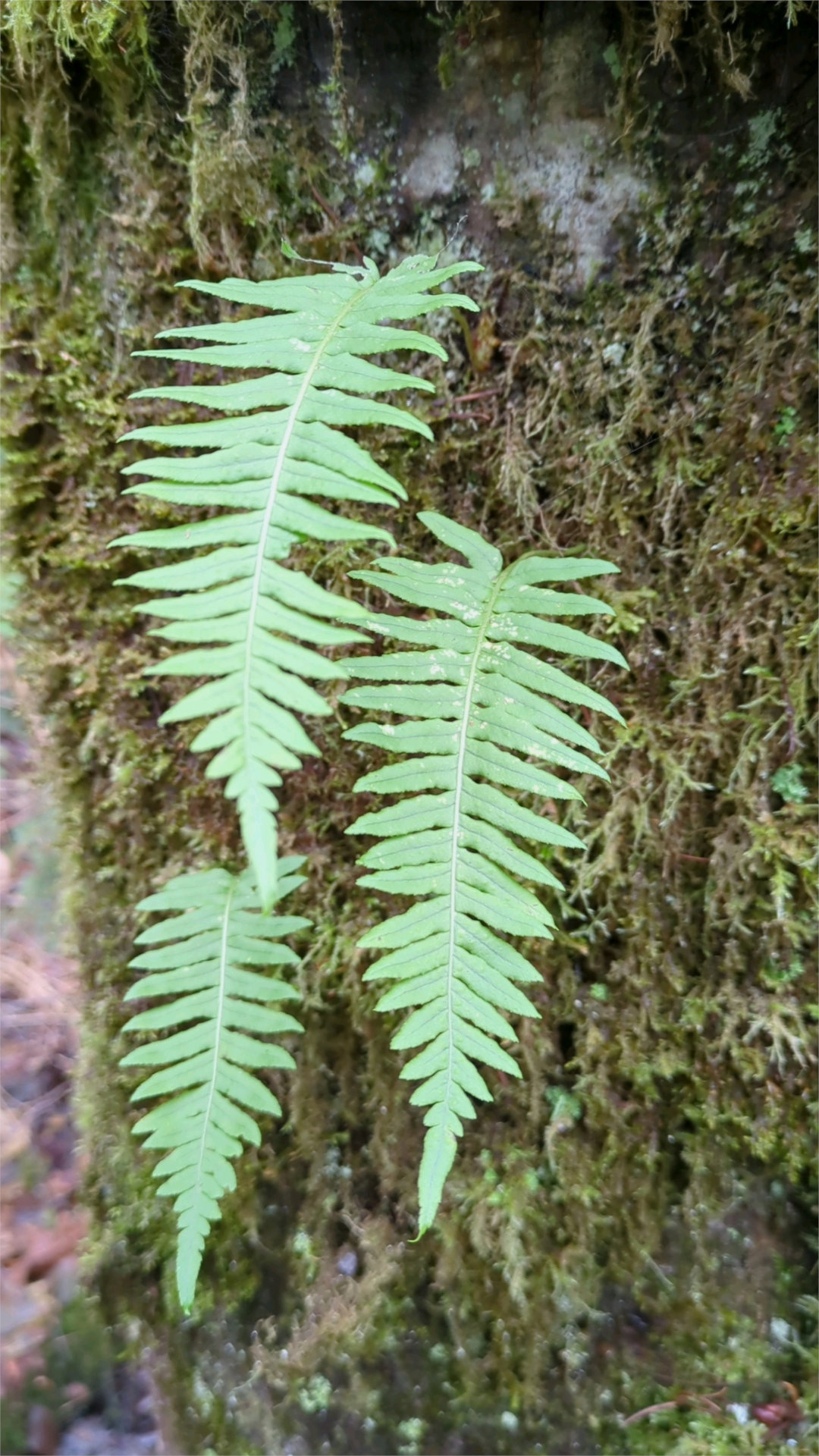
photo by Eric Worden
A trio of licorice fern fronds on a mossy black cottonwood tree trunk.
It is likewise indifferent to other norms of its neighbors: single scattered fronds emerge here and there from a moss carpet. Is the frond an individual plant or is it connected to the other fronds somehow? In reality, either may be true. The plants are small and they may have only a single leaf, or more established individuals may have multiple fronds connected by a hidden root under the moss. You can dig under the moss to find this root clinging to tree bark or a rock. Here, once again, the licorice fern shows its individuality, for the delicate and sprightly plant grows a muscular root as thick as a pencil.
Stored Water
These unusual habits and anatomy all harmonize to suit the licorice fern’s lifestyle up in trees. During the cooler rainy months perhaps many plants could hypothetically live in the trees for a while, but what happens when the rain stops for a few days or even for a whole month, as commonly happens in our summers? During dry periods, the small fronds sip water from their large root, and sometimes their stored water can last all summer long. The invariably present mossy carpet also helps to preserve moisture.
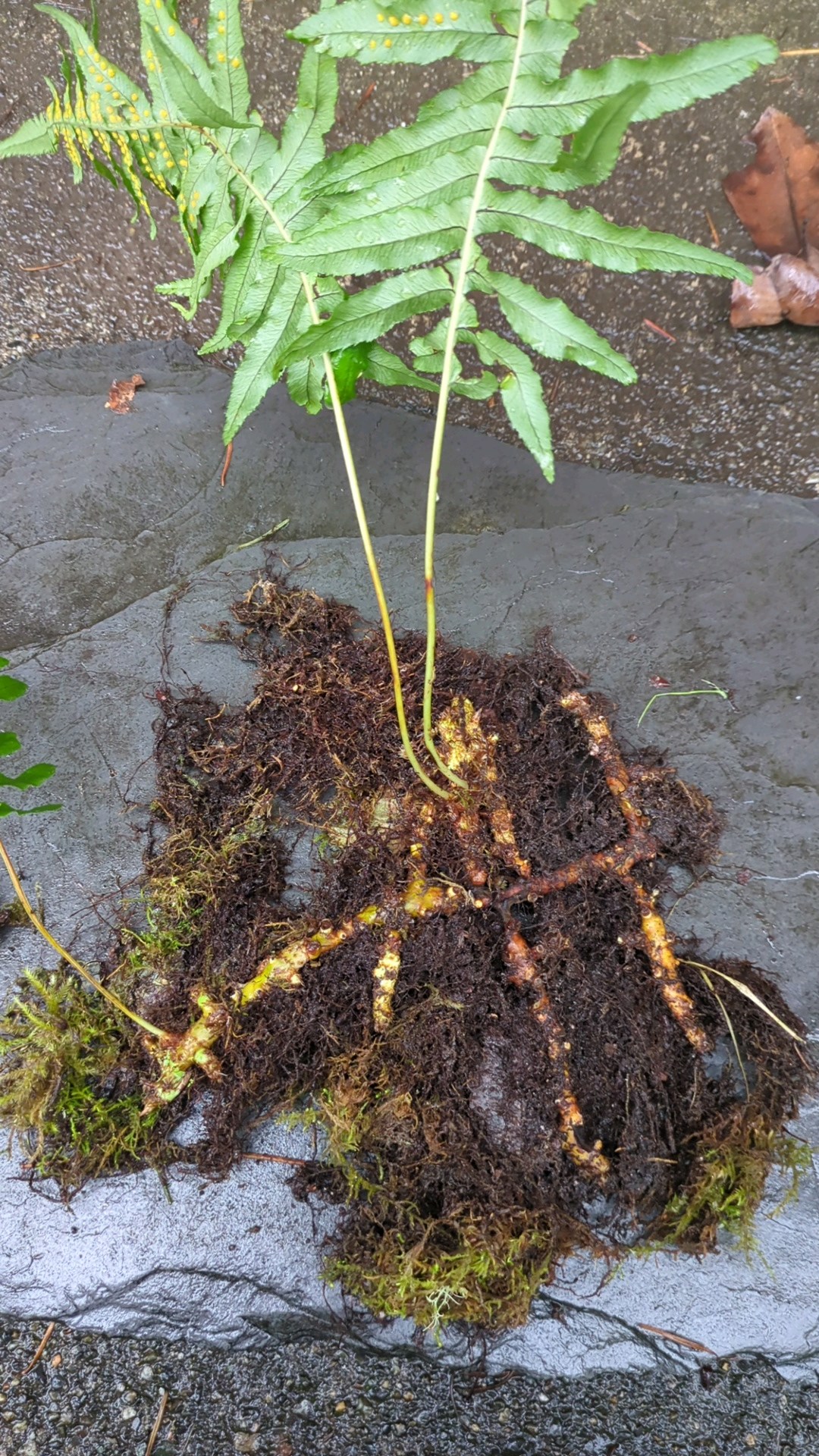
photo by Eric Worden
Delicate fronds growing from a muscular root, with mossy covering removed.
After even longer dry spells, the licorice fern will eventually drop its fronds and remain dormant as only a root until the rains return. For this reason, you’ll see many more licorice fern fronds in the trees during the winter than in late summer. Harmonious with the plant’s winter growing habit is its preference for growing on the side of big leaf maple and black cottonwood trees: these trees drop their leaves in fall, just when the ferns are waking up, and the bare tree branches let the winter sun fall on the fern’s green fronds.
Reproductive Habits
We haven’t yet reached the extent of the fern’s strange habits, for its sex life and reproduction are the strangest of all! Like all ferns, the licorice fern lacks flowers and seeds: nature invented ferns before it invented those things. During the rainy season, on the underside of the leaves you’ll find rows of fuzzy orange-ish bumps: these are spore-producing structures, for reproduction. The spores are dust-like, and are released into the air where they float away on the slightest breeze, to land elsewhere and germinate.
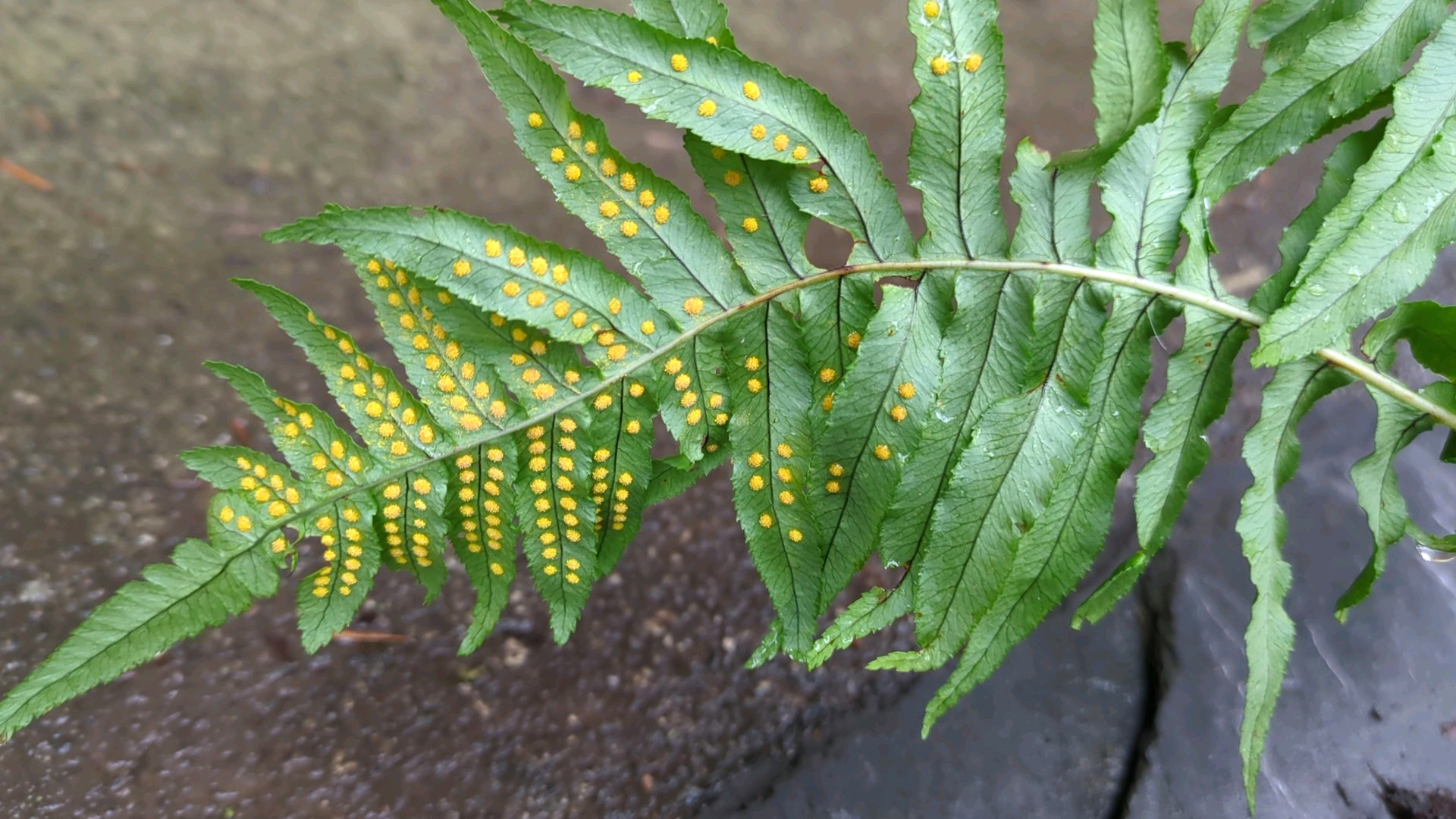
photo by Eric Worden
Rows of orange-ish spore-producing bumps (called sori) on a frond’s underside.
The spore does not germinate into a fern though, as you would recognize it. It germinates into a tiny plant only a few millimeters wide, having a single rudimentary leaf. This tiny plant, called a gametophyte, has one purpose: to produce sperm-like and egg-like cells. On the surface of the leaf, exposed to all the elements of the forest, the sperm-like cells swim to find an egg-like cell and to fertilize it. This fertilized egg then develops into a new fern. Just imagine if humans reproduced like this, with countless tiny homunculus as an intermediate generation!
Ecologically-minded people may wonder what role the licorice fern plays in the forest? The popular idea that every creature plays an important role (even fleas, for example) describes people’s social feelings more than it describes a pattern of nature. A more accurate pattern of nature is simply that things which exist tend to keep existing.
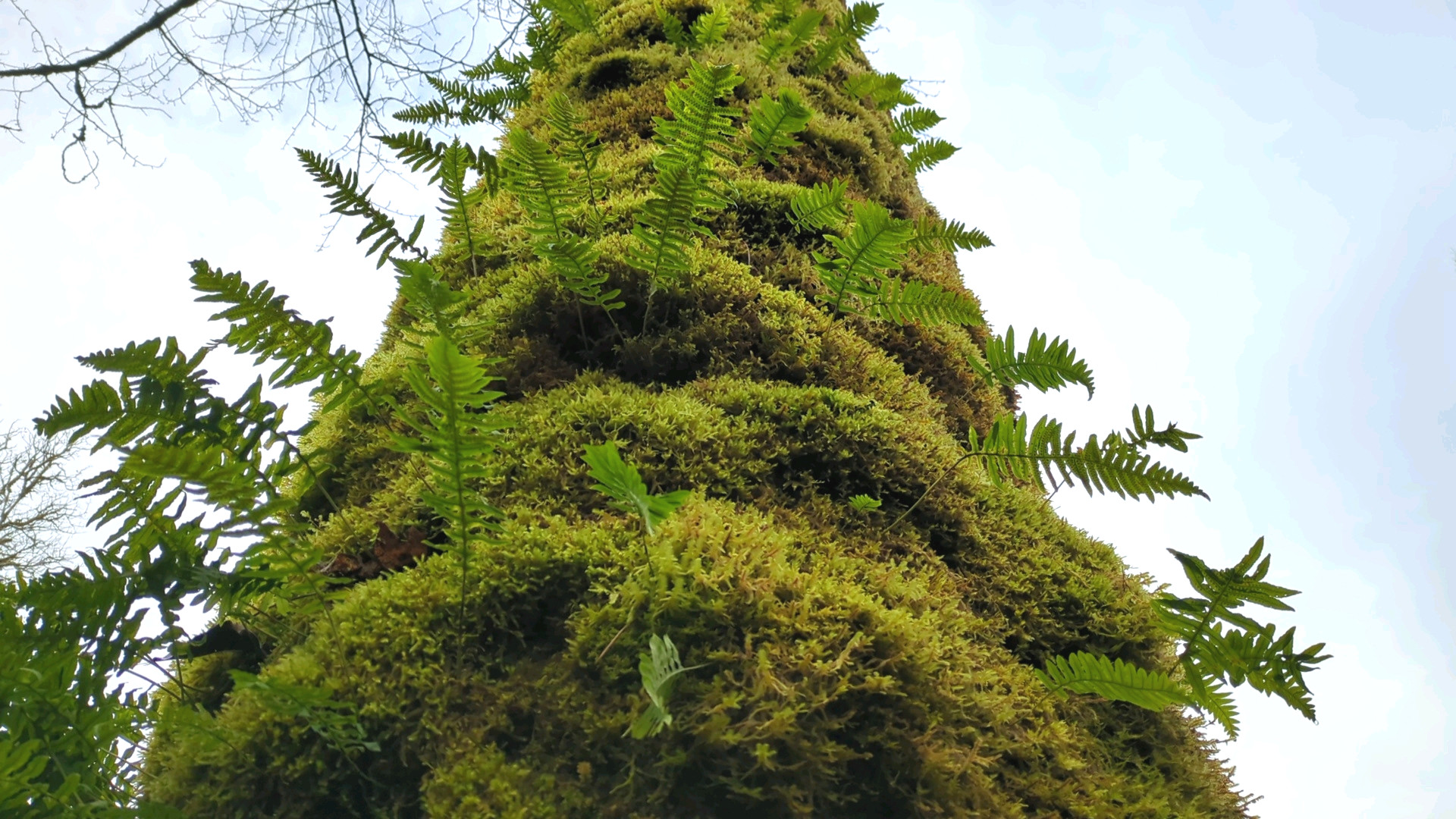
photo by Eric Worden
A community of licorice ferns growing high on a moss-covered black cottonwood tree trunk.
Intrinsic Beauty
Ferns have existed since unimaginably ancient times. The first ferns existed long before dinosaurs, and before all other land animals as well, except for some insect-like creatures. During this long span, most ferns developed effective defenses against animal browsing : few creatures eat significant quantities of ferns. Most creatures in nature, including this fern, have other types of less obvious relationships. For example, the licorice fern, like most ferns, is known to connect to symbiotic fungi through its roots, where they exchange nutrients. Though the licorice fern is small and plays a small role in the bigger picture of nature, it offers us intrinsic beauty to appreciate.
Of course, humans have tried to eat licorice ferns. They are not edible, but the roots have an astonishing flavor reminiscent of licorice. Before you go foraging, realize that the flavor is not pleasant to most people. To me, the flavor is quite similar to aspartame, the distasteful artificial sweetener used in early “diet” sodas. If you chew a tiny piece of the root, a sickening vapor-like sweetness quickly coats your entire mouth. The flavored substances are chemically complex steroidal saponins.
Sweeter Than Sugar
In experiments where the diluted substances were given to test subjects and compared to ordinary sucrose, the substance was found to be 600 times sweeter than sugar! It’s been found nontoxic to mice, and non-mutagenic to bacteria, so it’s likely safe to try sweetening your camp tea with a tiny piece of licorice fern root. Like honey and syrup, local people of ancient times, and people of recent times have valued the expectorant and demulcent uses of licorice fern root; that is, it gently stimulates mucous production in the esophagus which soothes sore throats and coughs.
I hope you enjoyed journeying with me and the enigmatic licorice fern. Come back next month when we can finally talk about spring flowers. To learn more about licorice fern and other native plants, visit the Washington Native Plant Society at wnps.org.
_____________________________________
Eric Worden is a lifelong amateur naturalist, and the chair of the Koma Kulshan chapter of the Washington Native Plant Society.